

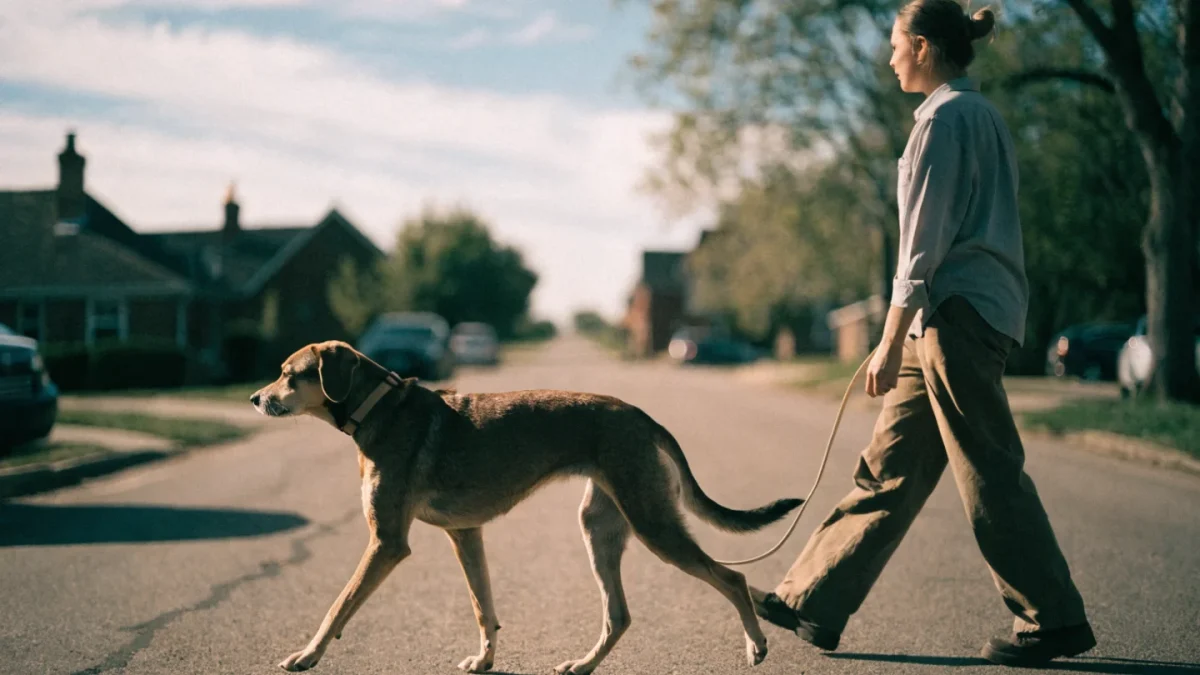
I have a soft spot for the walking-disaster dogs. They're not mean. They're enthusiastic. They love the world so much they've turned every walk into a full-body contact sport.
But enthusiasm and uncontrolled excitement aren't the same thing. And a dog that drags you toward every smell, every dog, every bird — that's not a joy to walk. Over time, people stop walking those dogs, which makes the whole problem worse.
The Pre-Walk Problem
A lot of walk excitement starts before you're out the door. The harness comes out and the dog goes ballistic. You struggle to get it on. The door opens and they're through it like a missile. You're already at a disadvantage before you've taken a step.
This is conditioned arousal. Harness = walk = explosive excitement. Break this chain.
- Get the harness out, then put it away again. Several times. No walk.
- Put the harness on, then sit and watch TV for five minutes. Take it off.
- Open the front door, take one step out, come back in.
The pre-walk rituals stop reliably predicting the walk. Arousal before departure lowers. Eventually you can get a dog who stands still for harness-on and walks out the door at a reasonable speed.
The Starting Routine
Train a threshold behavior at the door. Dog must sit or stand calmly before the door opens. If they can't — close the door. Wait. Try again. It takes a few weeks to build, but you're teaching the dog that calm behavior opens the door, not excitement.
The Focus Habit on the Walk
Once you're out, work on check-ins rather than constant loose leash. A check-in is when the dog looks at you voluntarily. Mark it and reward it. The dog begins looking back at you periodically during the walk, which:
- Keeps them oriented to you rather than entirely to the environment
- Gives them a way to earn reinforcement while walking
- Builds a default attention behavior that generalizes to more distracting contexts
Working Below Threshold
The core principle from reactive dog walking applies here too: an overexcited dog is just as hard to work with as a reactive dog. If the dog is locked onto a stimulus, they're not accessible to your cues.
Know what sends your dog over threshold. Another dog ahead on the path? Squirrel in the tree? The park entrance? Work at distance from those triggers initially, rewarding calm behavior, and gradually reduce the distance as the dog learns to stay regulated.
See leash training basics for the foundational loose-leash mechanics that work alongside excitement management. (See also: loose leash walking.)
The Long Game
Calm walks are built over weeks, not days. The dog is learning a new default — walking alongside a human without going berserk is a trained behavior, not a personality trait. With consistent work, most highly excitable dogs get significantly better within a few months of a structured walking program.