
I want to clear up something that confuses most new puppy owners: bite inhibition is not the same as "no biting."
When I say bite inhibition, I mean teaching your puppy to control how hard they use their mouth. That's step one. "No biting" is step two, and you can't skip to step two without step one in place — or you'll have a dog that has no bite inhibition when something frightens them as an adult.
This is the most important safety training you'll do with your puppy. More important, actually, than sit and stay. A dog that's never learned pressure control is a dog that causes real damage when startled, hurt, or overstimulated — even if they're not "aggressive" by nature.
Why the Order Matters
Puppies learn bite pressure from their littermates. When one puppy bites another too hard, the bitten puppy yelps and play stops. After enough repetitions, the biting puppy calibrates. They learn that gentle mouthing keeps the game going, and hard biting ends it.
When puppies are separated from their litter at 7-8 weeks, that education is still very much in progress. You're taking over the littermate role.
The process has two phases:
- Teach soft pressure (bite inhibition)
- Teach to stop mouthing altogether
Do them in order. Skip to phase two too early and you have a dog that's been suppressed from mouthing without ever learning to be gentle about it. The first time that dog is pushed past their threshold, you have no buffer.
Phase 1: Teaching Soft Pressure
Let your puppy mouth during play. When they bite too hard, yelp — one sharp, high-pitched sound — and freeze. Go completely still.
Two things can happen:
- They back off, look at you, maybe lick you. Resume play.
- They escalate, bite again, or get more wound up. Time to step out.
If they escalate, stand up, cross your arms, turn your back, or leave the room for 30-60 seconds. No scolding, no drama. Just the removal of your presence and the end of play.
Return, resume play. Repeat as needed.
Consistency here is everything. Every person the puppy interacts with needs to respond the same way. If one person yelps and another person laughs and keeps playing, you've created confusion about the rule.
Most puppies start to calibrate within a week of consistent feedback. High-drive puppies might take two or three weeks. Stick with it.
What "Too Hard" Means
You're not necessarily correcting every instance of mouthing. In phase one, you're correcting pressure above a threshold. Start with the hardest bites — the ones that actually hurt or leave marks. Once those soften, lower the threshold. Respond to medium pressure. Then lower again. Eventually you're responding to any tooth-on-skin contact.
This graduated approach works better than responding to all mouthing immediately. If you overcorrect before the puppy understands the game, they get confused and sometimes escalate out of frustration.
Phase 2: Reducing Mouthing Altogether
Once your puppy is consistently mouthing gently — most puppies reach this point around 14-18 weeks — you can start discouraging mouthing entirely.
The tools here are:
- Ignoring: Turn away from mouthing. No response, no interaction, no eye contact until paws and mouth are off you.
- Redirection: Before teeth make contact, redirect to a toy. Keep appropriate chew toys in every room.
- Management: Don't let your puppy get so overstimulated that they lose the ability to self-regulate. Know when to end play sessions.
You're not using punishment here. You're using the removal of what the puppy wants — which is your attention and interaction.
The Redirect Is Your Best Tool
A lot of bite work involves what you redirect to, not just what you discourage.
Puppies bite partly because they need to chew. Teething puppies need to chew more. If you don't give them appropriate outlets, they'll find their own — usually your hands, your ankles, or your furniture.
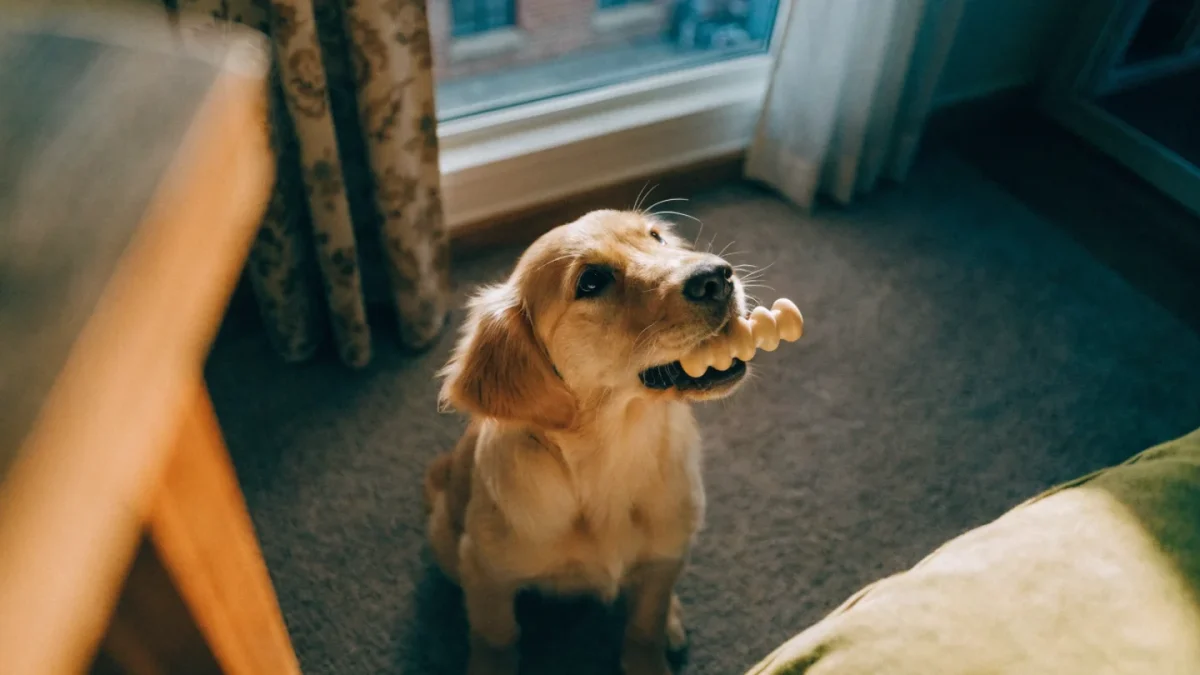
Keep a toy in your pocket or within arm's reach during every play session. When the mouthing starts, offer the toy before teeth hit skin. This is prevention rather than correction, and it's faster.
The toy that works best is usually the one with the most interesting texture or movement — rubber toys with ridges, rope toys, anything with unpredictable movement when shaken.
When the Standard Approach Isn't Working
Some puppies go through a biting phase that's harder than average. A few things to check:
Are they overtired? Overtired puppies lose bite inhibition fast. If your puppy is a nightmare at 5pm, it may be because they need a nap, not more play.
Are they overstimulated? High-arousal play (chasing, wrestling) ramps up bite pressure. Scale back the intensity of play and watch whether the biting moderates.
Is everyone responding consistently? Mixed signals — some people correcting, some people playing through it — stall the process significantly.
Is there a underlying concern? Puppies that bite and immediately freeze, that stare hard before biting, or that show no response to the yelp even after weeks of training are worth a conversation with a qualified behaviorist. (See also: jumping, mouthing, and pulling.)
Bite Inhibition for Adult Dogs
If you have an adult dog that never learned bite inhibition, it's harder to teach than with a puppy, but not impossible. The same principles apply — graduated thresholds, consistent responses, management, redirection. You'll likely need more patience and more time, and professional guidance is often helpful.
Start phase one today if your puppy is currently mouthing hard. The yelp and freeze response costs nothing and can prevent a lot of damage down the road. Give it two weeks of consistency before you decide it's not working.