
I had a client who came to me with a three-month-old puppy that already knew eleven commands. Or so she thought. The puppy sort of knew eleven commands — in the kitchen, with kibble, after about four repetitions of each cue. Outside, in the yard, near another dog? Zero.
Eleven wobbly behaviors is worth less than two solid ones.
The order in which you teach commands matters because each one creates a foundation for the next. Start out of sequence — or try to teach too many at once — and you end up with a confused puppy and shaky skills across the board.
Here's the sequence that makes sense, and why.
First: Name Recognition
Before your puppy can learn a single command, they need to know that their name means "pay attention to me right now."
This is not the same as "my puppy knows their name." Most puppies figure out their name in the first week just from ambient use. What you're teaching is a conditioned response — name means "look at Jake, something good is about to happen."
How to train it:
In a quiet room with no distractions, say your puppy's name once — clearly, cheerfully. The instant they look at you, mark it ("yes" or a clicker) and give a treat.
That's it. Repeat 10-15 times. Move to different rooms. Do it on a walk with mild distractions. Do it when something interesting is nearby. Build the reflex that the name = snap attention to you = reward.
Never say their name in a scolding tone during this phase. You want their name to be the best sound in the world, not a signal that something unpleasant is coming.
Second: Sit
Sit is the easiest command for most puppies to learn and the most widely applicable. It becomes the default "what should I do?" behavior — which means it replaces jumping, pawing, and demanding attention.
How to train it:
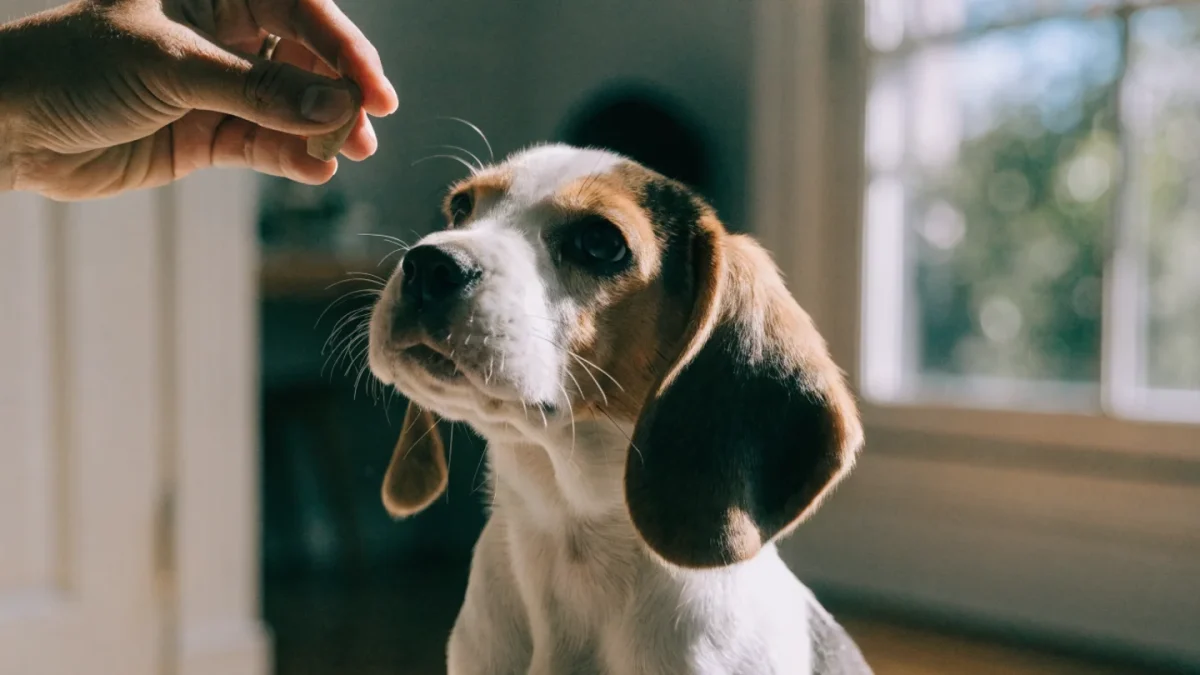
Hold a treat at your puppy's nose. Slowly move it back over their head. As the treat goes back, their nose goes up and their rear goes down. The moment their butt touches the floor, mark and deliver the treat.
After 5-6 successful repetitions, start adding the verbal cue "sit" just before you move the treat. Within a session or two, your puppy will sit on the word alone.
What to watch for: Say "sit" once. If they don't respond, help them with the lure. Never repeat the word multiple times — "sit, sit, SIT" teaches your puppy to wait for the third or fourth repetition before responding.
Third: Come
Come is arguably the most important safety command you'll teach. A reliable recall has prevented countless injuries, escapes, and confrontations. It's also the command most easily ruined by handlers who don't know what they're doing.
Train it right from the start and protect it fiercely.
How to train it:
Start in a small, low-distraction environment. Get a few feet away from your puppy. Crouch down, make yourself small and inviting. Say their name and "come" in a happy, excited voice. When they run to you, big reward — treats, praise, play, whatever they love.
The one rule you cannot break: Never call your puppy to you for something they don't want. Nail trims, baths, ending play, putting them in the crate — don't use "come" for these, or your recall starts predicting bad things.
If you need to take them somewhere unpleasant, go get them. Walk over, clip the leash, take them where you need to go. Save "come" for things that always end well.
Fourth: Stay
Stay comes fourth because it requires your puppy to already understand sit (you can only stay if you're already in a position) and to have some impulse control. Rushing to stay before the other behaviors are in place leads to a confused puppy that bounces out of every attempt.
Start with duration, not distance:
Ask for a sit. Count one second silently. If your puppy holds the sit, mark and reward. Repeat, gradually adding time — 2 seconds, 5 seconds, 10 seconds.
Don't add distance until you have solid duration. When you do add distance, take one step back, return to your puppy (don't call them to you), and reward them in position.
Release words: Your puppy needs to know when they're released from stay. Pick a consistent release word — "free," "okay," "done" — and use it every time you end a stay exercise.
When to Add Each Command
The sequence above can all be introduced in the first few weeks your puppy is home. They don't need to be fully trained in name recognition before you start sit — you're building them in parallel, just with different priorities.
A rough timeline:
- Week 1-2: Name recognition, introduction to sit
- Week 2-3: Sit more solid, start come in low-distraction settings
- Week 3-4: Come with mild distractions, introduction to stay
- Month 2+: Proofing all four behaviors in new environments
Training Session Rules
Keep sessions to five minutes maximum with puppies under four months. Their focus evaporates faster than you think. Three short sessions per day will outperform one long one every time.
Always end on success. If your puppy is struggling with something new, ask for something they know well before ending the session. Leave them wanting more.
Treats should be small (pea-sized) and high-value. Kibble works in low-distraction environments. For anything harder, use real food — meat, cheese, freeze-dried liver. The reward should match the difficulty of what you're asking. (See also: basic obedience training for dogs.)
What to Skip (for Now)
Heel, stay at distance, leave it, and down can all wait until the foundation commands are solid. Not because they're unimportant, but because trying to train too many things at once dilutes everything.
A dog that reliably comes, sits, and responds to their name is genuinely useful. A dog that sort of knows twelve commands is not.
This week: drill name recognition until your puppy snaps their head toward you every time you say it. That responsiveness is the foundation everything else is built on.