
I had a client once — first-time dog owner, rescue puppy, absolute chaos in the house. She called me three days after bringing her pup home and said, "Jake, I think I got a broken one." The puppy had chewed through a phone charger, peed on the couch twice, and bitten her hand hard enough to draw blood during play.
Her puppy wasn't broken. He was eight weeks old and had never been taught a single rule. That's not a bad dog. That's just a dog.
Training a puppy is less about fixing problems and more about building habits before problems take root. This guide covers everything you need to know — in the order you actually need to know it.
Start Training the Day Your Puppy Comes Home
A lot of people wait until their puppy "settles in" before starting training. That's a mistake. Every day without structure is a day your puppy is learning something — just not what you want.
The first 24 hours don't need to be intense. You're not drilling commands. You're establishing the basics: where does this dog sleep, where does this dog eliminate, and what happens when teeth hit skin. Those three things will shape the next six months.
The good news is that puppies are learning machines. Their brains are literally primed for this. The socialization window — the period when new experiences are absorbed fastest — runs from roughly three to fourteen weeks. If your puppy is in that window, don't waste it.
House Training: The Foundation You Can't Skip
House training is the first thing people want to solve and the first thing they underestimate. It's not complicated, but it requires consistency for weeks, not days.
The core rule: Puppies need to go outside after every significant event — waking up, eating, drinking, playing, and any time they've been in the crate for more than an hour or two. That's a lot of trips outside. Plan for it.
Build a Schedule
A simple schedule works better than watching for signals, especially in the first few weeks when you don't know your puppy's body language yet.
For a puppy under 12 weeks:
- First thing in the morning
- After every meal (15-20 minutes after)
- After every nap
- After every play session
- Before crating
- Before bed
- Once during the night if needed
As your puppy gets older and their bladder develops, the gaps get longer. By 4-5 months, most puppies can hold it for 3-4 hours during the day.
What to Do When They Get It Right
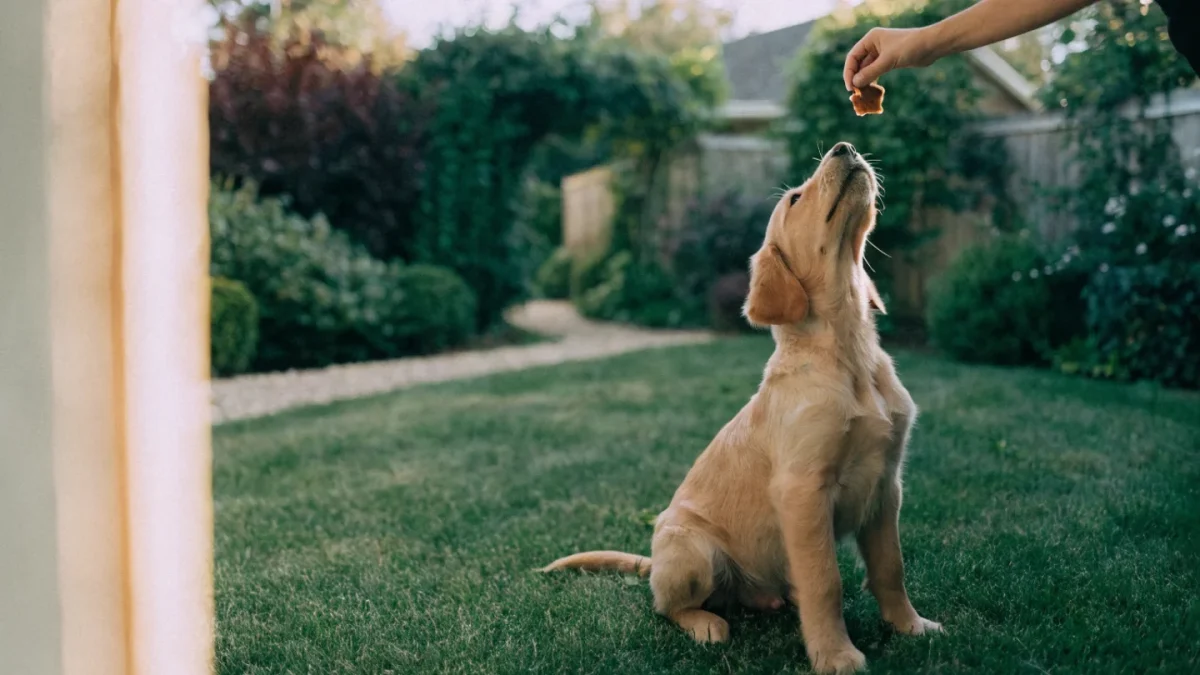
Go outside with your puppy every single time. When they eliminate outside, mark it immediately with a calm "yes" and give them a treat. Don't save the celebration for inside — the reward needs to happen within two seconds of the behavior.
What to Do When Accidents Happen Inside
Clean it up, say nothing, move on. Puppies don't connect a correction to something they did two minutes ago. Rubbing a puppy's nose in it or scolding them after the fact doesn't teach anything — it just makes them scared of you.
If you catch them in the act, a calm "outside" and immediate trip to the yard is enough.
Bite Inhibition: Teaching Puppies That Teeth Hurt
Puppies bite. This is normal. What you're teaching during this phase isn't "never put your mouth on a human" — it's "put your mouth on a human gently." That distinction matters because a dog that has learned to control bite pressure is dramatically less dangerous if something ever startles them.
How It Works
When a puppy bites too hard during play, yelp — one sharp sound — and go still. If they back off, play resumes. If they escalate, time out: remove yourself or them for 30-60 seconds.
Most puppies figure this out within a week if the response is consistent. Some — usually the higher-drive ones — need more repetition. Stick with it.
The Redirect
Puppies bite partly because they need to chew. Keep appropriate chew toys within arm's reach during every play session. When teeth come out, redirect to the toy before they connect with skin. This teaches them what's acceptable before you have to correct anything.
First Commands: What to Teach and When
You don't need to train a dozen commands at once. Two or three solid behaviors are worth more than ten wobbly ones.
Start With Sit
Sit is the easiest command for most puppies and the most useful. It gives you a default behavior for "don't jump on guests" and "don't rush the door."
Lure method: Hold a treat at your puppy's nose, move it slowly back over their head. Most puppies will sit naturally as the treat goes backward. The moment their butt hits the floor, mark it ("yes") and deliver the treat. After several successful repetitions, add the word "sit" just before you start the lure.
Name Recognition
Before any other command, your puppy needs to know their name means "pay attention to me." Start in a quiet room. Say their name once. The moment they look at you, mark and treat. Practice everywhere — in the yard, on walks, with mild distractions. A puppy that snaps their head toward you when you say their name is a puppy you can train.
Come
Come is the most important safety command you'll ever teach and the easiest one to accidentally ruin. Never call your puppy to you for something they don't like — nail trimming, bath time, ending play. If "come" predicts something unpleasant, they'll stop coming.
For now, just practice recall in low-distraction environments. Crouch down, arms open, call their name and "come," and make yourself the most interesting thing in the world when they arrive.
Crate Training: Not a Punishment, a Safe Space
The crate is one of the most useful tools in puppy training — not because it confines your dog, but because it gives them a defined space where they learn to self-regulate.
Puppies don't naturally like small spaces. You have to build that association slowly. Start by just feeding meals near the crate, then at the entrance, then inside with the door open. Only start closing the door when the puppy is comfortable going in on their own.
Never use the crate as punishment. Never leave a puppy in the crate so long they're forced to soil it — that defeats the house training entirely.
A rough guide for maximum crate time (not counting overnight):
- 8-10 weeks: 30-60 minutes
- 11-14 weeks: 1-3 hours
- 15-16 weeks: 3-4 hours
- 4 months+: up to 4 hours during the day
Socialization: The Window That Closes
Between 3 and 14 weeks, puppies are wired to accept new experiences as normal. After that window, novel things become things to be cautious about by default.
This doesn't mean socializing an older puppy is impossible — it absolutely isn't — but it's easier now than it will be in three months.
Socialization isn't just "meeting other dogs." It's exposure to:
- Different types of people (hats, beards, children, older adults)
- Surfaces (grass, gravel, tile, grates)
- Sounds (traffic, vacuums, dropped pots)
- Other animals
- Being handled (ears, paws, mouth)
Aim for short, positive exposures. One good experience is worth ten overwhelming ones. If your puppy is shutting down — freezing, trying to flee, hiding behind you — you've gone too far too fast. Back off, slow down, rebuild.
Training Sessions: Short, Frequent, and Fun
Puppies have the attention span of a goldfish in a thunderstorm. Five minutes of training done three times a day will outperform one thirty-minute session every time.
Keep sessions short enough that your puppy is still engaged when you stop. End on success — ask for something they know well, reward it, then quit. You want them leaving the session wanting more, not relieved it's over.
High-value treats matter here. Kibble works for easy behaviors in low-distraction environments. For new behaviors, challenging environments, or recall work, use something genuinely exciting — small pieces of cooked chicken, cheese, hot dog. The treat should match the difficulty of what you're asking.
What Consistency Actually Means
"Be consistent" is advice everyone gives and almost no one specifies. Here's what it means in practice:
Same words. If "off" means "get off the couch" and "down" means "lie down," everyone in the household has to use those same words. Your puppy isn't interpreting meaning — they're pattern-matching sounds to consequences.
Same rules. If your puppy is not allowed on the furniture, that rule applies every time, with every person in the house. One exception teaches your puppy that rules are negotiable.
Same response. If jumping on people results in attention sometimes and a correction other times, you've created a gambling situation — and variable reward schedules are the most powerful reinforcement there is. Your puppy will jump more, not less.
Handling Setbacks Without Losing Your Mind
Every puppy goes through phases. The adolescent phase — roughly 6 to 18 months depending on breed and size — is the one most people aren't prepared for. Behaviors that seemed solid will wobble. Commands that worked perfectly will get selective.
This is normal. This is not failure.
Stay calm, go back to basics when needed, and don't add punishment to what is fundamentally a developmental phase. The puppy who looks like they've forgotten everything at 8 months usually looks like a pretty solid dog at 14 months.
Regression happens. Biting may spike during teething. House training may slip during growth spurts. Keep your expectations calibrated to your puppy's age, not to what they were doing two weeks ago.
FAQ
At what age should I start training my puppy?
Start the day they come home. Even a 7-week-old puppy can learn sit, name recognition, and house training basics. The earlier you establish rules, the less work you'll have to undo later. (See also: crate training dogs.)
How many commands should I teach at once?
Focus on two or three at a time. Add new behaviors once current ones are reliable in low-distraction environments. Trying to train too many things at once leads to wobbly behaviors across the board.
My puppy bites really hard — is this aggression?
Almost certainly not. Puppies explore the world with their mouths. Hard biting during play is normal and improves with consistent bite inhibition training. If your puppy is growling, showing teeth, or freezing during handling, that warrants a separate conversation with a professional.
How long does it take to house train a puppy?
Most puppies are reliably house trained between 4 and 6 months. Some take longer. Consistency is the biggest factor — the more often you get them outside at the right times, the faster they learn.
Do I need to hire a professional trainer?
Not necessarily, but a group puppy class during the socialization window is worth it for the exposure alone. If you're dealing with significant fear, reactivity, or aggression, a qualified professional will save you a lot of time and prevent you from making things worse.
The single most useful thing you can do this week: build a potty schedule and stick to it. Everything else — the commands, the crate, the socialization — gets easier when you're not constantly cleaning up accidents and losing trust in your puppy's ability to signal their needs. Start there.