

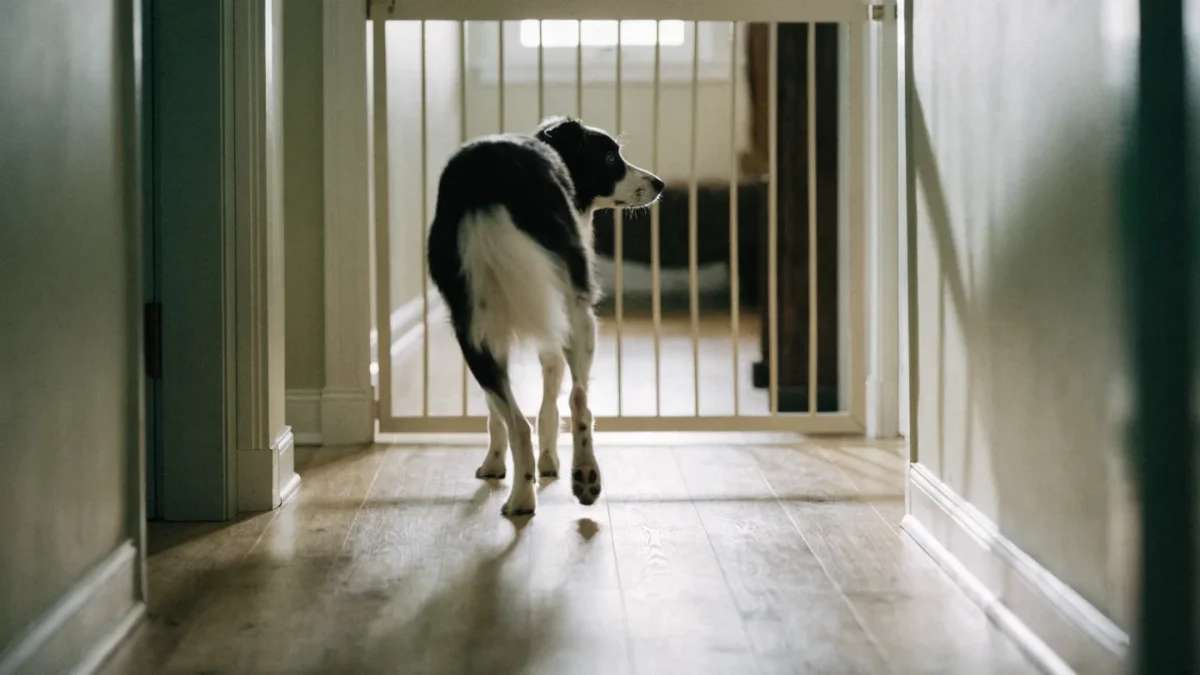
Management and training are two different things, and you need both.
Training teaches the dog what to do. Management prevents the dog from rehearsing the problem behavior while training is working. Every time a dog successfully practices an unwanted behavior, that behavior gets slightly more practiced and slightly more established. Management closes that loop.
Baby gates, exercise pens, crates, and tethers are your management toolkit.
Baby Gates
The most versatile management tool in most households. A well-placed gate restricts dog access to specific areas without requiring constant active supervision.
What they're useful for:
- Keeping dogs out of certain rooms (kitchens during meal prep, bedrooms, offices)
- Separating dogs in multi-dog households during feeding or high-value chew time
- Preventing bolting out the front door during arrivals
- Creating puppy zones that limit how much house the young dog has access to
- Temporary multi-pet introductions (cat-dog, new dog introduction)
Gate selection:
Height matters for dogs that jump. Standard 30-inch gates are fine for most small to medium dogs; taller dogs, particularly athletic ones, may need 36-inch or higher gates. Pressure-mounted gates are convenient for interior doorways; wall-mounted gates are more secure for high-traffic or high-pressure points (top of stairs, main entry).
Gates with dog doors built in are useful in multi-pet households where you want cats (or small dogs) to move through while large dogs cannot.
Exercise Pens
A collapsible wire or plastic pen that creates a contained zone without a permanent structure. More flexible than a gate because you can configure the size and location.
What they're useful for:
- Creating puppy zones in larger open spaces (living rooms without natural doorways)
- Outdoor containment in yards that aren't fenced
- Temporary zones at events, travel, or in situations where you need the dog contained
- Creating visual separation in training contexts
Size and height:
Match pen height to dog's jump height (and climbing tendency). A 24-inch pen works for small dogs and low-drive puppies; dogs with any athletic ability need at least 36 inches, often 48. Panel count determines area — more panels for larger dogs that need space.
Tethers
A leash or cord attached to a fixed point, keeping the dog within a specific radius. Useful for in-session management and for preventing range creep during training.
What they're useful for:
- Preventing a dog from moving around the room during a training session
- "Umbilical" training — the dog tethered to you during daily activities so they're always within training range
- Managing a dog during guest arrivals when you can't actively hold them
Safety: Never leave a tethered dog unsupervised. A dog left alone on a tether can become tangled, which is a strangulation risk. Tethers are for active management, not passive containment.
Crates
The most complete management tool — covered thoroughly elsewhere. The key point here is that a crate is the only tool that provides full containment with comfort when you can't supervise actively.
The Management Mindset
Management tools aren't admissions of failure. They're the intelligent prevention of problem rehearsal. Every trainer uses them. They don't substitute for training, but they make training possible by preventing the competing behavior from accumulating while the trained behavior is being established.
If your dog has been counter-surfing for two years, it's a deeply rehearsed behavior. You need training and you need management of counter access while training works. Training alone, without management, competes against rehearsal that keeps happening. Management stops the rehearsal.