
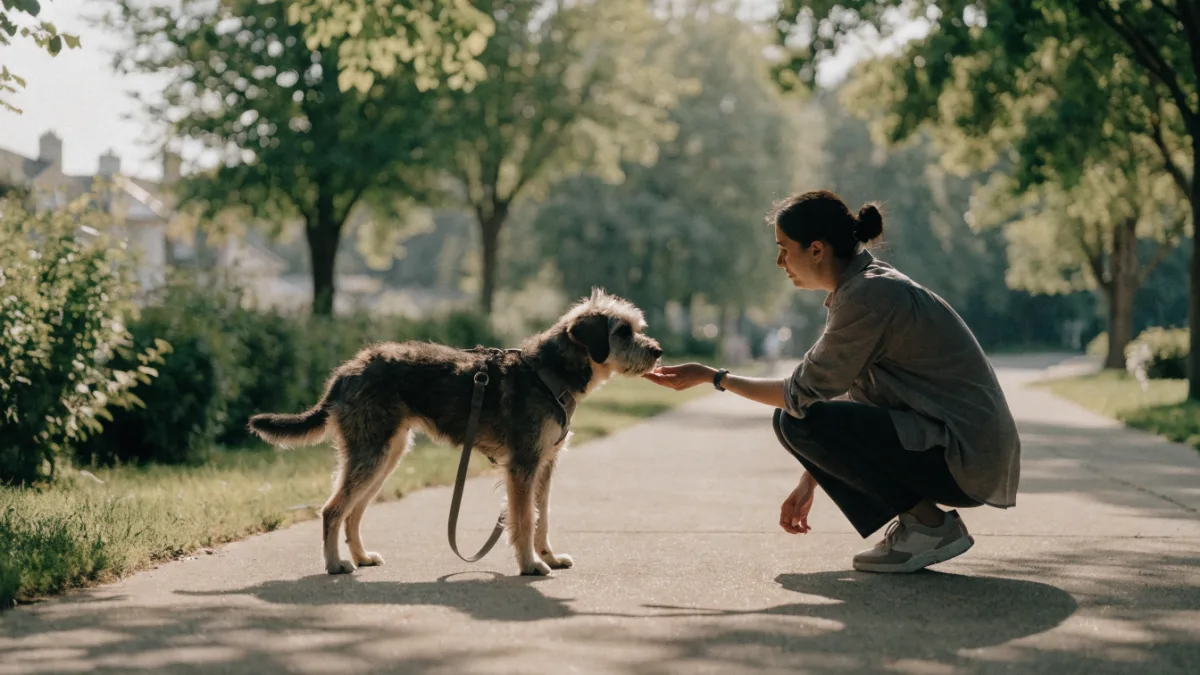
You finally brought home the rescue dog of your dreams. Inside the house, they’re snoozing on the couch, offering belly rolls, and being an absolute angel. Then you clip on the leash, step onto the sidewalk, and a neighbor walks by with their poodle. Suddenly, your sweet angel turns into a barking, lunging, spinning tornado. You’re desperately trying to hold onto the leash while hoping the neighbor doesn’t call animal control. If this sounds familiar, take a deep breath. You aren’t doing everything wrong, and your dog isn’t broken. You’re dealing with leash reactivity, and it is incredibly fixable.
Reactivity Is About Fear, Not Aggression
People tend to look at a barking, lunging dog on a sidewalk and immediately think, “That dog is aggressive.” Nine times out of ten, they couldn’t be more wrong. True aggression is incredibly rare. Leash reactivity is almost always born out of pure frustration, overstimulation, or fear. I used to make the mistake of thinking a dog acting out on a leash was trying to be tough. I was completely wrong. When a dog feels threatened by a trigger—whether that’s another dog, a skateboarder, or a garbage truck—their natural instinct is to create distance. In the wild, a scared dog simply runs away. That’s their “flight” response.
But when they are tethered to you by a six-foot nylon leash, their flight option is gone. They physically cannot escape the thing that scares them. So, their defense mechanism defaults to “fight.” They bark, lunge, and growl, trying to make the scary thing go away. And because dogs are masters of association, they quickly learn that barking makes the threat retreat. They think they’re keeping themselves safe. You can read more about this specific dynamic over at,[1] which does a fantastic job of breaking down what your dog is actually experiencing during these meltdowns.
Your Energy Is Contagious
Before we get into the physical mechanics of walking your dog, we have to talk about you. Dogs are basically emotional sponges. They are highly attuned to our body language, our breathing, and our tension. If you see another dog approaching and your immediate thought is, “Oh no, here we go again,” you are going to change your behavior. You might shorten your grip on the leash, hunch your shoulders, hold your breath, or tense your arm.
Your dog feels that leash tighten. They feel your body tense up. From their perspective, if their human is acting anxious and on edge, there must be a genuine threat nearby. You are literally confirming their worst fears. When you tighten the leash, you escalate the situation.
The hardest part of rehabilitating a reactive dog isn’t changing the dog’s behavior. It’s changing the owner’s behavior. Drop your shoulders, unclench your jaw, and breathe.
Normalizing the struggle is important here. It’s completely normal to feel embarrassed or frustrated when your dog blows up on a walk. But getting upset, yanking the leash, or shouting at your dog will only add to their anxiety. I know it’s tough to keep your cool when people are staring, but punishing a scared dog only gives them another reason to be afraid.
Managing the Environment
Don’t just wing it. Proactive management is your very first line of defense. You have to set your dog up for success by controlling what you can control. I always tell owners to treat the first few months of walking a reactive rescue like a covert operation. You are actively avoiding triggers until your dog builds up some coping skills.
Timing and Route Selection
If you know the neighborhood gets packed with joggers and dog walkers at 5:00 PM, don’t walk your dog at 5:00 PM. Go early in the morning, or wait until after dinner when the sidewalks clear out. Choose routes with wide open spaces. Avoid narrow alleyways or tight sidewalks where you might get cornered. If you see a trigger heading your way, don’t be afraid to cross the street, duck behind a parked car, or simply turn around and walk the other way. There is no prize for forcing your dog to walk directly past a trigger. Distance is your best friend, as highlighted by the.[2]
Reading the Subtle Signals
If you wait until your dog is barking to react, you’ve waited too long. By the time the explosive barking starts, your dog is over their threshold. They aren’t listening to you, and they aren’t thinking clearly. You have to learn to read canine body language so you can intervene before the explosion.
Watch your dog’s ears. Are they pinned back, or standing at stiff attention? Are they giving a hard, unblinking stare at the approaching trigger? Look for sudden stiffness in their body, a stiff, high tail wag, or excessive lip licking and yawning. These are all early warning signs that your dog is getting stressed. The moment you see these signs, that is your window to act.
The 3-Step Reaction Protocol
So, you’re on a walk. You’ve checked your own breathing, you’re scanning the environment, and suddenly, another dog rounds the corner. Here is the exact protocol you should follow to keep the situation from escalating. We discuss this method constantly with owners in [3] because it relies on clear, consistent action rather than panic.
- Spot the trigger early: As soon as you see the trigger, before your dog even notices it, start your game plan. Don’t wait to see how your dog reacts.
- Try a treat: Take a high-value piece of food—real chicken, hot dogs, string cheese—and put it directly on your dog’s nose. You aren’t asking for a “sit.” You are just using the treat to redirect their focus.
- Remove the dog: While they are sniffing the treat, calmly turn 180 degrees and walk away. Feed them the treat as you move away from the trigger.
This isn’t about bribing your dog. It’s about interrupting their fixation on the trigger and giving them a clear path to escape the scary situation.
Building New Habits: Engage/Disengage and Decompression
Once you’ve mastered the art of dodging triggers, you can start actually changing how your dog feels about them. This requires moving away from outdated, harsh training methods. Older, traditional techniques often relied on aversive tools like prong collars or leash corrections. Modern, science-based training strictly advocates for positive reinforcement. Shock collars and prong collars might temporarily suppress the barking, but they don’t fix the underlying fear. In fact, they usually make the dog associate the pain of the collar with the approaching trigger, making the reactivity much worse in the long run.
The Engage/Disengage Game
Right now, the gold standard for fixing leash reactivity is the “Engage/Disengage” game. It teaches your dog to make the choice to focus on you, rather than forcing them to.
Find a distance where your dog can see a trigger but isn’t completely freaking out—maybe it’s 50 yards away. Wait for your dog to notice the trigger. The second they look at it, mark the behavior by saying “Yes!” or using a clicker, and give them a treat. You are rewarding them for simply looking at the trigger without reacting. Eventually, your dog will look at a trigger, and then automatically look back at you, expecting a treat. When they do that, they’ve voluntarily disengaged. You have successfully changed their emotional response from panic to, “Oh boy, another dog! That means I get paid!”
Let Them Sniff
Finally, rethink how you walk your dog. We get so caught up in the idea of a “proper heel” that we forget dogs need to be dogs. Staring straight ahead on a tight sidewalk is highly unnatural for a canine. Allow your rescue to decompress by letting them sniff. In fact, structured “sniffaris” or decompression walks on a long line in a quiet park or nature trail are highly recommended by modern trainers. Sniffing physically lowers a dog’s heart rate and naturally reduces anxiety. If your dog’s daily walk consists of marching down a busy street without stopping to smell the fire hydrants, you’re demanding they work in a high-stress environment for no reward.
Every Win Keeps a Dog Home
Fixing leash reactivity isn’t an overnight fix. There will be good days, and there will be days where you get caught off guard and your dog melts down on the sidewalk. When that happens, don’t beat yourself up. Just get your dog out of the situation and try again tomorrow. Every time you choose to take a deep breath, cross the street, and hand your dog a piece of chicken instead of yanking their leash, you are building trust. Severe behavioral issues and reactivity are leading reasons why rescue dogs get returned to shelters. By committing to positive reinforcement, understanding your dog’s fears, and managing your own energy on the leash, you aren’t just fixing a nuisance behavior. You are saving a life, keeping a dog out of the shelter system, and giving a rescue the peaceful, happy life they deserve.
Sources
- The Dog's POV — thedogspov.com
- Animal Humane Society's reactivity guidelines — animalhumanesociety.org
- rescue training communities — facebook.com