

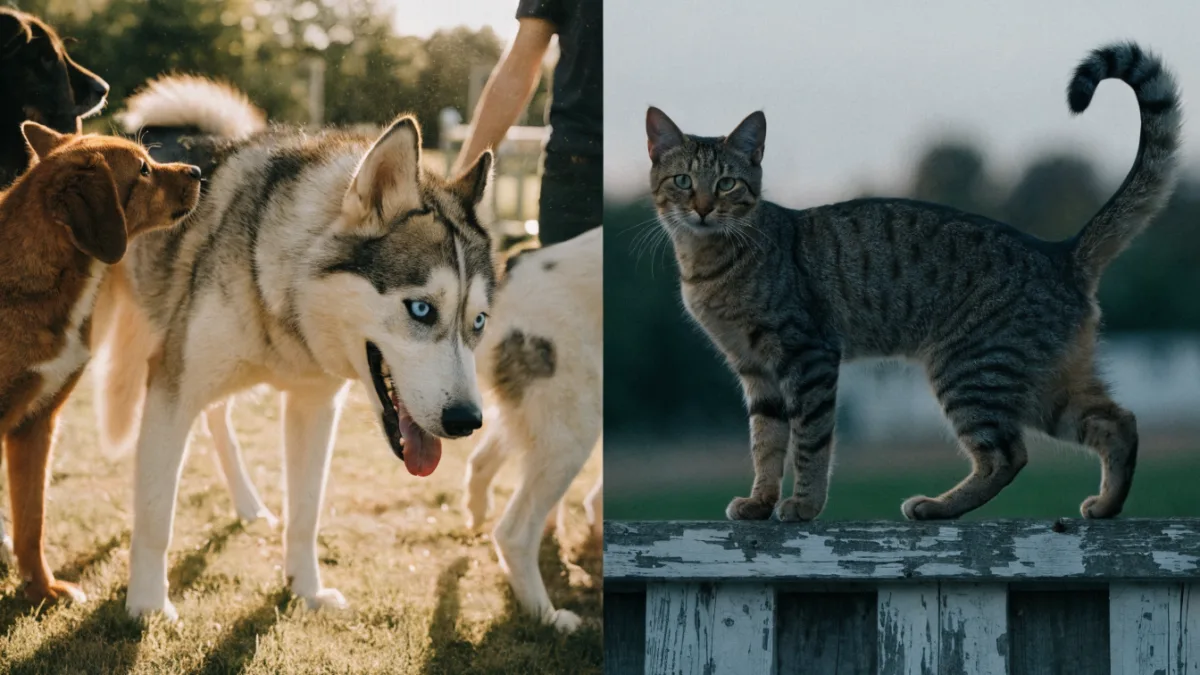
Your dog eats dinner like someone’s about to steal the bowl. Your cat eats eleven kibbles, wanders off, and comes back for the next eleven forty minutes later. If you’ve got both, you’ve probably wondered whether that’s just personality. It isn’t. That’s roughly 20,000 years of evolutionary history playing out at the food dish, and once you see it, you can’t unsee it — in how they eat, how they greet you, and how they handle a Tuesday afternoon without you.
Two Start Points: The Wolf and the Wildcat
Dogs descend from gray wolves, and domestication started somewhere between 15,000 and 30,000-plus years ago. Here’s the part that matters: humans didn’t just tame wolves, we selected for the ones that cooperated, tolerated strangers, and wanted to be around us. Generations of that filtering produced an animal that treats social connection as a survival need, not a bonus feature.
Cats took a completely different path. They descend from the African wildcat, Felis silvestris lybica, and were domesticated around 9,000–10,000 years ago in the Fertile Crescent. And honestly? Cats largely domesticated themselves. They gathered around grain stores where rodents thrived, and the cats chill enough to tolerate humans ate better. Nobody was breeding them to work in teams. We hired them as solo pest control and let them keep their whole solitary-hunter toolkit.
The deepest split is how they hunt. Wolves are cooperative pursuit hunters — they take down large prey by working together, which rewards coordination, communication, and individuals who stick with the group. Wildcats are ambush hunters — they succeed through stealth, patience, and going it alone. Almost every behavior difference between your couch companions traces back to that fork in the road.
Even sleep reflects it. Cats log 12–16 hours a day and dogs 12–14. A cat’s body is built for short, explosive bursts between long energy-conserving stretches. Your cat isn’t lazy — she’s budgeting.
So, Are Dogs Pack Animals?
Sort of — but not the way pop culture told you, and this is worth getting right.
The old model of dog packs — rigid rank hierarchies where everyone’s fighting for the top spot — came from mid-century wolf research that’s since been walked back by the researchers themselves. Wolf biologist David Mech has spent decades publicly correcting his own earlier work: wild wolf packs aren’t battle-royale hierarchies. They’re families. Mom, dad, the kids. The “leaders” are just the parents.
And domestic dogs? Even further from that model. Studies of free-roaming dogs show they form loose, flexible groups — dogs drift in and out, and they don’t coordinate hunts the way wolves do. Your dog is not sitting around plotting a takeover of your household.
What dogs actually are is obligately social. They’re wired to function as part of a social unit, and after thousands of years of domestication, that unit is you. They don’t simply enjoy company — their stress regulation is calibrated around having it. That’s why a dog left alone too long doesn’t get bored; he gets distressed.
I worked with a couple last year — first-time owners with a Lab puppy. They’d done everything right: crate, toys, a walk before leaving. Four hours alone and he’d chewed the doorframe. They thought they had a behavior problem. They had a social animal experiencing social isolation, which is a different fix entirely.
Feline Independence Is Real — and Overrated
Now flip the coin. Cats are facultatively social: capable of social life, but flexible about it depending on resources and how they grew up. That’s the accurate version of “feline independence.” Not loners — opportunists.
Proof: feral cats form colonies, often built around mother-daughter lines, wherever food is stable. Cats absolutely can do community. They just don’t require it the way dogs do, and they don’t perform their distress the way dogs do either.
That last part trips people up. There’s a recurring debate — like [1] — about why cats seem fine alone while dogs fall apart. Part of the answer is wiring. Part of it is that cats mask distress, so their suffering gets missed. Separation-related stress in cats is real and historically underdiagnosed precisely because a stressed cat goes quiet and still rather than destroying your baseboards.
Case in point: the same couple from the Lab story also had a two-year-old tabby who “did great” when they traveled. Then they noticed bald patches on her belly. She’d been over-grooming — a classic displacement behavior in anxious cats. The dog announced his stress. The cat whispered hers. Different languages, same loneliness.
And here’s a finding that surprised me. A [2] found that people rated their overall relationships with cats slightly better than their relationships with dogs — but reported greater emotional closeness with dogs. Both things can be true. Cats aren’t smaller-hearted; they’re quieter about it. Research from Oregon State in 2019 even found cats form secure and insecure attachments to their people at rates comparable to dogs and human infants. The bond is real. It just doesn’t come with a greeting parade at the door.
Where You’ll See the Wiring Every Day
Mealtime
Your dog inhales food because his ancestors ate in competition — in a group of scavengers and littermates, slow eaters lose. The begging isn’t gluttony either; dogs are social eaters who want food events shared with the group. Your cat’s ten-mini-meals routine mirrors how a solo ambush hunter actually operates: small catches, eaten alone, spaced out. Some cats will even cache food or leave “gifts” — a dead mouse on your welcome mat is a solitary hunter’s inheritance showing up in your hallway.
Affection
Dogs show attachment through proximity and ceremony: physical contact, licking, the full-body greeting when you walk in, sustained eye contact. That gaze matters — research shows dogs get an oxytocin boost from mutual gazing with their humans. It’s a genuine chemical bonding loop.
Cats run a different protocol. Their affection is choice-based: they sit on you because they chose you, which is arguably a bigger compliment. They knead, they slow-blink at you (a documented affiliative signal — try slow-blinking back), they sleep on your dirty laundry because it smells like their social unit. Cats get their bonding-hormone response more through touch and affiliation than eye contact. And here’s my favorite fact: adult cats almost never meow at each other. Meowing is largely a channel cats developed specifically for talking to humans. Your cat invented a language for you.
One caution on reading signals: behaviorists like [3] do a great job explaining why a wagging tail isn’t automatically happiness — it’s arousal, which can be joy or agitation depending on everything else the body is saying. Learn the whole picture, not one flag.
Matching the Wiring to Your Life
None of this means one species is easier or better. It means they cost you different things:
- If you want active, built-in social engagement — daily walks, training sessions, a companion who’s thrilled by your existence — a dog fits. Budget real time daily. That’s not optional for a social animal; it’s the whole deal.
- If your life needs quieter, lower-maintenance companionship — a cat fits. But “lower maintenance” isn’t “no maintenance.” Cats need environmental enrichment: climbing space, puzzle feeders, hunting-style play in short bursts, and consistent, brief interaction on their terms.
- Either way, watch the quiet ones. A cat who seems “fine” alone may be masking stress. Changes in eating, grooming, or litter habits are worth a vet’s-office visit, not a shrug.
Individual variation is huge in both species — there are velcro cats and aloof dogs — so treat the wiring as a starting assumption, not a verdict. And both species deliver real, well-documented mental health benefits. You’re not choosing between a good pet and a lesser one. You’re choosing between two different evolutionary stories.
Worth remembering where those stories came from, too. Gray wolves are listed as Least Concern globally, but they’ve been wiped out across huge portions of their historic range. African wildcats now face a quieter threat — genetic dilution through interbreeding with domestic cats. The two animals asleep on your sofa are the living legacies of those ancestors, and the best thing you can do as an owner is stop asking them to be something they’re not. Your dog isn’t needy; he’s a pack-minded animal who chose you as his family. Your cat isn’t cold; she’s a solo-hearted hunter who decided, entirely on her own, that you were worth keeping around. That’s the whole trick — meet them where ten thousand years left them.
Sources
- this one on Reddit — reddit.com
- study catalogued in the NIH database — pmc.ncbi.nlm.nih.gov
- Dr. Westlund — instagram.com