

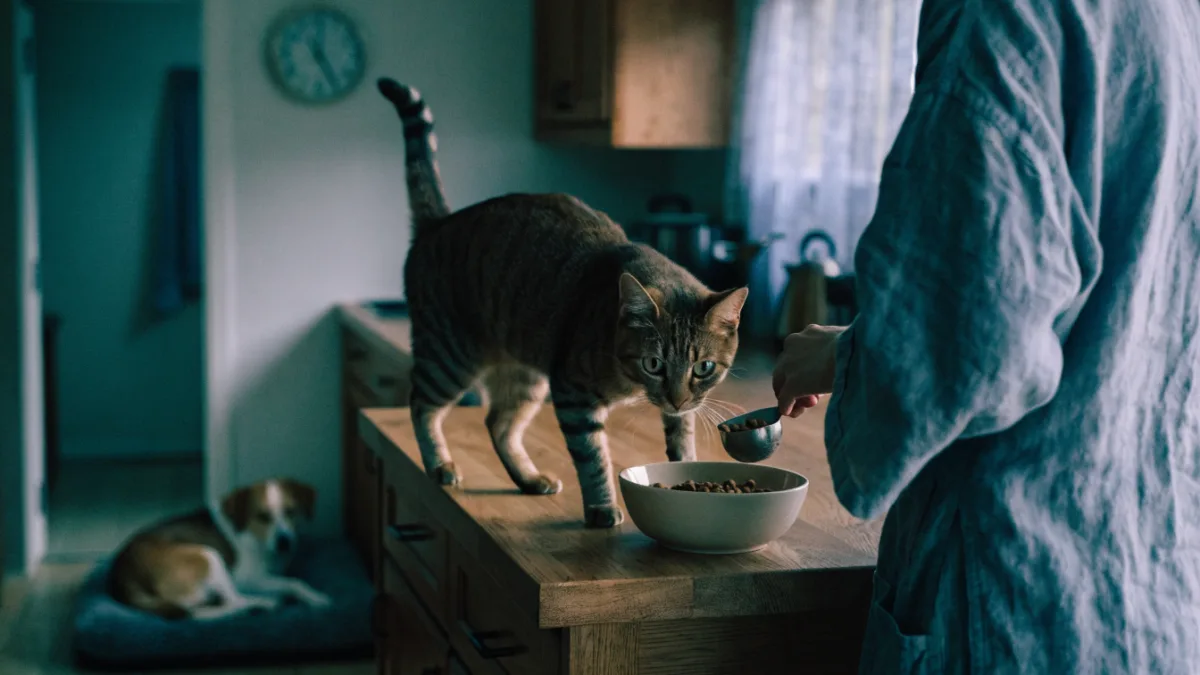
My cat Mochi has a sixth sense for the exact moment my alarm is set to go off. Not the time before it, when I’m still in a reasonable sleep cycle. No — she waits for that precise window around 4:47 AM when I’m in my deepest, most delicious REM state, and then she commences what I can only describe as a one-cat percussion ensemble on my bedroom door. Meanwhile, my sister’s Labrador retriever, Biscuit, wouldn’t stir at that hour if you set off fireworks. He’s face-down in his bed, snoring with the conviction of someone who has no plans until at least 9 AM.
If you’ve ever wondered why your feline overlord treats dawn like a personal performance venue while your dog treats the entire day like an extended nap, there’s actual biology behind it. And understanding that biology might — might — buy you a few more hours of sleep.
What “Crepuscular” Actually Means (And Why It’s Not the Same as Nocturnal)
Let’s clear up a misconception that refuses to die: cats are not nocturnal. I know, I know — your cat does laps around your living room at midnight and you’re thinking, “Emily, that is definitively nighttime behavior.” But biologically speaking, domestic cats fall into a category called crepuscular, which means they’re most active during the twilight hours of dawn and dusk.,[1] and she’s right to push back on it.
Here’s the distinction that matters:
- Nocturnal animals are active primarily at night — think bats, owls, opossums.
- Diurnal animals are active during the day — that’s us, along with many primates and birds.
- Crepuscular animals peak at dawn and dusk — cats, dogs, deer, rabbits, and a surprising number of predators and prey alike.
That midnight zoomies session? It’s actually the tail end of your cat’s dusk activity window. The 4 AM door-scratching? That’s the dawn window kicking in. Your cat isn’t broken. Your cat is running on software that hasn’t been updated since the Pleistocene.
The Evolutionary Reason Your Cat Treats Sunrise Like an Emergency
To understand crepuscular pets, you have to look at what dawn and dusk meant for survival in the wild. For small predators like the ancestors of domestic cats, twilight hours were the sweet spot for hunting. Their primary prey — mice, voles, small birds — are also crepuscular, meaning they’re out and about during those same windows. A cat’s eyes are specifically adapted for the low-light conditions of dawn and dusk, with vertical slit pupils that can open wider than ours to capture every available photon.
So when Mochi wakes me up at 4:47 AM, she’s not being deliberately obnoxious. She’s experiencing a genuine biological surge — her body is telling her that prime hunting time is happening RIGHT NOW and she’s missing it. The fact that her “prey” is a bowl of kibble in the kitchen doesn’t override millions of years of evolutionary programming.
This is the part that changed everything for me: once I stopped interpreting Mochi’s early morning demands as a personal vendetta and started seeing them as a biological need she couldn’t control, I stopped being angry about it. Still exhausted, sure. But angry? No.
Why Dogs Are a Different Story
Dogs share the same crepuscular ancestry — wolves and wild canids also hunted during twilight hours when temperatures were moderate and light conditions favored their tracking abilities. But here’s where things get interesting from a behavioral science standpoint: domesticated dogs have had roughly 15,000+ years of cohabitation with humans, and that has shifted many of them toward a more diurnal pattern that matches our own.
Some behaviorists argue the point, and it’s a genuine debate in the field. Are modern dogs still fundamentally crepuscular, or have they adapted enough to be considered diurnal? The answer seems to be: it depends on the dog, the household routine, and how much their humans reinforce particular schedules.,[2] alternating between marathon sleep sessions and random energy spikes.
The Sleep Math: Why Your Dog Logs 14 Hours and Your Cat Logs 15
Here’s a fun fact that might make you jealous: dogs sleep an average of 12–14 hours a day, and that number can climb to 16–20 hours for puppies, senior dogs, and larger breeds. Cats are even more committed to the cause, often racking up 15 hours of sleep daily, sometimes up to 20 in older or particularly lazy individuals.
But — and this is crucial — neither animal sleeps the way humans do. We’re monophasic sleepers, meaning we do our sleeping in one long uninterrupted block. Cats and dogs are polyphasic, meaning they sleep in shorter bursts scattered throughout the day and night. This is why your dog can crash hard at 2 PM, seem comatose for an hour, and then be ready for a walk at 3 PM like nothing happened.
This polyphasic pattern also explains why a high-energy dog can appear to “sleep all day” while still being a maniac at the dog park that evening. They’re not actually lethargic — they’re just efficient about distributing their rest. A bored dog with nothing else to do will simply sleep more, which can mask the fact that they’re actually under-exercised and under-stimulated.
Fixing the “Cat Waking Me Up” Problem (Without Losing Your Mind)
Okay, here’s the part you actually clicked for. If your cat is treating 4:30 AM like go-time, you’re not helpless — but you do need to work with their biology rather than against it.
The Pre-Bed Hunt
Remember how I said cats are wired to hunt at dawn? You can partially satisfy that drive the night before. A solid play session about 30–60 minutes before your bedtime — the kind that actually gets them moving, stalking, pouncing, and tired — can shift some of that energy expenditure to a more convenient hour. I’m talking interactive wand toys, laser pointers (followed by an actual toy they can “catch” so they don’t get frustrated), or anything that mimics the hunt-catch-kill sequence. Fifteen minutes of genuine, vigorous play, not five minutes of half-hearted dangling while you watch Netflix.
The Midnight Buffet (Automated)
If your cat’s wake-up routine involves screaming at you for food — and let’s be honest, that’s usually what’s happening — an automated feeder set for 4:00 or 4:30 AM can be genuinely life-changing. The cat gets their “dawn hunt” reward without you being involved, and over time, many cats will redirect their attention from your sleeping body to the machine that actually produces kibble. This isn’t an overnight fix; it can take a couple weeks for the new association to stick. But it works often enough that I’d call it one of the most effective interventions for cat waking me up problems.
Ignoring the Performance
This is the hard part. If you’ve been getting up to feed your cat at 4:30 AM for months, you’ve taught them that this performance works. The only way to break that cycle is to stop rewarding it — completely, consistently, for as long as it takes. Any response from you, even a negative one like yelling or shooing, is still attention. The [3] is funny until it’s your own sleep deprivation on the line.
Managing the Dog Sleep Schedule
If your dog seems to sleep all day and then explode with energy at inconvenient times, the issue usually isn’t their biological clock — it’s a mismatch between their exercise needs and their daily routine. Dogs are remarkably adaptable to human schedules, but they still have those crepuscular energy peaks hardwired in.
The fix is fairly straightforward: structured exercise at both ends of the day. A solid morning walk or play session burns off that dawn energy, and an evening session captures the dusk peak. A dog who gets a 20-minute stroll at noon and nothing else is going to be a problem by 6 PM. I’ll defer to trainers like Jake for the specifics of exercise plans for different breeds and energy levels, but the general principle holds: work with those natural energy windows rather than fighting them.
Also worth noting: recent veterinary behavior research has emphasized that physical exercise alone isn’t enough. Mental enrichment — puzzle feeders, scent games, training sessions, anything that makes your dog think — produces a deeper, more restorative kind of tiredness. A dog who’s only physically exercised might have tired muscles but a wired brain, which leads to the restless napping pattern that drives owners crazy.
A Quick Word About Cats and Wildlife
Since we’re talking about crepuscular instincts, it’s worth mentioning that this programming has real consequences beyond your sleep schedule. Free-roaming and feral cats do their most effective hunting at dawn and dusk — exactly when wild prey species are also most active. Studies of cat predation consistently show peak hunting during these windows, and the impact on songbird and small mammal populations is significant in many regions. If your cat goes outdoors, keeping them inside during dawn and dusk hours — or better yet, providing a safe enclosed outdoor space like a catio — dramatically reduces their ecological footprint while satisfying your cat-welfare obligations at the same time.
Look, I’m not going to pretend that understanding your pets’ biological clocks will magically fix every sleep disruption. Mochi still wakes me up sometimes. But knowing why she does it — that it’s not spite, not personal, just ancient programming running on a modern cat — makes it easier to respond with solutions instead of frustration. And those solutions, applied consistently, can genuinely shift the dynamic. I’m writing this after seven uninterrupted hours of sleep, which is not something I could have said a year ago. Progress, not perfection.
Sources
- Cat behaviorist Pam Johnson-Bennett has been correcting this label for years — facebook.com
- Plenty of dog owners report pets that seem genuinely confused about what time it is — reddit.com
- viral content about cats going wild at dawn and dusk — tiktok.com