

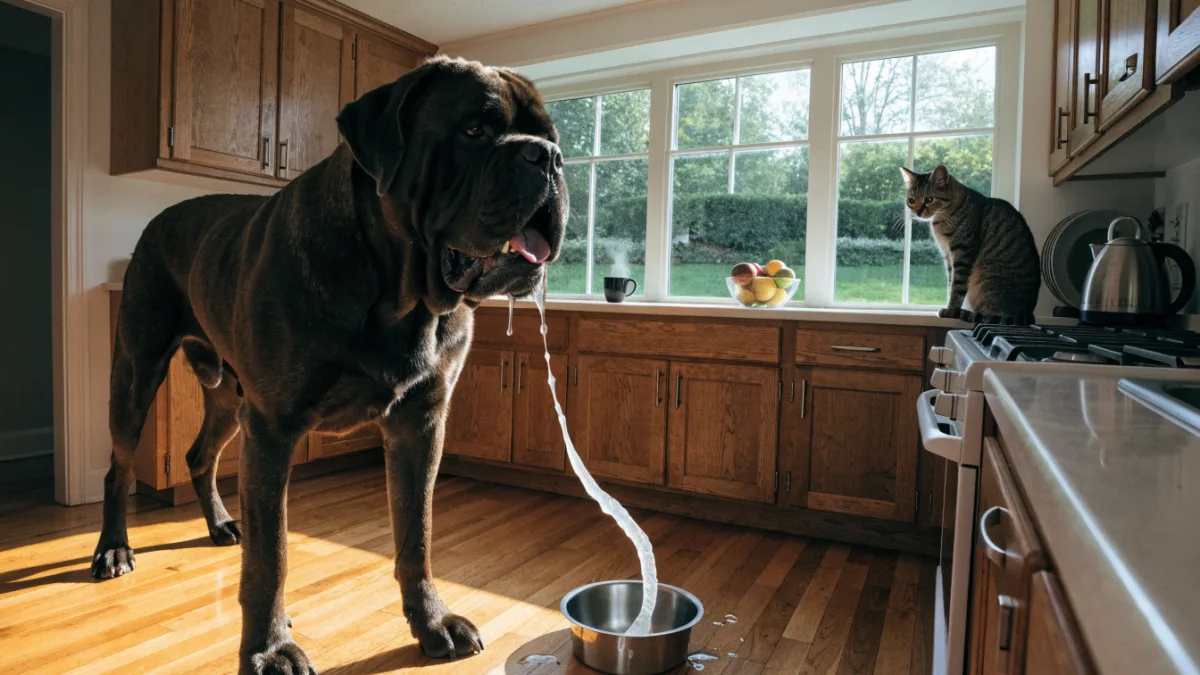
If you share your home with a Mastiff, a Bloodhound, or a St. Bernard, you already know the reality of living with a slobbery dog. You keep “slobber towels” in every room. You’ve learned to wipe your walls. You’ve accepted that a string of viscous spit connecting your dog’s mouth to your knee is just a standard greeting. But if you’ve ever watched a cat meticulously clean its fur, remaining completely dry in the process, you’ve probably wondered why dogs and cats are separated by such a massive, slimy biological divide. It comes down to thousands of years of selective breeding, radically different evolutionary blueprints, and basic structural anatomy.
The Anatomy of the Flew: Where the Slime Lives
To understand dog breed slobber, you have to look at the structure of a dog’s mouth. The culprit behind the slime isn’t excess saliva production—it’s poor architectural containment. Dogs have loose, fleshy upper lips called “flews.”
In breeds like the Mastiff, Newfoundland, or Basset Hound, these flews are heavy, thick, and pendulous. They hang completely over the teeth, creating deep pockets in the cheeks and the corners of the mouth. Because the lips don’t seal tightly against the gums, a dog’s saliva pools in those fleshy reservoirs. When the dog pants, eats, or simply lowers its head to sniff a fire hydrant, the pool overflows. When the dog shakes its head, the pooled saliva goes airborne, coating your ceiling, your windows, and your guests.
Why Cats Keep It Together
Contrast this with cat mouth anatomy. Felines are built for precision. A cat’s lips are tight, dry, and highly muscular, sealing flawlessly against their teeth and gums to create a watertight barrier. Even when a cat’s mouth is full of saliva to aid in digesting a mouse or grooming its coat, none of it escapes.
Cats are obligate carnivores designed to shear meat and clean themselves to eliminate their scent from predators. They cannot afford to drool. If a cat is drooling, something is wrong. When they do slime, it’s usually a rare, isolated behavioral quirk—like the “biscuit-making” nursing reflex they exhibit when they are incredibly content and kneading a blanket.
Why Humans Engineered the Slobber
The drool we complain about today is entirely a byproduct of human engineering. We bred dogs to do difficult, dangerous jobs, and their loose jowls were a necessary feature for survival and performance.
Trapping Scents and Fighting Bulls
Take the Hound group. When Bloodhounds and Basset Hounds track a scent, they sweep the ground with those massive, droopy flews. The loose skin and heavy lips act like a net, actively trapping scent particles against their noses so they can stay locked on a trail.
Mastiffs, Dogue de Bordeaux, and Bulldogs were originally bred for baiting, fighting, and guarding. Their loose, thick, pendulous lips were an intentional defense mechanism. If an angry boar or rival animal attacked, it would grab a mouthful of loose flesh rather than crushing the dog’s jaw or breaking its teeth. The drooping skin allowed the dog to sustain facial bites and keep fighting.
The Canine Air Conditioner
There’s another reason dogs need all that extra moisture: they don’t sweat. While they have minor sweat glands in their paw pads, dogs cool their bodies primarily through panting. Saliva is a vital evaporative coolant. When a dog pants, moisture evaporates from their heavily vascularized tongue and mouth, cooling the blood, which then circulates to keep their internal temperature from spiking. For a heavy, thick-coated Mastiff running in the heat, drool is a literal lifesaver.
The “Hypoallergenic” Lie and the Saliva Allergen Debate
I want to take a second to address a massive misconception in the dog world: the idea of the “hypoallergenic” dog. People assume pet allergies are triggered by hair, so they buy breeds that don’t shed. But the real culprit is usually a specific protein found in pet saliva, urine, and dander.
When a large, loose-lipped dog slings saliva all over your house, your couch cushions, and your bare arms, they are actively spreading that specific allergen across every surface. For someone with severe dog allergies, a giant slobber machine is the worst possible companion. Don’t let anyone sell you a “hypoallergenic Mastiff.” It doesn’t exist.
When Drool Means Danger: Reading the Red Flags
If you own a giant breed, you know what your dog’s baseline slobber looks like. But sudden, out-of-character drooling—or hypersalivation—is one of the clearest warning signs that your dog needs a veterinarian. Never write off a massive spike in drool as just “typical breed behavior.”
Dental and Oral Pain: Tartar buildup, a rotting tooth, or a piece of wood wedged across the roof of the mouth will cause a dog to drool uncontrollably. I once saw a friend’s hound go from normal to a walking slime factory in an hour; the culprit was a piece of mulch lodged perfectly between his upper molars.
Toxins and Trauma: Dogs explore the world with their mouths. If they lick a toxic toad, chew on a toxic plant, or ingest a chemical irritant, their body will flood their mouth with saliva in a desperate attempt to flush the toxin away.
The Silent Killer — Gastric Dilatation-Volvulus (Bloat): This is the big one for owners of Mastiffs, Hounds, and deep-chested large breeds. When a dog’s stomach fills with gas and twists on its axis, it is a fatal, seconds-count emergency. One of the very first silent signs of bloat is sudden, profuse, uncontrolled drooling. The twisted stomach presses against blood vessels and causes severe nausea, resulting in heavy, continuous slime. If your dog is drooling excessively, pacing anxiously, and trying to vomit without producing anything, get to an emergency vet immediately. Don’t wait.
Heatstroke: Because saliva acts as a coolant, a dog that is overheating will pant heavily and drool profusely. If the drool is thick and ropey, and the dog is lethargic or collapsing, they are cooking from the inside out.
Managing the Mess
Living with a heavy drooler isn’t a tragedy, but it does require a shift in your lifestyle. You keep their skin folds clean to prevent lip fold dermatitis—a painful, smelly bacterial infection that thrives in the warm, damp crevices of their jowls. You wipe their mouths daily.
Recently, the pet industry has finally caught up to the reality of owning a giant breed. The market is flooded with “drool gear”—quick-drying silicone food mats that catch the drips, specialized slobber towels, and “snood” style bibs that large dogs wear indoors to keep their saliva off your furniture. Dental care has also improved, with enzymatic water additives and dental sprays that help break down tartar without forcing you to pry open a 150-pound dog’s jaws to brush their teeth.
The next time you peel a string of slime off your favorite shirt, remember that it’s a testament to your dog’s history. Their loose lips and heavy jowls are the exact features we humans spent centuries breeding into them so they could fight bulls, hunt wolves, and survive the elements. You’re just wearing the receipt of their working-class heritage.