

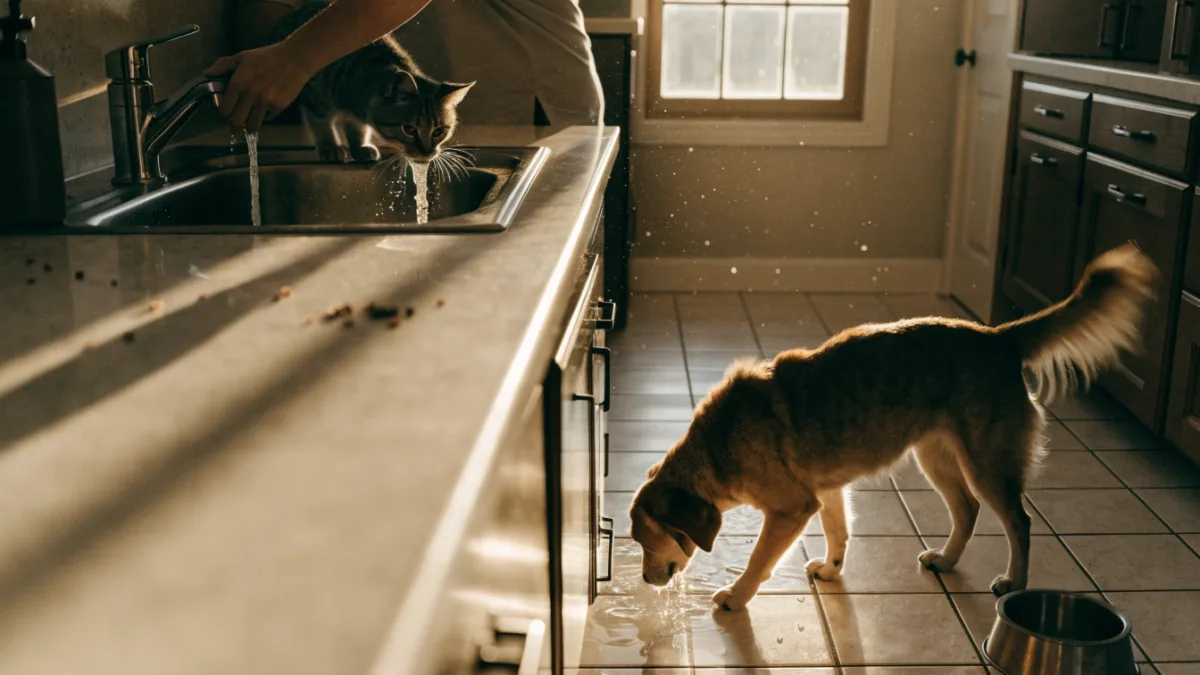
I spent forty-five dollars on a ceramic water bowl for my cat Mochi last summer. It’s got a little bamboo stand, a wide design so her whiskers don’t touch the edges — the whole thing looks like it belongs in a spa. She drank from it exactly twice before deciding that the dripping bathroom faucet was her personal fountain of youth. Meanwhile, my partner’s dog Biscuit walked past his perfectly clean stainless steel bowl last Tuesday to stick his entire face into a murky puddle that had formed on a plastic bicycle cover in the yard. He looked absolutely thrilled. The bowl? Not even a glance.
If you’ve ever stood in your kitchen watching your cat ignore pristine water to lick the shower drain, or dragged your dog away from a suspicious puddle on the sidewalk, you’ve probably asked yourself the same question I have roughly once a week: why do I even bother?
The Clean Water Paradox Nobody Warned You About
Here’s the thing that drives every pet owner a little bit insane: we do everything right. We buy the bowls. We change the water. We filter it, sometimes, because we read an article that said tap water has minerals cats don’t love. And our pets look at us like we’ve offered them a glass of dust.
But from an evolutionary standpoint, what we see as “clean” and what our pets see as ” appealing” are two completely different things. Both dogs and cats have innate drives — deep, ancient, hardcoded into their DNA — to seek out water sources beyond what’s handed to them in a bowl. This isn’t picky behavior. It’s survival instinct wearing a cute furry costume.
In the wild, standing water is a gamble. It could be fresh rainwater. It could also be a breeding ground for bacteria, parasites, or worse. Running water, on the other hand, generally means a stream or river — water that’s constantly being oxygenated and cleaned by movement over rocks and sediment. To a wild ancestor, the sound and sight of moving water signaled “safe.” A still puddle might be fine, but it also might be where a diseased animal drank yesterday.
Your pampered indoor cat has never had to worry about giardia in her lifetime. Her brain doesn’t know that, though.
Feline Faucet Lickers: The Running Water Obsession
Cats are the running water connoisseurs of the pet world. If you’ve lived with a cat, you’ve probably experienced some version of this: the midnight tap-demand, the cat who materializes the second you turn on the shower, the one who stares at you with enormous eyes until you create a tiny trickle from the bathroom sink.
Mochi’s thing is the bathtub faucet. She’ll sit on the edge of the tub for twenty minutes waiting for someone to turn it on just enough for a thin stream. Then she cups the water with her paw and licks it off — because of course she has a technique.
Why Moving Water Wins
In the wild, cats evolved as desert-dwelling predators. They got most of their hydration from prey, which meant they didn’t develop the same strong thirst drive that dogs have. A cat in the wild might only seek out water occasionally, and when she does, she’s drawn to sources that seem freshest — which usually means moving water. Still pools in the desert can be stagnant, warm, and full of stuff that could make a small predator very sick.
So when your cat turns up her nose at the bowl you just filled, she’s not being difficult on purpose. Her instincts are quietly whispering that still water is suspicious, and that sound of a faucet? That’s the good stuff.
The “Novel Vessel” Phenomenon
But it’s not just movement. Cats are also notorious for preferring water from vessels that are absolutely not intended for them. Your water glass on the nightstand. The mug you left on your desk. A plant pot’s drainage tray. The sink after you’ve done dishes.
I’ve watched Mochi walk past three different water sources to get to the small pool of water sitting in my pothos plant’s saucer. There’s something about that water — maybe it’s been sitting in terracotta, maybe it picked up earthy notes from the soil, maybe cats just love watching us slowly lose our minds.
The bowl itself can also be part of the problem. Water that’s been sitting in a ceramic or metal bowl can take on the taste or smell of the container. To sensitive feline noses, that’s not appealing. Plant water, rain water, water that’s been sitting in something natural — it smells alive. And to a creature driven by instinct, alive is better than sterile.
Canine Puddle Drinkers: The Scavenger’s Approach
Dogs are a different story entirely. Where cats are cautious connoisseurs, dogs are opportunistic enthusiasts. If there’s water on the ground, a dog will at least consider drinking it. Muddy puddle? Sure. Tire track filled with brown water? Even better. That weird puddle that formed on top of the tarp covering your firewood? Absolutely.
Biscuit, who belongs to my partner, is a puddle enthusiast of the highest order. We’ll come back from a walk where he had access to his water bottle attachment no fewer than three times, and he’ll make a beeline for whatever murky accumulation he can find near the apartment complex dumpster. The fresh water we offered him on the walk? Barely a sip.
Why Dogs Go Straight for the Gross Stuff
Dogs evolved as scavengers. Their ancestors didn’t have the luxury of being picky. If water was available, you drank it, because you didn’t know when you’d find more. This opportunistic drive is still alive and well in modern dogs, even the ones who get organic treats and sleep on memory foam beds.
That earthy, muddy smell that makes us wrinkle our noses? To a dog, that’s information. It’s water that’s been sitting in nature, absorbing minerals from soil, picking up scents from whatever passed by. It’s like a liquid newspaper. Dogs are gathering data with every slurp.
There’s also the temperature factor. Puddles that have been sitting outdoors are often cooler than indoor bowl water, especially in summer. And some dogs just seem to prefer the taste — all those dissolved minerals and organic compounds create a flavor profile that plain filtered water simply can’t match.
So What’s the Worried Owner to Do?
First, the reality check: some alternative water sources are genuinely dangerous. Puddles can harbor pathogens like Giardia and Leptospira. Standing water in urban areas can contain antifreeze runoff, which is lethal even in tiny amounts. Plant water with fertilizer residue is bad news. I’m not going to tell you to let your pets drink whatever they find — that’s between you and your vet, and the risks are real.
But understanding why they’re doing it can help you work with their instincts instead of against them.
The Water Fountain Compromise
This is where pet water fountains come in. They’ve become hugely popular for good reason — they bridge the gap between what our pets want and what we want for them.
A good fountain keeps water moving, which addresses the feline instinct that says “running equals fresh.” Many cats who refuse bowls will happily drink from a fountain. The filtration systems help remove the container taste that puts sensitive noses off. And for dogs, the continuous flow can be more enticing than still bowl water, which might reduce the appeal of that puddle on the sidewalk.
When you’re shopping for one, look for a fountain made from materials that won’t impart flavor — ceramic or high-quality stainless steel tend to be better than plastic, which can develop microscopic scratches that harbor bacteria and hold onto smells. Check that the pump is quiet, because cats especially will avoid something that sounds threatening. And pay attention to capacity; if you have multiple pets, you’ll want something that doesn’t need refilling every few hours.
Working With the Weirdness
Here’s what I’ve learned from living with Mochi and her various water opinions: sometimes you just have to provide options. She has her fountain, which she uses. She has a wide ceramic bowl in the kitchen, which she occasionally respects. And yes, sometimes I let her have her little trickle from the bathtub faucet because the joy on her face is worth the minor inconvenience.
The key is not to take it personally. Your cat isn’t rejecting your care when she ignores the expensive bowl. Your dog isn’t trying to horrify you when he drinks from a puddle. They’re following instincts that kept their species alive long before anyone invented pet care aisles or ceramic fountains.
We can’t fully override millions of years of evolution with a nice bowl and filtered water. But we can understand what our pets are looking for — freshness, movement, interesting flavors, temperature — and try to offer safer versions of those things. And we can forgive them for the times they still choose the muddy puddle anyway, because sometimes instinct just wins.
Your pets aren’t broken. They’re just wild animals in very small, very pampered packaging — and honestly, that’s part of what makes living with them so endlessly interesting.