
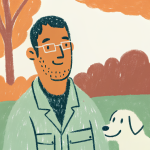
I’ll never forget the first time I saw a dog completely lose his mind over a car. I was working with a guy and his eight-month-old Australian Cattle Dog. We were walking on a quiet sidewalk when a sedan passed us going maybe 25 miles per hour. In a split second, this dog went from casually sniffing the grass to launching himself at the end of the leash, shrieking, snapping, and spinning like a top. The owner looked at me, embarrassed, and said, “He just wants to play with them.”
He didn’t want to play. What looked like a silly, hyperactive game was actually a full-blown psychological meltdown. Car chasing is one of the most dangerous, explosive behaviors you can deal with as a dog owner. It is a behavioral obsession that puts dogs in the emergency room every single day. No matter how fast, strong, or athletic your dog is, a 3,000-pound chunk of metal moving at speed will always win that fight. If your dog is obsessed with moving vehicles, you have a massive safety issue on your hands. But understanding exactly why they’re doing it is the first step to fixing it.
It’s Not a Game—It’s an Overload
When a dog locks onto a passing car, they aren’t thinking about having fun. They are experiencing intense sensory overload. The loud rumble of the engine, the whoosh of the wind, and the spinning, flashing movement of the tires act like a magnetic force field for a dog’s nervous system.
This behavior often kicks into high gear surprisingly early. I’ve seen dogs as young as five months old develop a sudden, obsessive interest in traffic. Once that switch flips, the dog learns that barking, lunging, and stalking make the car move. From the dog’s perspective, they are controlling the environment. The car comes, the dog freaks out, and the car leaves. In the dog’s mind, they just successfully chased a massive beast away from their territory. It is highly self-rewarding, which makes it incredibly hard to stop.
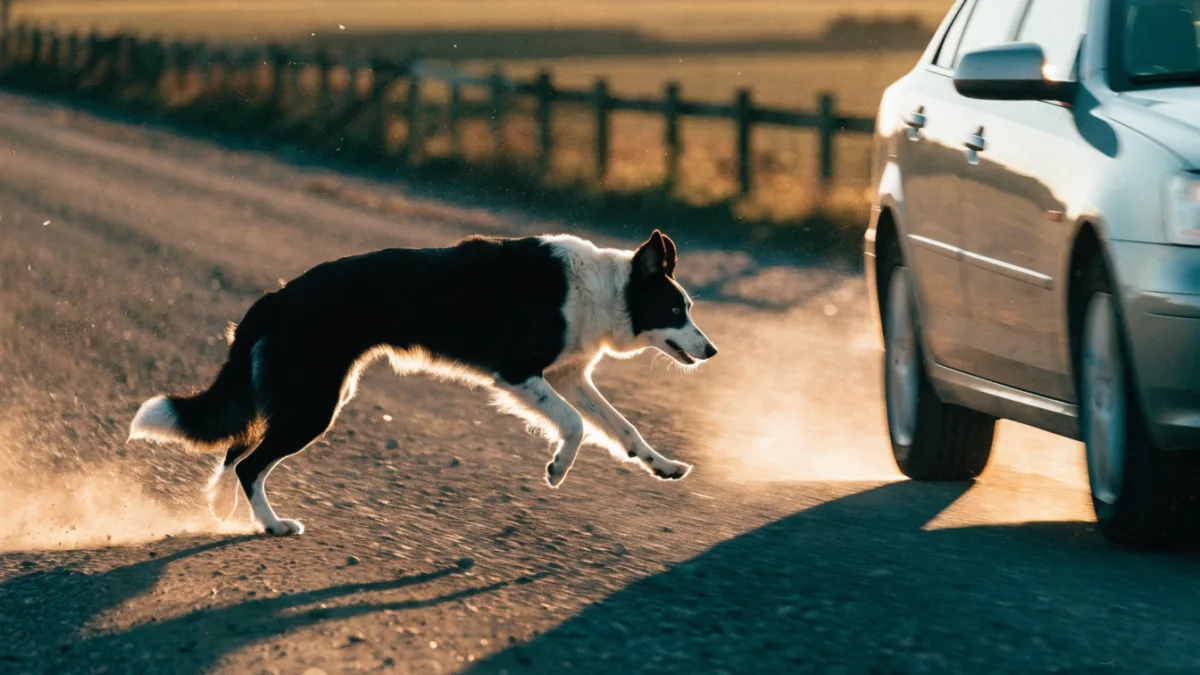
If you watch closely, you’ll notice this isn’t a playful bounce. For some dogs, the obsession is so severe that they will begin “stalking” a car from several blocks away. They’ll drop their head, fix their eyes hard on the target, and hold their breath until the car gets close enough to trigger a full-force lunge. Once a dog is in that stalking zone, they are practically deaf to your voice. They are operating on pure instinct.
The Big Debate: Predators or Panic?
Ask five different dog trainers why dogs chase cars, and you might get five different answers. In the behavior world, there is a fascinating, ongoing debate about what actually drives this extreme reactivity.
One prominent school of thought, championed by world-class trainers like Ivan Balabanov, argues that car chasing has absolutely.[1] Instead, it is a severe fear or reactivity issue. The idea here is that the loud, fast-moving vehicle terrifies the dog. The dog reacts defensively, barking and lunging to aggressively tell the scary object to back off. When the car inevitably drives away, the dog feels a massive sense of relief and empowerment. They think their aggressive display saved their life.
As Balabanov points out, a dog hunting prey acts very differently than a dog reacting to a threat. The intense, frantic, out-of-control lunging at a car often looks much more like panic than calculated hunting.
But there is another side to this story. If you’ve ever worked with a Border Collie or an Australian Shepherd, you know that herding instinct is a powerful, undeniable force. For these breeds, the debate leans heavily toward genetics and prey drive. Herding dogs are literally bred to stalk, control, and move fast-moving objects. Most of our companion herding dogs don’t have access to a flock of sheep. When they see a shiny tire spinning rapidly down the road, their genetic wiring lights up. They can’t help themselves. They treat the car like a giant, fast-moving sheep that needs to be rounded up. For these dogs, it truly is a misdirected hunting and herding drive.
The reality? Both camps are probably right. The root cause depends heavily on the individual dog sitting in front of you. A nervous German Shepherd might be barking out of fear, while a driven Cattle Dog is chasing out of pure instinct.
Why “Showing Them Who’s Boss” Fails
I’ll be the first to admit it: I used to buy into the old-school dog training methods. Years ago, if a dog lunged at a car, the standard advice was to give a sharp leash correction, poke the dog in the side, or make a loud “tsst” sound to snap them out of it. That was the dominant dog training philosophy on television, and millions of people copied it, myself included.
I was wrong.
Modern behavioral science has entirely dismantled the idea that dogs chase cars because they are trying to be the “alpha” of the household. Trying to dominate a reactive dog doesn’t cure the obsession. It just adds a layer of stress to an already stressful situation. If your dog is chasing because they are terrified of the car, giving them a leash correction just proves their point: See? The car shows up, and I get hurt. I told you cars were evil! You end up fueling the exact behavior you’re trying to stop. We’ve shifted away from viewing these dogs as stubborn or dominant, and instead recognize them as animals struggling with anxiety, over-arousal, or intense genetic drive. They aren’t giving you a hard time; they’re having a hard time.
The Roadmap to Recovery
Fixing car chasing isn’t about a magic word or a special collar. It requires a structured approach that changes how your dog feels about vehicles from the ground up. [2] is entirely possible, but you have to be realistic and patient. Here is how we actually get it done.
Step 1: Lock Down the Hardware
Before you do any training, you need to make sure your dog is physically secure. If your dog slips out of their collar and darts into traffic, the game is over. A standard flat collar will not cut it for a serious car chaser. You need a secure, well-fitted harness. Look for a harness with a martingale loop at the chest or a strap that goes over the dog’s back to prevent them from backing out of it. I’m a huge fan of front-clip harnesses because they redirect the dog’s pulling momentum back toward you, rather than allowing them to get leverage by pulling straight ahead with their chest. Head halters are another excellent option for heavy pullers, giving you gentle, safe control over the dog’s nose and line of sight. Pair whichever tool you choose with a sturdy, standard leash—never a retractable one.
Step 2: Master the Distance
You cannot train a dog to be calm around cars while standing three feet from a busy highway. It would be like trying to teach someone meditation while they sit in the front row of a rock concert. You have to find your dog’s “threshold.” This is the distance at which they notice a car but haven’t completely lost their mind yet. For some dogs, this might be 10 feet. For highly reactive dogs, it might be 50 yards. Find that distance. When a car passes at that specific range, your dog should be able to take a treat and respond to their name. Over time, you will slowly, inch by inch, close that gap.
Step 3: Reward the Check-In
This is where the actual behavioral change happens. You’re going to stand at your safe distance with a pocket full of high-value treats—think real meat, not dry biscuits. When a car approaches, you are going to start feeding your dog rapidly before they have a chance to fixate. You are teaching your dog an alternative behavior. Instead of lunging at the car, they learn to look at you. The ultimate goal is the “check-in.” You want the dog to see a car, process it, and then immediately turn their head back to you expecting a reward. You are fundamentally changing their emotional response. Car approaches = look at owner = get roast beef.
If your dog won’t take the treat, you’re too close. Back up. You have to stay under that reactivity threshold to make progress.
This isn’t an overnight fix. You are fighting against deep-rooted instincts, high-level fear, and a self-rewarding habit loop. Some days will be great, and other days a loud motorcycle will blow past you and you’ll feel like you’re back at square one. That’s normal. The goal isn’t perfection; the goal is steady, safe progress.
At the end of the day, curbing this obsession is about more than just having a polite walking companion. It is an act of conservation in your own neighborhood. We spend countless hours and dollars protecting wildlife from the dangers of human infrastructure. Your dog relies entirely on you to protect them from those same dangers. When you put in the work to break through their dangerous fixation, you aren’t just fixing a behavior problem. You are saving their life, keeping them safely by your side for years to come.
Sources
- nothing to do with predation — facebook.com
- Training a dog to stop lunging at cars — youtube.com