

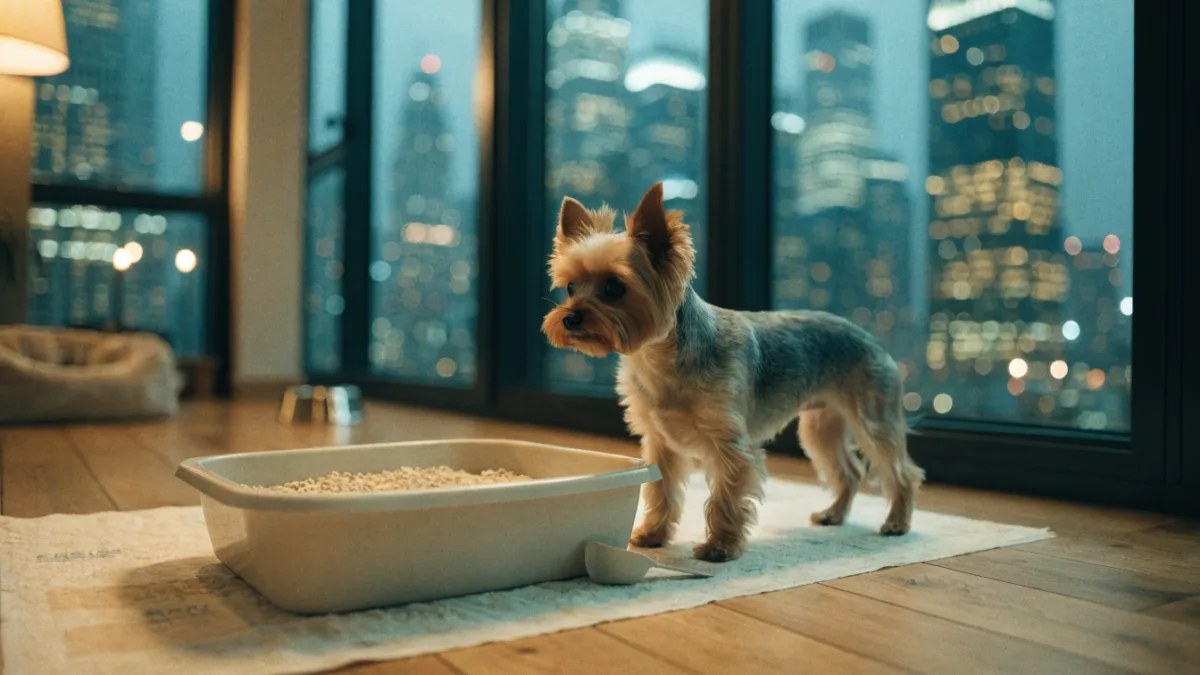
A client of mine — let’s call her Maria — lives on the 14th floor of a high-rise with a four-pound Chihuahua named Pepper. Every single time Pepper needed to pee, Maria had to grab the leash, call the elevator, walk through the lobby, and find a patch of grass. At 6 a.m. In the rain. At 11 p.m. when she was already in her pajamas. She looked exhausted when she called me, and she asked what felt like a wild question: “Can I just train her to use a litter box?”
The answer is yes. And honestly, I wish more people knew about it.
Who This Actually Works For
Let’s get the obvious out of the way: litter box training is not for every dog. If you’ve got a Labrador or a German Shepherd, stop reading and go buy more poop bags. This is a small dog strategy — think Chihuahuas, Yorkshire Terriers, Pomeranians, Dachshunds, Maltese, toy poodles, and other dogs under roughly 20 pounds. The logistics just don’t work for bigger dogs. A Mastiff in a litter box is a mental image you can’t unsee, and the volume of waste would be unmanageable.
But for small breeds? It’s genuinely a game-changer. These dogs have tiny bladders and fast metabolisms, which means they need to go more frequently than large dogs. That midnight potty break becomes a lot less painful when the “bathroom” is ten feet from your bed.
Age isn’t a dealbreaker either. I’ve litter-trained eight-week-old puppies and twelve-year-old rescues who’d only ever gone on grass. Older dogs might take a little longer to pick it up because you’re asking them to reverse a deeply ingrained habit, but they get there. Dogs are far more adaptable than we give them credit for.
The “Cat Litter” Problem
Why Traditional Clay Litter Is a Bad Idea
Here’s where I need to push back on the premise a little. The phrase “cat litter” gets used loosely, but you should think carefully about what actually goes in the box.
Standard clumping clay litter — the stuff most cat owners buy — is genuinely dangerous for dogs. Cats are fastidious groomers who carefully step over their litter. Dogs are scavengers who will eat literally anything that smells remotely interesting. I’ve seen dogs snack on litter like it’s kibble. When clumping clay hits a dog’s stomach, it absorbs moisture and expands. That can cause a gastrointestinal blockage that requires emergency surgery. It is not a minor risk.
If your dog can reach the litter, assume they’ll try to eat it. Plan accordingly.
What to Use Instead
You’ve got several good options, and none of them involve clumping clay:
- Paper pellet litter: Made from recycled paper. Highly absorbent, low dust, and won’t cause the same emergency if your dog takes a curious lick. This is probably the most popular choice for small dog owners.
- Wood pellets: Usually pine. Smells clean, absorbs well, and breaks down into sawdust when wet. Cheap and widely available.
- Alfalfa pellets: Sometimes sold specifically as dog litter. Has a natural grass-like scent that some dogs find appealing.
- Artificial turf patches: These are essentially flat trays with fake grass on top and a drainage layer beneath. Great for dogs who are already grass-trained and need a substrate that feels familiar.
- Natural and biodegradable options: Tofu litter, walnut shell litter, and cassava-based litters have become more common recently. They’re marketed as safer if accidentally ingested and are better for the environment than clay.
The substrate you choose matters less than consistency. Once you pick something, stick with it. Switching from paper pellets to turf to wood chips in the span of a week will confuse your dog and slow down training significantly.
Building the Right Setup
The box itself needs some thought. A standard cat litter pan is often too small for a dog, even a small one. Dogs don’t squat the same way cats do — they circle, they pace, they sometimes lift a leg. Your dog needs room to turn around comfortably and find their spot.
Here’s what I recommend looking for:
- A large, shallow, open pan. An under-bed storage bin with low sides works beautifully. You want low entry points for short-legged dogs like Dachshunds, but enough depth to contain the litter.
- High back and side walls if you have a leg-lifter. Male dogs — and some females — will lift their leg and spray urine horizontally. A standard low pan will send pee right onto your wall. Look for boxes with high backs, or consider a three-sided enclosure. Some indoor dog potties even come with a little vertical post or “fire hydrant” for marking behavior.
- Easy-to-clean materials. Plastic is standard. Look for smooth surfaces without a lot of ridges or texture, because those grooves will trap bacteria and smell.
- Non-slip bottom. If the box slides around every time your dog steps in, they’ll learn to avoid it. A rubber mat underneath solves this.
Location matters too. Put the box in a quiet, low-traffic area where your dog won’t be startled mid-business. Not next to the washing machine that kicks into spin cycle. Not where kids are running past. And not right next to their food and water — dogs naturally avoid eliminating where they eat.
The Training Process
Treat It Like Outdoor Potty Training
Here’s the thing that trips people up: they assume litter box training is somehow different from regular potty training. It’s not. The mechanics are identical. You’re just changing the destination.
Instead of rushing your dog to the back yard after a nap, you walk them to the litter box. Same timing. Same positive reinforcement. Same patience required.
The Schedule
Consistency is everything. In the first few weeks, you need to physically walk your dog to the litter box at these key moments:
- First thing in the morning. Before you do anything else. Before coffee. Before you check your phone.
- Immediately after waking from any nap. Puppies sleep a lot, which means a lot of box trips.
- Within 10 to 15 minutes of eating or drinking. Food and water move through small dogs quickly.
- After vigorous play. Activity stimulates the bowels.
- Right before bed.
- Whenever you notice sniffing, circling, or that sudden distracted look. Those are pre-potty signals. Catch them early.
Here’s what I told Maria: for the first week, pretend your dog is an eight-week-old puppy with zero bladder control. Take them to the box more often than you think is necessary. It’s much easier to prevent an accident than to clean one up and retrain the habit.
The Reward
The moment your dog’s feet leave the box after doing their business, you praise them like they just won a Nobel Prize and hand them a high-value treat. Not tomorrow. Not when you get to the kitchen. Within one to two seconds of them finishing.
I use real meat for this — small pieces of chicken, turkey, or whatever I’ve got in the fridge. Kibble doesn’t cut it for initial potty training. You want something that makes your dog think, “Wow, going in this box is the best thing that’s ever happened to me.”
One common mistake: don’t interrupt your dog mid-stream to praise them. Let them finish. Some dogs get startled and hold it, which defeats the purpose.
Handling Accidents Without Losing Your Mind
You will have accidents. Probably several. It’s part of the process, and it doesn’t mean your dog is stubborn or that the training isn’t working.
If you catch your dog in the act of going somewhere other than the box, don’t yell. Clap once — just enough to interrupt — then calmly pick them up or guide them to the box. If they finish there, reward. If you find an accident after the fact, just clean it up. There’s nothing to be gained by showing it to your dog or rubbing their nose in it. That’s an old myth that does nothing but damage trust.
Clean accident spots with an enzymatic cleaner. Regular household cleaners don’t break down the uric acid crystals, which means your dog can still smell the accident and will return to that spot. Enzyme cleaners destroy the odor at a molecular level.
The “Blurred Lines” Problem
This is the controversy worth talking about. Some trainers argue that teaching a dog to eliminate indoors confuses them about where the bathroom is and isn’t. The concern is that your dog might start treating your bathroom rug, the corner behind the couch, or that nice entryway mat as acceptable potty spots.
It’s a valid concern, but it’s preventable. Here’s how:
Be extremely consistent about the box location in the beginning. Don’t move it around. Don’t use multiple boxes in different rooms until your dog has been reliably using the original one for at least a month. The clearer you make it that “this specific spot is the bathroom,” the less likely your dog is to generalize to other indoor locations.
I’d also recommend putting a distinct mat or tray under the box. You want a visual and textural boundary that says “this is different from the rest of the floor.” Dogs are smart about contextual cues once they’re established.
Why This Matters Beyond Convenience
I used to think litter box training was a quirky gimmick. Then I started working with more apartment dwellers, seniors with limited mobility, and people whose work schedules make midday potty breaks impossible. For these owners, the litter box isn’t a luxury — it’s the difference between keeping their dog and feeling overwhelmed.
House training problems are one of the most common reasons dogs are surrendered to shelters. Anything that helps owners successfully manage their dog’s bathroom needs keeps dogs in homes. That’s not a small thing.
When Maria called me last month to say Pepper is now reliably using her box and she’s sleeping through the night for the first time in two years, I could hear the relief in her voice. That’s what this is really about — building systems that work for real people living real lives with dogs they love.
Your dog doesn’t care whether they pee on grass or paper pellets. They care about doing what makes you happy and getting a piece of chicken for it. Meet them where they are, be patient with the process, and you might be surprised how quickly they figure it out.