
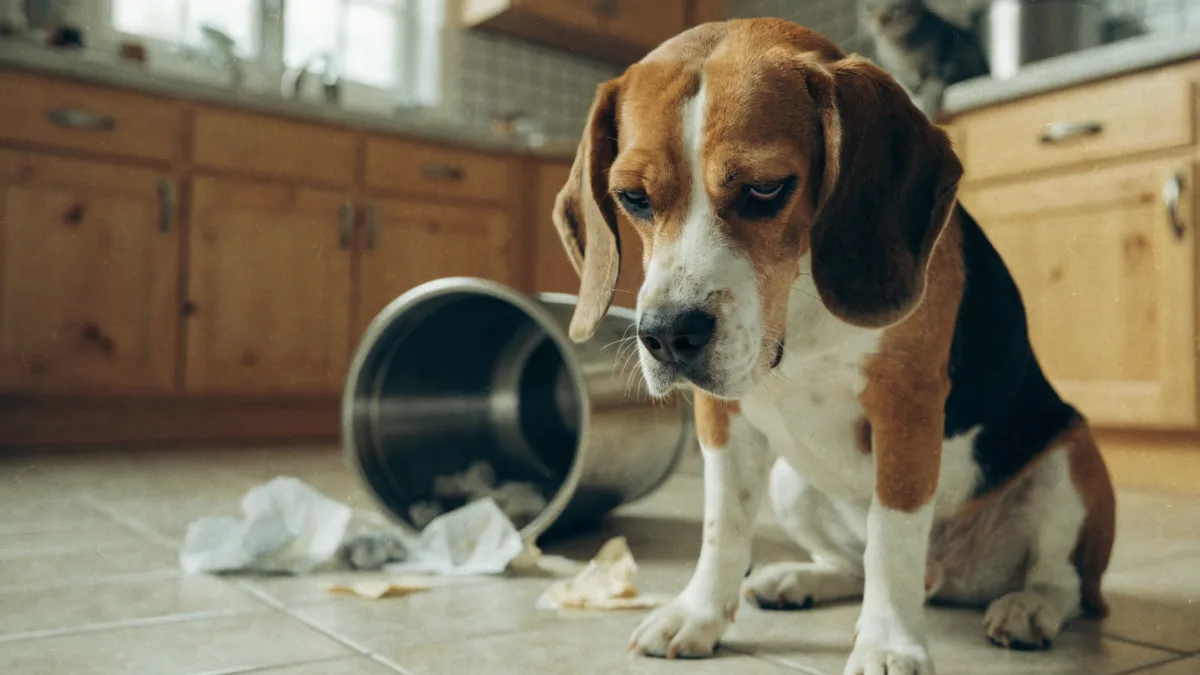
You walk through the front door after a long day at work. You immediately spot it: the kitchen trash can is knocked over, yesterday’s coffee grounds and eggshells scattered across the tile. Your dog is standing three feet away, head low, ears flat, tail tucked, looking up at you with those big, sad “I’m so sorry” eyes.
It’s a classic scenario. Every pet owner has seen it. You probably sighed, maybe pointed at the mess, and said, “What did you do?” It feels incredibly obvious. Your dog knows they did wrong, and they feel terrible about it. But here is the hard truth from a behavioral standpoint: that expression has absolutely nothing to do with the trash.
When we ask if our pets feel remorse, we are dealing with a classic case of anthropomorphism. We are projecting complex human emotions onto our furry friends. So, do dogs feel guilt? Or are we just reading their body language through a very human lens? Let’s break down what is actually happening inside your pet’s head.
The Science of the “Guilty Look”
To understand why your dog looks like they just committed a federal crime, we have to look at a landmark 2009 study by canine cognition researcher Dr. Alexandra Horowitz. Her research completely changed how we understand the guilty look in dogs.
In the study, owners were asked to tell their dogs not to eat a treat, and then they left the room. Some dogs ate the treat, and some left it alone. But here is where it gets interesting. When the owners came back, they were sometimes told their dog ate the treat, and sometimes told their dog left it alone—even if the opposite was true.
Here’s the kicker: dogs who were completely innocent still showed that classic “guilty” look if their owner scolded them or acted upset. On the flip side, dogs who actually ate the forbidden treat did not look guilty at all if their owner greeted them happily.
The conclusion was simple but profound. The guilty look isn’t a reflection of a dog feeling bad about a past action. It is a direct reaction to their owner’s current body language and tone of voice. They aren’t sorry about the trash; they are reacting to you.
The Language of Appeasement
If it isn’t guilt, what is it? In pet psychology, we call this “appeasement behavior.”
Dogs are incredibly skilled at reading human body language—far better at reading us than we are at reading them. When you come home and see a mess, your posture changes. Your jaw might tighten. Your eyes get wide, and your voice gets sharp. Your dog sees this shift instantly. They don’t think, “Oh no, I shouldn’t have knocked over that trash can two hours ago.” Instead, they think, “My human is really tense right now, and I need to diffuse this situation before it gets worse.”
To do that, they offer appeasement gestures. It’s the canine equivalent of saying, “I see you’re upset, I’m not a threat, please calm down.”
When your dog offers that “guilty” look, look for these specific physical cues:
- Averted gaze: Looking away or showing the whites of their eyes (often called “whale eye”).
- Lip licking: Flicking their tongue out, even if they haven’t eaten anything.
- Lowered posture: Making themselves physically smaller by crouching or rolling onto their back.
- Tucked tail: Pressing their tail flat against their belly.
- Paw lifting: Raising a single front paw while standing or sitting.
I used to completely misread this with a rescue mutt I worked with years ago. Every time I grabbed my keys to leave, he would start slinking around and licking his lips. I thought he was feeling guilty about something he had chewed up while I wasn’t looking. Turns out, he had severe separation anxiety. He wasn’t hiding a secret crime; he was terrified of me leaving. Once I stopped viewing his behavior through the lens of human guilt, I was able to actually address his underlying anxiety.
What About Cats? Do They Feel Remorse?
Let’s not leave the felines out of this. If you have a cat, you’ve probably seen them knock a glass off the table, look you dead in the eye, and then casually stroll away. But what about when you find a shredded roll of toilet paper in the hallway, and your cat is suddenly hiding under the bed?
Just like dogs, cats do not feel guilt in the human sense. Feline psychology is fundamentally different from ours. Cats are highly attuned to their environment and incredibly sensitive to sudden movements or loud noises.
If a cat knocks over a trash can and then slinks away when you walk in, they aren’t sulking in shame. They are displaying avoidance behavior. They have learned from past experiences that when there is a mess on the floor, their owner tends to get loud or aggressive. The cat isn’t running away because they feel bad about the mess; they are running away because they anticipate an angry reaction from you.
Primary vs. Secondary Emotions
To really wrap our heads around this, we need to look at how animal emotions actually work. Psychologists generally divide emotions into two categories: primary and secondary.
Primary Emotions
These are the basic, hardwired feelings that help an animal survive. Dogs and cats absolutely experience primary emotions. They feel:
- Fear
- Joy
- Anger
- Disgust
- Sadness
These emotions don’t require complex cognitive processing. A loud noise triggers fear; a juicy steak triggers joy.
Secondary Emotions
These are the complicated, self-reflective feelings that require a sense of self and an understanding of societal rules. Secondary emotions include:
- Guilt
- Shame
- Pride
- Spite
- Jealousy
To feel guilt, an animal needs a moral compass. They need to understand the abstract concept of “right” and “wrong” outside of what directly benefits or harms them. Science strongly suggests that dogs and cats lack the cognitive complexity in their prefrontal cortex to process these secondary moral emotions.
When a dog steals a piece of pizza off the counter, they aren’t plotting a malicious act of spite. They are acting on a primary drive: hunger, combined with a highly rewarding smell. They “know” they aren’t supposed to do it only in the sense that they have learned stealing food sometimes results in an unhappy owner. But in the moment, the reward of the pizza outweighs the risk of you getting annoyed later.
Why Punishing After the Fact Fails Miserably
Understanding that pets don’t feel guilt isn’t just a fun science fact. It completely changes how you should approach training and behavior modification.
Because dogs and cats don’t process remorse, punishing them after the fact is completely ineffective. Let’s say you come home to a chewed-up sofa cushion. You drag your dog over to the mess, point at it, and yell.
Here is what happens in your dog’s mind: They are not connecting the punishment to the fact that they chewed the cushion three hours ago. They are only connecting the punishment to the fact that you arriving home means bad things happen. You aren’t teaching them not to chew the couch. You are teaching them to be afraid of you when you walk through the door.
This is why you’ll often see a dog looking perfectly fine and relaxed until you discover the mess. The moment you see it and your demeanor changes, the appeasement behaviors kick in. It’s a self-fulfilling prophecy. You get mad because they look guilty, and they look guilty because you’re getting mad.
If you want to stop unwanted behaviors, you have to catch them in the act, or better yet, prevent them from happening in the first place. If your dog gets into the trash when you’re at work, buy a locking trash can or put it in the pantry. Manage the environment. Don’t rely on a moral conscience that simply isn’t there.
If Not Guilt, Then What Do They Feel?
Just because dogs and cats don’t feel guilt or spite doesn’t mean they are unfeeling robots. They possess a rich tapestry of social emotions. In fact, while they may lack secondary moral emotions, research confirms they absolutely do feel jealousy.
Studies have shown that dogs exhibit clear signs of jealousy when their owners show affection to a rival—like a realistic stuffed dog. They will push, nudge, and try to get between the owner and the fake dog. This highlights that their emotional range is highly tuned to resource guarding, social bonding, and affection.
There is also an ongoing debate in the animal behavior world regarding a rudimentary sense of “fairness” in dogs. In famous tests, researchers had two dogs perform the same trick (give a paw). One dog got a delicious piece of sausage. The other dog got nothing, or a boring piece of bread. Very quickly, the dog getting the lesser reward refused to keep giving their paw, showing clear signs of frustration at the unequal treatment.
However, the general scientific consensus remains that this sense of inequity is rooted in primary expectations of reward, not a complex human sense of moral fairness.
Shifting Our Perspective
For a long time, outdated training philosophies relied on the “spiteful dog” myth. If a dog peed on the rug, they were being dominant. If they chewed a shoe, they were acting out of revenge for being left alone. Modern veterinary behaviorists have actively campaigned against this narrative, shifting the focus to fear, anxiety, and appeasement.
Misinterpreting appeasement behaviors as guilt actually harms the human-animal bond. When you assume your pet is acting out of spite, you get angry. When you realize your pet is just acting like an animal driven by instinct and reacting to your stress, you can approach the situation with empathy.
Ultimately, our pets don’t need to feel guilty to be good companions. They just need us to understand them for exactly who they are: brilliant, emotional, instinct-driven creatures that are doing their best to navigate a human world. When you stop expecting your dog or cat to process the world like a human in a fur suit, you open the door to a much deeper, more honest relationship with the animal sitting right in front of you.