

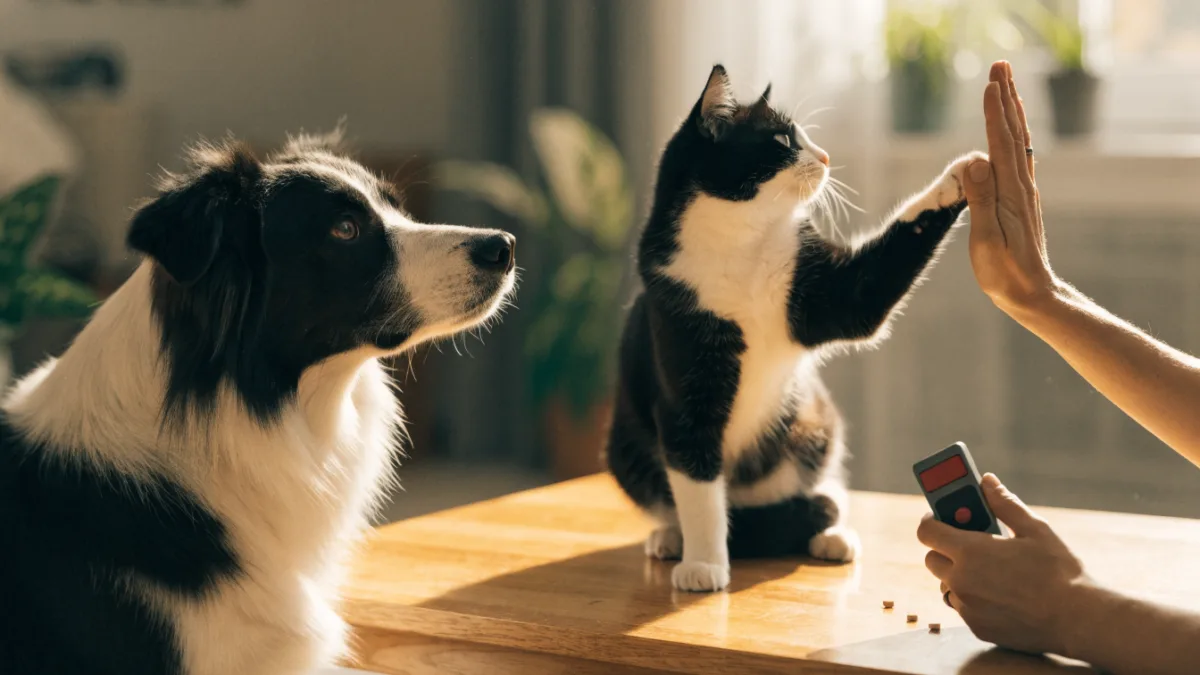
The first time I clicked a clicker in front of a cat, he ignored it. The second time, he knocked it off the coffee table and left the room. Ten days later he was sitting on cue and giving high fives — and his owner, a lifelong “cats can’t be trained” person, sat on the kitchen floor staring at him like he’d just filed her taxes.
That’s the thing about marker training. It’s not a dog technique or a cat technique. It’s one mechanic — mark the exact moment your pet does something right, then pay them — and it works across species, from Border Collies to barn cats to belugas. So whether you’re deep into clicker training for dogs, side-eyeing the whole idea of clicker training cats, or just looking for a positive reinforcement method that doesn’t involve force, here’s how it works and exactly where to start.
What That Click Actually Means
A click means nothing on its own. It’s a plastic noisemaker until you build the association — and that’s the first step. Trainers call it “charging” the clicker: click, treat. Click, treat. About 10–20 repetitions and your pet’s brain connects the two.
The marker signal’s job is to announce that a reward is coming — it bridges the exact moment of the correct behavior and the moment the payoff arrives.
That’s why behavior folks call it a conditioned reinforcer or a bridging stimulus.:[1] the marker connects behavior to reward with precision that praise alone can’t match.
Here’s the part most beginners get wrong: timing. The click has to land within a second or two of the behavior, or your pet connects it to whatever they’re doing right now. Early on, my timing was rough. I meant to click a terrier’s sit and caught the moment he stood back up instead. Guess what he learned brilliantly? Standing up after sitting. The click is a promise — whatever was happening when it fired gets paid.
Two rules that never bend:
- One click = one treat. Even if you clicked by mistake. Especially if you clicked by mistake.
- The click ends the behavior. Once it fires, your pet is released. The paycheck is coming.
This isn’t fringe science, either. It descends from B.F. Skinner’s operant conditioning, and his students Keller and Marian Breland reportedly used it on tens of thousands of animals across more than 140 species back in the 1940s and 50s. Ex-dolphin trainer Karen Pryor brought it to pet dogs with Don’t Shoot the Dog in 1984. A 2003 controlled study found dogs taught a targeting task with a clicker plus food learned faster than dogs paid in food alone — though follow-up research has been mixed, and I’ll be honest about where the click really earns its keep: shaping. That’s rewarding tiny approximations toward a behavior the animal wouldn’t offer whole. You don’t wait for a perfect wave; you click a weight shift, then a lifted paw, then two inches off the ground.
The Starter Kit (It’s Small)
- A clicker. Get a push-button style (quieter, softer sound) and maybe a box-style one (louder, sharper). They cost next to nothing.
- A treat pouch that opens with one hand, because fumbling kills momentum.
- Pea-sized high-value treats. Kibble rarely cuts it for training. For cats: lickable treat tubes or tiny bits of tuna.
- A target stick — or just a wooden spoon. Works fine.
- A mat or towel for station training later.
- A quiet room with minimal distractions for the first few sessions.
Clicker or just say “Yes”?
A crisp verbal marker is a legitimate substitute —.[2] The clicker’s edge is consistency: it sounds identical every time, it’s emotionally neutral, and it never gets buried in the daily chatter your voice carries. Controlled studies suggest the advantage shrinks for simple behaviors with well-timed markers, so use what suits you. My take: click when you’re shaping precision, verbal marker when your hands are full.
If the sound spooks your pet
Some dogs and cats find the metallic snap genuinely aversive. Don’t test it two inches from their face. Use a quieter push-button clicker, click inside your pocket, muffle it, or drop to a tongue click. One cat I worked with cleared the room at the box clicker’s snap — we switched to a soft push-button model and he was volunteering within a session.
Your First Session With a Dog
Five minutes, max. End before your dog wants to end.
Step 1: Charge the clicker
Click, treat. No command, no expectation. Ten to twenty reps. Test it: click when your dog’s looking away. If the head snaps around, the circuit’s built.
Step 2: Name game
Say the name, click the head turn, deliver the treat up at your eye line. You’re teaching attention, and attention is the currency everything else gets bought with.
Step 3: Lured sit
Treat at the nose, move it slowly back over the head. Click the instant the rear hits the floor — not during, not after. Then toss a treat away to reset for another rep.
Step 4: Hand target
Flat palm near the nose. Click the nose-touch. This sounds trivial; it isn’t. A solid hand target becomes your leash-walking reset, your crate loader, your “look at me instead of that squirrel” button.
A friend’s cattle dog mix, Roo, learned the hand target in one five-minute session in her kitchen. Three weeks later she used it at the vet’s office to walk him onto the scale — the same dog who used to pancake at the exam room door. No force, no drama. She just had a way to tell him exactly what earned the payoff.
Your First Session With a Cat (Yes, Really)
For the skeptics: a 2017 shelter study found cats learned to sit, spin, and high-five in under 15 minutes of cumulative training time. Total. Across sessions. Cats aren’t untrainable — they’re just running a different business model, and the terms are non-negotiable:
- Sessions run one to three minutes. Two short sessions a day beat one long one, every time.
- Train before meals, not after. A full cat is a retired cat.
- The cat initiates. If they walk away, the session’s over. No chasing them around with a spoon.
- Pay seriously. Lickable treat tubes, tuna, tiny chicken bits.
Step 1: Charge the clicker
Same as the dog. Click, treat. Some cats get it in five reps, some need a few sessions. No rush.
Step 2: Spoon target
Smear a lickable treat on a wooden spoon. Your cat follows it — and now you can move a cat around a room, into a carrier, onto a mat, without laying hands on them.
Step 3: Capture a sit
Cats sit constantly. Click the moment the rear hits the floor, then treat. Within a session or two, most cats figure out the sit is the vending machine code.
Step 4: Paw target
Present a flat hand down low, click the paw touch, pay. This is the first brick in nail-trim training: paw in hand, then hold the paw one second, then touch the clippers to a nail while the lickable tube is running. Small steps, heavily paid.
One of my favorite cases was Smudge, a gray tabby whose nail trims used to require two people, a towel, and a sincere apology. Six weeks of two-minute sessions later, his owner was trimming claws while he worked a treat tube, calm as a Sunday. Smudge hadn’t gotten braver. He’d gotten paid, and he understood the deal.
Beyond Tricks: The Stuff That Actually Matters
Tricks are the gateway. The real payoff is cooperative care — marker-trained animals voluntarily participating in medication, carriers, handling, and vet procedures. Zookeepers use these exact mechanics to get voluntary blood draws, injections, and ultrasounds from rhinos, sea lions, and tigers. Your kitchen sits and the tiger presenting a tail for a needle run on the same playbook: mark precisely, pay reliably.
The welfare case is solid, too. Reward-based training is consistently linked to fewer problem behaviors and lower stress than punishment-based approaches, and a 2020 study found dogs trained with aversive equipment showed elevated cortisol and more pessimistic behavior than dogs trained with rewards. The American Veterinary Society of Animal Behavior formally endorses reward-based methods.
Three myths worth burying:
- “He’ll only behave when I’m holding the clicker.” The clicker is a teaching tool, not a prosthetic. Once a behavior is on cue, you fade it — intermittent treats and praise take over.
- “Cats can’t be trained.” Fifteen cumulative minutes and a tuna-smeared spoon say otherwise.
- “Treats are bribery.” It’s payment. You work for a paycheck. Nobody calls it bribery when you show up on Friday.
And if you’re switching over from force-based methods — like the folks I see,[3] honestly unsure whether training without correction counts as “real” training — the awkwardness you feel at first is normal and temporary. It fades faster than you’d think, usually around the first session where your dog figures something out before you’ve finished setting it up.
Here’s the takeaway: the click changed everything because it’s honest communication, not control. Mark the moment, pay the bill, end on a win — that works whether your student weighs eight pounds or eighty. And every time you click and treat in your kitchen, you’re running the same science that lets zoo and rehabilitation teams give endangered animals a say in their own medical care, no sedation or restraint required. That’s the legacy you’re tapping into. So pay your animal well, keep your clicks truthful, and don’t let anybody tell you cats can’t learn.
Sources
- Four Paws puts it plainly — four-paws.org
- plenty of trainers run both — reddit.com
- posting in force-free groups — facebook.com