
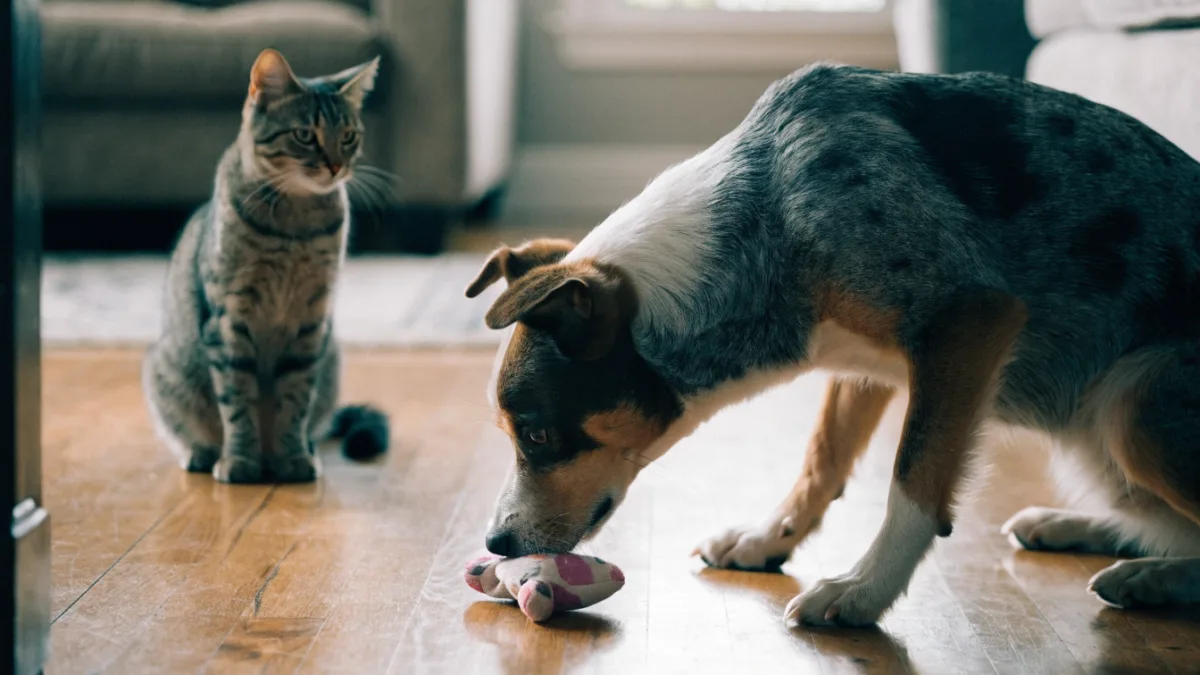
Picture this. You’ve got a Lab named Moose and a cat named Biscuit. Most days, they’re fine. Moose snores on the rug. Biscuit minds her business. But the second you hand Moose a bully stick, the whole energy in the room shifts. His body stiffens. His eyes harden. Biscuit wanders past on her way to the litter box, and Moose lunges with a bark that rattles the windows.
That’s resource guarding. And in a multi-species household, it’s one of the most common — and most misunderstood — problems you can run into.
What Resource Guarding Really Is (And What It Isn’t)
Resource guarding isn’t about your dog being “mean.” It’s not a dominance play. It’s a survival instinct, plain and simple — the same instinct that kept wild canids alive when food was hard to come by and another animal approaching your meal could mean going hungry for a week. That drive doesn’t disappear just because your dog eats premium kibble from a ceramic bowl.
In technical terms, resource guarding describes the set of behaviors an animal uses to maintain access to something they value while keeping perceived threats away. That something could be food, a chew toy, a sleeping spot, or even a favorite person. The perceived threat could be another dog, a cat, a child, or you.
Here’s what most people miss: guarding rarely starts with a bite. It escalates. First comes the subtle stuff — a stiffen of the body, hard eye contact, closed mouth. If that doesn’t work, the dog adds vocalizations: a low growl, a warning bark. Only when those earlier signals are repeatedly ignored or suppressed does the behavior climb to snapping, lunging, and actual contact. Patricia McConnell’s work on dog-to-dog resource guarding lays this progression out clearly, and it’s essential reading if you’re living with more than one animal under your roof.
Management Before Training
Physical Separation Is Your Best Tool
Your first job isn’t training. It’s management. You need to prevent the guarding behavior from happening while you work on changing the underlying emotions.
Physical barriers are your best friend here. Baby gates, exercise pens, and closed doors let you control who has access to what and when. Feeding time is the obvious place to start. If your dog guards their food bowl, feed them in a separate room with the door closed. Same goes for high-value items — bully sticks, stuffed chew toys, real bones. Don’t hand your dog a premium chew in the same cramped room as your cat and cross your fingers. That’s not management. That’s gambling.
GPS tracking collars — the kind that monitor location without delivering any correction — can add a layer of safety if you’re managing animals with outdoor access. They let you keep tabs on where each animal is without needing eyes on all of them constantly. Look for collars with reliable connectivity, waterproof casing, and accurate real-time tracking. But remember: a GPS collar tells you where your dog is. It doesn’t change how they feel about the cat walking past their food.
The Invisible Fence Problem
Some resources mention invisible fencing as a management tool for separating animals. I want to address this head-on because it’s a genuine point of controversy in the behavior world.
Invisible fences work by delivering an electric shock when a dog crosses a buried boundary line. On paper, it keeps the dog contained. In practice, there’s a serious problem — especially in multi-species homes. When a dog receives a shock, they associate that pain with whatever they happen to be looking at in that moment. If your dog gets zapped while watching your cat stroll across the yard, they may start linking the cat to pain. Instead of reducing tension, you’ve just poured fuel on the fire.
This is why I don’t recommend invisible fences or any shock-based containment for dogs with guarding tendencies, especially in multi-pet households. Stick with physical barriers you can see and control.
Changing the Emotional Response
The Trade-Up Game
Here’s where the real work happens. The goal isn’t to teach your dog that guarding is wrong. The goal is to change how they feel when another animal approaches their stuff. You want your dog to see the cat walking toward their bowl and think, “Oh sweet, here comes the bonus food.”
The trade-up game is simple in concept. When your dog has something they value, you approach with something better. Kibble in the bowl? Offer a piece of real chicken. Standard chew toy in their mouth? Offer a smear of peanut butter on a lickable rubber toy.
Here’s how it plays out in real life. I worked with a German Shepherd who guarded her food bowl from the family’s senior cat. The cat wasn’t even interested in the food — she just liked walking through the kitchen at mealtimes. But the dog read every pass-by as a potential theft. We started by having the cat on the far side of the room, well within the dog’s sight but far enough away that the dog didn’t tense up. Each time the cat appeared, we dropped a chunk of boiled chicken into the dog’s bowl. Within a few weeks, the dog’s body language shifted completely. Instead of stiffening when the cat entered the kitchen, her tail started wagging.
This isn’t just anecdotal. A study published in Applied Animal Behaviour Science found that something as straightforward as adding palatable food to a dog’s regular meals reduced resource guarding behaviors. The higher-value food increases the reward of the meal while simultaneously lowering the anxiety of losing it. The dog stops feeling like they need to defend and starts feeling like they’re winning.
Teaching a Solid “Drop It”
If your dog grabs something they shouldn’t have — or if you need to remove a high-value item before another pet gets too close — you need a reliable way to get it without a fight. That’s where “drop it” comes in.
Never just grab. Reaching into a dog’s mouth or snatching something away is the fastest way to intensify guarding. Instead, teach your dog that releasing an item earns them something better.
Start with low-value stuff. Hand your dog a boring toy. Hold a treat under their nose. When they open their mouth to take the treat, say “drop it” and let the toy fall. Pick up the toy, hand over the treat, then give the toy back. That last part matters more than people think. Your dog needs to learn that giving something up doesn’t mean losing it forever. Once the concept is rock-solid with boring items, you can gradually work up to higher-value things.
Five Mistakes That Make Guarding Worse
1. Punishing the Growl
This is the big one. When your dog growls, the instinct to correct them is strong. Resist it. A growl is information. Your dog is telling you they’re uncomfortable and asking for space. If you punish the growl, you haven’t fixed the anxiety driving it — you’ve just muted the warning system. Now you’ve got a dog who feels just as threatened but skips straight to biting. That’s how serious incidents happen.
2. Letting Them “Work It Out”
The “they’ll sort it out themselves” approach gets animals hurt. A 12-pound cat and an 80-pound dog aren’t negotiating on equal footing. Your job is to manage the environment so the conflict doesn’t happen in the first place. There’s no glory in letting animals figure it out through intimidation or force.
3. Feeding Everyone in the Same Tight Space
If your kitchen is small and you’re feeding three animals within arm’s reach of each other, you’re manufacturing stress. Give each animal their own space. Separate rooms, physical barriers, different feeding times — whatever it takes. This isn’t overkill. It’s basic courtesy.
4. Inconsistent Boundaries
If the couch is sometimes “yours” and sometimes “the dog’s,” you’re creating unpredictability. Dogs do better with clear, consistent patterns. Manage the environment the same way every day while you work through the training process.
5. Assuming It’s Only About Food
Food is the most common trigger, but dogs guard all kinds of things. Toys, beds, specific spots on the floor, trash cans, and even particular people. Pay close attention to what sets your dog off in your specific household. The triggers might surprise you.
Here’s what I want you to take away from all this. Resource guarding doesn’t mean your dog is broken. It doesn’t mean you’re a bad owner. It’s a natural behavior with deep roots in survival instinct — the same instinct that kept your dog’s wild ancestors alive. A 2018 study by JA Jacobs confirmed something I’ve seen play out in countless homes: resource guarding can be actively modified and reduced through behavioral intervention. Not through force, not through punishment, but through trust, management, and changing the emotional response one repetition at a time.
Start with management. Separate the animals during high-value moments. Control the environment so your dog doesn’t feel the need to guard. Then build new associations using trades, treats, and patience. If the guarding is severe or you’re seeing actual aggressive incidents, find a qualified professional who uses positive reinforcement methods. There’s no shame in getting help — and no substitute for hands-on guidance when safety is on the line. Your dog isn’t trying to be difficult. They’re trying to protect what matters to them. Your job is to show them they don’t have to.