

My neighbor’s Golden Retriever, Biscuit, treats the neighborhood pool like a personal water park. She launches herself off the edge before anyone can stop her, retrieves toys until her humans are visibly tired, and basically transforms into an aquatic missile the moment she sees anything resembling a body of water. Then there’s my friend’s French Bulldog, Mochi, who once stepped into a shallow backyard kiddie pool, panicked immediately, and somehow ended up floating backward like a very distressed hairy buoy. Two dogs. Two wildly different relationships with water. And honestly? Both reactions tell us something important about the myth we’ve all been sold about dogs and swimming.
The Instinct Is Real. The Execution? Not Always.
Let’s give the myth its due first. The phrase “doggy paddle” exists for a legitimate reason. Dogs and cats are quadrupeds—they walk on four legs. When most four-legged animals find themselves submerged in water, their instinct is to do exactly what they do on solid ground: move those legs in a walking or trotting motion. That reflexive leg movement is what we call paddling, and it’s genuine. The mechanical structure of a four-legged body is naturally suited to this motion in a way that our upright bipedal bodies are decidedly not.
But here’s where people get into trouble: they confuse the reflex with the ability. Paddling is instinctive. Actually swimming—keeping your head above water, controlling your breathing, staying oriented, moving toward an exit, not exhausting yourself in three minutes—is a skill. And for some dogs, it’s a skill their bodies simply won’t support, no matter how much they want to comply.
This brings me to the old “just throw ’em in, they’ll figure it out” approach. I’ve heard people say this at barbecues like they’re dispensing ancient wisdom. They’re not. They’re describing a great way to terrify an animal, cause them to inhale water, and potentially create a fatal situation. A panicked dog thrashing in deep water isn’t learning anything except fear. Proper introductions to water should be gradual, positive, and happen in water shallow enough that the dog can stand. If you want specific training protocols for introducing a dog to water, that’s Jake’s department—my expertise starts and ends with “don’t throw your pet into a pool.”
Bulldog Water Safety: When Physics Becomes a Problem
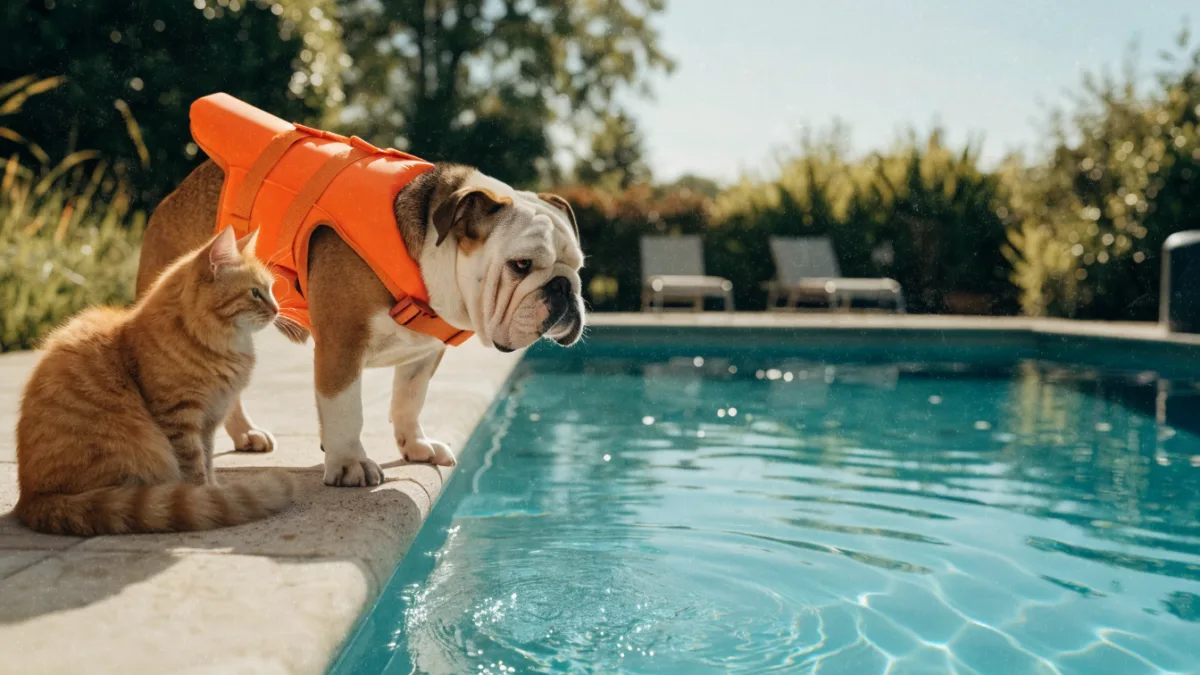
Now we need to talk about the breeds that turn the “all dogs can swim” myth into something genuinely dangerous. Brachycephalic dogs—Bulldogs, Pugs, French Bulldogs, Boston Terriers—those wonderful squishy-faced companions we all love are essentially built to sink. I know that sounds harsh, but it’s physics, not opinion.
Think about what’s happening anatomically. These dogs have heavy heads relative to their body size, shortened airways that already struggle with efficient breathing on dry land, and dense body structures without much natural buoyancy. Their respiratory system is compromised before they ever touch water—that’s why they snore, wheeze in heat, and can’t do extended exercise. Now add water. They have to work harder to breathe while trying to keep their nose above the surface, but their heavy head tilts them forward, nose-down. That’s the exact opposite of what you want happening in water.
So here’s the rule, and I’m not flexible about this: brachycephalic dogs should never be in or near water without a properly fitted canine life jacket, and they should never be left unattended near a pool. Not for thirty seconds. Not while you grab a towel. Bulldogs can drown in the time it takes to answer a text message.
The pet safety industry has actually made impressive strides here. Modern life jackets designed for flat-faced breeds now feature extra buoyancy material concentrated around the neck and chest, which counteracts that top-heavy anatomy and keeps their airway tilted upward. If you have one of these dogs and you’re anywhere near water, invest in one. Look for a jacket with a chin float to keep the head above water, a sturdy handle on the back for emergency lifts, and bright colors so you can spot them instantly.
The Other Sinkers
It’s not just the flat-faced crew. Greyhounds, Whippets, Dobermans, and other deep-chested, low-body-fat breeds also struggle. They’re built for speed on land, not flotation in water. Body fat helps with buoyancy—it’s a big part of why Portuguese Water Dogs and Chesapeake Bay Retrievers float so naturally. Lean, muscular breeds with deep chests simply don’t have the natural floatation to stay at the surface comfortably. They can often learn to swim with support and gradual training, but they’ll always need more assistance than a breed literally designed for water work.
Can Cats Swim? Yes, and It’s Fascinating
This is the part that genuinely delights me. Most cat owners will tell you, with absolute certainty, that their cat cannot swim. They base this on the dramatic performances their cats deliver during bath time—the yowling, the clinging, the look of utter betrayal. But here’s what’s actually true: cats are physically capable swimmers. They just would genuinely rather do almost anything else.
When a cat ends up in water, their survival instincts engage immediately and efficiently. They lift their head high, stretch their neck upward, and use all four paws to tread water in a motion that is unmistakably a “kitty paddle.” It’s not frantic. It’s controlled, deliberate, and surprisingly graceful. If there’s an exit within reach, they’ll find it and head straight for it.
So why do cats despise water so intensely? Several reasons, and they’re all very cat. First, when a cat’s fur becomes waterlogged, it becomes heavy, uncomfortable, and compromises their agility—which, for a species that relies on quick reflexes for safety, feels deeply wrong. Second, cats are meticulous groomers. Wet fur means hours of undignified re-grooming, and that’s simply not acceptable in the feline social order. My cat Olive once got accidentally splashed by a passing dog at the beach, and she gave me a look of such profound offense that I’m still, months later, not fully forgiven.
But in the wild? Many cat species don’t just tolerate water—they excel in it. Tigers are powerful swimmers who use rivers and lakes to cool off and sometimes hunt. Jaguars regularly pursue prey in waterways. There’s a wild feline species called the Fishing Cat—found in wetlands across South and Southeast Asia—that literally dives into water to catch fish. It’s built for an aquatic lifestyle in a way your housecat isn’t, but the underlying capability is there across the family. Your cat’s hatred of the bathtub isn’t about physical inability. It’s about dignity.
Pool Safety: What Every Household Needs to Know
Whether you have a water-obsessed Lab or a Bulldog who should never be deeper than a puddle, here are the essentials that apply to every household with pets and access to water.
Teach Them the Exit
This is the single most important thing you can do for any pet around a pool. When a dog falls into water, their instinct is to paddle to the nearest edge and try to claw their way over it. Most pools don’t have edges a dog can climb. They need to know where the steps are. Walk your dog into the pool via the shallow steps, let them feel where the exit is, and practice finding it from different points in the pool. This works for cats too—if your cat has outdoor access near a pool, they need to know where the stairs or ramp are located.
Install an Animal Escape Ramp
Pool ramps designed for animals have gotten genuinely excellent. These attach to the pool edge and provide an angled surface that pets—and local wildlife—can use to climb out. If a raccoon, a neighbor’s escaped cat, or your own pet falls in at night when no one’s watching, that ramp is the difference between a close call and a tragedy. If you own a pool, this isn’t a luxury accessory. It’s basic responsibility.
Know When Something Is Wrong
A dog that’s swallowing water, coughing, or going vertical—front paws paddling frantically while their back end sinks—is in trouble. Get them out immediately. Even dogs that seem fine after a scary moment in the water can develop respiratory issues hours later, so talk to your vet about warning signs if your pet has had a near-drowning experience.
Respect Your Pet’s Limits
Some dogs will never enjoy swimming, and that’s fine. Forcing a reluctant dog into deep water doesn’t build confidence—it breaks trust. Similarly, forcing a hydrophobic cat into water for “desensitization” often backfires badly, damaging the bond you’ve built. There’s a difference between gentle exposure and coercion. Know where that line is with your specific animal.
Here’s the takeaway: the natural world is more nuanced than the myths we tell about it. Not every dog is a swimmer, cats are more capable than we assume, and both species deserve to be around water on terms that respect their anatomy and their preferences. And while we’re talking about aquatic abilities—those wild cat species that actually thrive in water, like the endangered Fishing Cat, depend on wetland habitats that are disappearing fast across Asia. When we protect wetlands, we’re not just saving abstract ecosystems. We’re saving animals that have mastered something our own pets can only dream of: living comfortably in two worlds at once.