
I’ll never forget the first time I put a highly reactive German Shepherd into a scent work class. The owner was exhausted. She had been walking this dog five miles a day, trying to drain his energy, but he was still a nervous wreck around strangers and new environments. We brought him into the training room, set out six cardboard boxes, and put a piece of freeze-dried liver in one of them. Within ten minutes of sniffing, this dog was panting, drooling, and entirely focused on the task. By the end of the hour, he was fast asleep on his mat. His owner looked at me like I had performed a magic trick. I hadn’t done anything special. I just unlocked his nose.
Most people completely underestimate how much brainpower it takes for an animal to process scent. Humans have roughly five to six million olfactory receptors. Dogs have up to 300 million. The part of a dog’s brain dedicated to analyzing odors is proportionally 40 times larger than ours. Cats aren’t slouches either, packing an estimated 40 to 80 million receptors into those tiny noses. When your dog stops to sniff a fire hydrant, they aren’t stalling. They are reading a highly detailed, invisible biography of every dog that has passed by that day.
Because processing all that data requires massive cognitive effort, scent work is uniquely exhausting. A solid 10 to 15 minutes of active sniffing can tire out a dog just as much as a 30-to-45-minute brisk walk. It is the ultimate life hack for rainy days, senior dogs with mobility issues, or puppies with endless energy. Even better, it is one of the few dog sports that is entirely inclusive. Blind, deaf, or three-legged dogs can compete and excel at the highest levels because this game doesn’t require visual cues or perfect physical compliance. It just requires a nose.
The Foundation: Why You Need to Stop Talking
If you want to try nosework, you have to change your entire approach to training. Most basic obedience relies on luring. You take a piece of food, hold it in front of the dog’s nose, and move your hand to guide them into a sit. Scent work is the exact opposite. You have to stand back, keep your mouth shut, and let the dog figure it out independently.
I used to make this mistake constantly. I would point at the box. I would tap the floor. I was basically doing the puzzle for the dog. But when you do that, the animal is just following your visual cues, not actually using their brain to hunt.
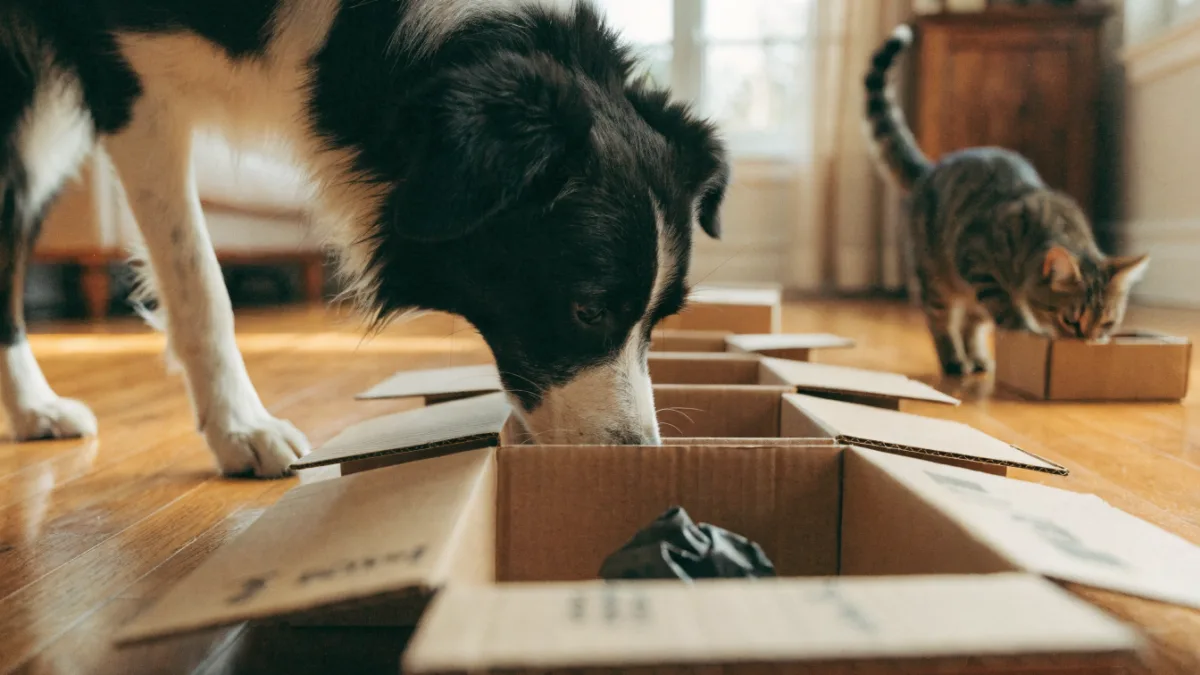
You start with the classic “box game.” You don’t need any fancy equipment for this. Grab four or five cardboard boxes of different sizes and scatter them on the floor. Have your dog sit or wait in another room. Take a high-value treat—something stinky like liver, hot dog, or a favorite toy—and place it inside one of the boxes. Walk away from the box, ideally making a wide loop so you don’t leave a direct human scent trail right to the prize.
Bring your dog into the room on a standard leash and just stand still. Don’t point. Don’t talk. Let them investigate. When they inevitably put their nose in the correct box and grab the treat, mark the behavior with a word like “Yes!” or “Find it!” and throw a massive party.
Leveling Up: Building Your DIY Scent Kit
Once your dog understands the concept of searching for food in boxes, you can transition them to searching for a specific essential oil. In organized canine sports like [1] or AKC Scent Work, dogs are trained to target specific scents: Birch, Anise, Clove, and Cypress.
You can build your own scent kit at home in about ten minutes. You do not need to buy a pre-packaged, expensive kit, but you do need to be specific about your materials. Here is what you need to look for:
- Essential Oil: Start with Birch. It is the standard starter scent for most organizations.
- Cotton Swabs: Cut standard cotton swabs in half. The paper or wooden shafts work best. These will absorb the oil.
- Tweezers: You absolutely need a pair of metal tweezers to handle the swabs. If you touch the swab with your bare fingers, your hands will transfer human scent onto the cotton. Before you know it, your dog will be alerting to the smell of your fingertips instead of the oil.
- A Glass Jar: Store your oil-soaked swabs in a small glass jar with a tight-fitting lid. Plastic absorbs odors over time, which will ruin your materials.
- Scent Vessels: Look for small, secure plastic or metal containers with holes punched in the top. Magnets or straps designed to hold the vessel securely under a box flap or behind a chair are ideal. You want something the dog cannot easily open or swallow.
To prepare your scent, put a few drops of Birch oil onto your cotton swabs using the tweezers, drop them in your glass jar, and seal it tight. Let it cure for a day or two. When you are ready to train, use your tweezers to place one swab into your scent vessel, hide the vessel, and let your dog hunt. When they find it, reward them with a treat right at the source.
A Major Warning on Essential Oils
We need to have a serious chat about safety. Many essential oils are highly toxic to pets. Dogs and especially cats lack the specific liver enzymes required to properly metabolize many of these compounds.
You must never allow your dog or cat to ingest essential oils. The oils must be heavily diluted, and the scented swabs must be locked inside secure scent vessels that the animal cannot open. If you are doing an outdoor search in the grass, make sure you retrieve the vessel when the dog is done. Never leave a cotton swab sitting out in your home or yard.
Feline Scent Work: Tapping Into the Predator
People look at me like I’m crazy when I tell them they can train their cat to do scent work. But cats are highly scent-driven predators. Scent work for felines taps directly into their ingrained instinct to stalk, hunt, and forage. The recent surge in structured feline scent training on social media isn’t just a cute trick; it is a massive leap forward in indoor cat enrichment.
For cats, you don’t need to mess with essential oils at all. Skip them entirely. Stick to food and herbs.
You can start by hiding high-value treats—like freeze-dried meat—in small boxes or toilet paper tubes. You can fold the ends of the tubes over to make it slightly more challenging. As the cat gets better at the game, invest in some puzzle feeders or hide their favorite targets under small plastic cups. You can also use catnip or silvervine as a target scent.
There is one critical rule for training cats: keep the sessions incredibly short. Cats will frustration-paint your walls if you make the game too hard. Two to three minutes of active searching is a full workout for a house cat. If they start swatting the boxes around or walking away, the session is over. You want to end on a win while they are still engaged.
The Takeaway for You and Your Pet
You don’t have to compete to reap the benefits of this sport. [2] at home are just as beneficial as organized trials. Scent work builds profound confidence in shy or anxious animals. It reduces boredom, alleviates symptoms of separation anxiety, and strengthens the bond between you and your pet because you are finally communicating in a language they inherently understand.
When you watch your dog or cat confidently work a room, systematically eliminating empty boxes to find that one hidden target, you are watching a highly refined survival skill in action. These are the exact same skills utilized by professional conservation detection dogs. Out in the real world, those professional dogs use their noses to track the scent of endangered wildlife, locate invasive plant species, and help conservationists protect vulnerable ecosystems. Every time you hide a scent vessel in your living room, you are honoring that ancient, vital partnership. So grab some cardboard boxes, cut up a few cotton swabs, and let your dog or cat show you exactly what their nose was built to do.
Sources
- K9 Nose Work® — bestfriends.org
- Casual "find it" games — akc.org