
I used to have a client with a young Vizsla. High energy, bouncing off the walls. The owner would run her five miles every single morning, come home, and the dog would still be pacing the living room and chewing up the baseboards. The owner was exhausted. The dog was just building better cardio. If you’ve ever lived with a working breed, a herding dog, or a high-drive terrier, you’ve probably lived this exact nightmare. You try to physically exhaust them, and somehow, you just end up with a fitter, more energetic animal.
What finally solved the Vizsla’s behavior wasn’t more miles on the sidewalk. It was 15 minutes of sniffing.
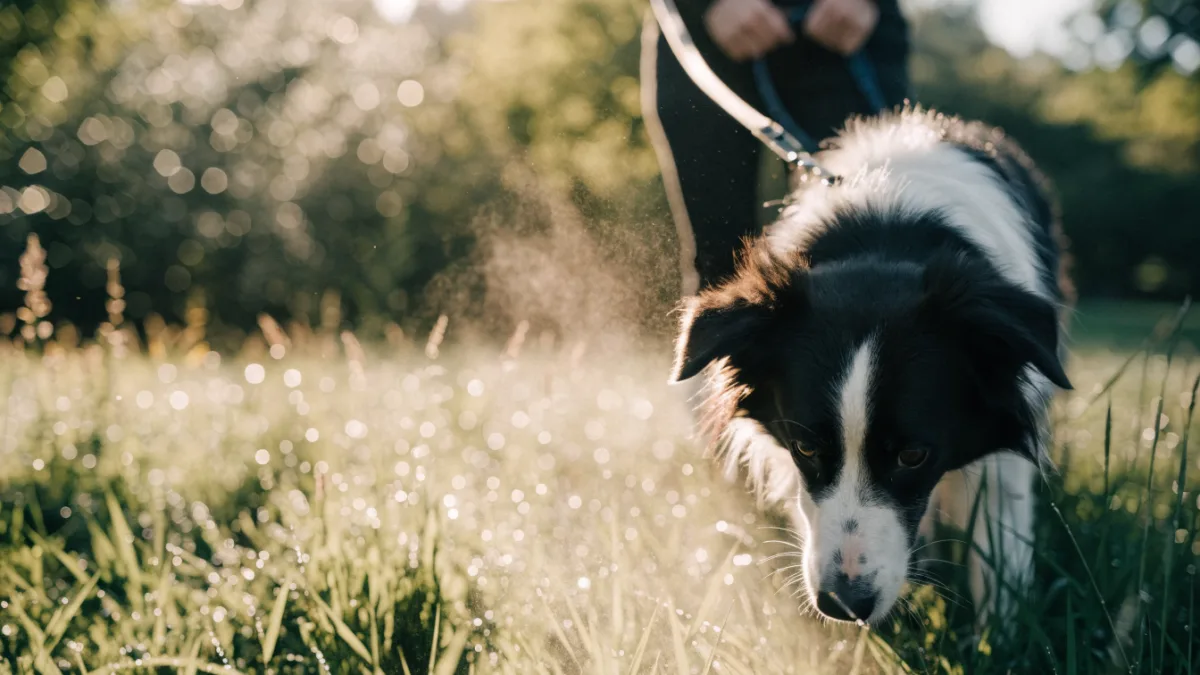
Welcome to the “sniffari.” It flips the script on traditional pet ownership. Instead of focusing on physical distance or a brisk pace, the goal is to let your dog lead and process the environment through their nose. And if you think mental exhaustion is just a dog thing, think again. Cats need it too, but they play the scent game by totally different biological rules.
Rethinking the “Good Boy” Walk
We get obsessed with the idea of a perfectly behaved dog on a leash. For a lot of people, that means strict obedience. Eyes forward, perfect pace, no stopping. If the dog drops their nose to the grass, it’s viewed as a lack of discipline.
Let’s be real for a second. If someone dragged you through an art museum blindfolded, you wouldn’t enjoy it. You’d probably be frustrated and burnt out. When we force our dogs to march past every bush, fire hydrant, and patch of dirt without stopping, we are doing exactly that..[1] It is a biological necessity.
Physical exercise is great, but it has a ceiling. If you only ever run your dog, you’re just building their physical endurance. They get more stamina, which means they eventually need even more exercise to get tired. It’s an endless cycle.
Mental exhaustion is completely different. Fifteen to 20 minutes of focused scent work can mentally exhaust a dog just as much as a long physical walk. You’ll notice the difference immediately when you get home. Instead of pacing the house, your dog will crash on the floor and take a deep, restorative nap.
Mental exhaustion often results in a much more settled and calm pet compared to physical exhaustion alone.
The Great Leash Debate: Obedience vs. Enrichment
There’s an ongoing debate in the training community about this exact topic. Traditionalists often argue that a dog stopping constantly on a walk is being disobedient. They want a strict heel.
Modern behaviorists and enrichment-focused trainers take the opposite view. Denying a dog the opportunity to sniff is actually detrimental to their mental health. It increases frustration and anxiety.
I used to be a lot stricter about leash walking. I wanted the dogs I worked with to move with me, pay attention to me, and ignore the environment. But over the years, I realized I was asking them to ignore half their brain. When I started incorporating dedicated sniffaris—where I just attach a long line to a well-fitted harness and let the dog choose the direction and the pace—their overall behavior at home skyrocketed. The leash walk stopped being about my ego and started being about the dog’s mental health.
How Dogs Process the World
Humans rely heavily on sight. We take in the majority of our surroundings visually. Dogs and cats? They take in the world through their olfactory system.
Dogs are what scientists call macrosmatic. It means they have a highly developed sense of smell, complete with a massive olfactory epithelium lining the inside of their long snouts. When your dog stops at a tree on your block, they aren’t just smelling another dog’s bathroom break. They are reading a highly detailed timeline.
They can tell what sex the other dog was, what they ate for breakfast, how long ago they passed by, and even what kind of mood they were in. It’s an incredibly complex social network happening right at shin height. Letting them work this system acts as a natural decompression outlet. It forces the brain to focus, which naturally lowers anxiety. Dogs who get regular scent work are generally more confident, less reactive, and have a much more optimistic outlook on the world.
The Feline Sniffari: A Totally Different Game
Here is where things change. You can’t exactly put a harness on your indoor cat and take them on a neighborhood sniffari. Well, you can try, but good luck getting them to track a scent for three blocks.
Cats process scent differently than dogs. While dogs are built to track scent trails over miles of open terrain, cats are built for close-quarters information gathering. Cats are mesocephalic. They have a moderate scenting ability. Their sense of smell is significantly stronger than a human’s, but they don’t rely on it exclusively like a hound does. They rely on a combination of sight, acute hearing, and smell to monitor their immediate territory.
For a cat, mentally exhausting them with scent requires short, high-intensity games. You are working with a micro-territory. Instead of a long outdoor walk, you’re looking at hiding high-value treats in a puzzle box. You can introduce silvervine, valerian root, or fresh catnip into different rooms of the house.
Watch how a cat interacts with a new scent. They don’t just inhale it. They approach, analyze, and often use the Flehmen response—opening their mouth slightly to draw the scent into a specialized organ on the roof of their mouth. Letting a cat work a puzzle feeder where they have to use their nose to find the food mimics the mental toll of hunting. It exhausts them quickly and satisfies that deep, biological drive to forage.
The Physical Benefits of a Mental Workout
Scent work doesn’t just change behavior. It actually changes physiology.
Studies have shown that introducing specific scents into an animal’s environment reduces stress and boredom while increasing optimistic, relaxed behaviors. Scent work has,[2] including decreasing a dog’s heart rate and lowering blood pressure.
This is why you’re seeing a massive shift in the pet industry. We are moving away from pure physical-exercise gear and moving toward mental-stimulation products. You’ll also see veterinary behaviorists using species-specific pheromones and carefully selected botanical scents—like lavender or chamomile—in shelters and vet clinics to clinically reduce anxiety in kenneled or stressed pets.
When an animal engages in a sniffari, their heart rate drops. Their breathing slows. They are present in the moment, doing a job they were biologically designed to do.
Taking the Nose Beyond the Backyard
The next time you clip on the leash, resist the urge to pull your dog away from that patch of grass. Give them five minutes to investigate..[3] Let them lead the way. And for your indoor cat, start hiding their food in puzzle toys and rotating new scents to let those little noses do some heavy lifting.
It is also pretty incredible to think about how powerful these noses really are. While our pets are using their noses to find hidden kibble in the living room, their wild counterparts are doing incredible work out in the field. Domestic dogs are regularly deployed as conservation canines. These working dogs use that exact same macrosmatic biology to track the scat of endangered species, like tigers or orcas, or to sniff out invasive plants and illegally trafficked wildlife. They are helping researchers protect the planet’s most vulnerable animals, all by doing exactly what your dog does on a Tuesday morning walk.
So give your pets the gift of their noses. You aren’t spoiling them. You are giving them the mental workout they desperately need.
Sources
- Sniffing isn't a bad behavior — instagram.com
- measurable physical benefits — veterinarypartner.vin.com
- Go on a sniffari — facebook.com