

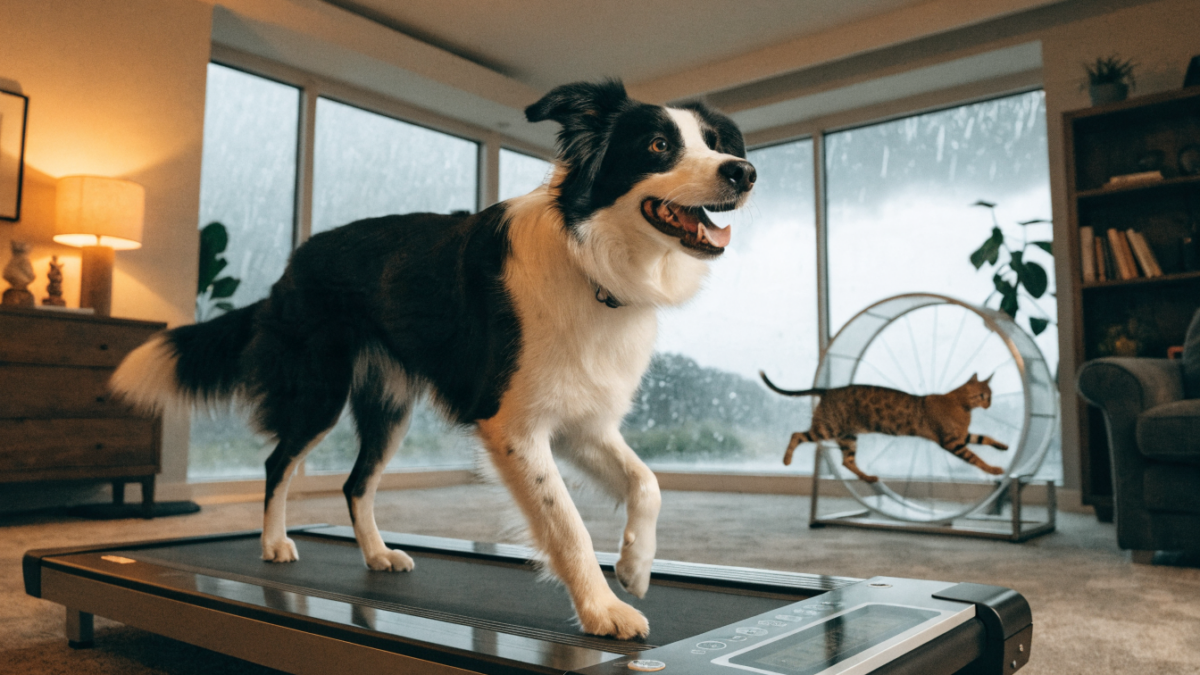
It was January, and the sidewalks had been frozen solid for a week straight. Marcus — a guy with a two-year-old Belgian Malinois named Kai — was losing his mind. Kai was destroying furniture, counter-surfing, and pacing circles in the living room. Marcus was doing everything right: structured walks when the ice melted, puzzle feeders, training sessions. But it wasn’t enough. That’s when I suggested a treadmill.
Not as a replacement for anything. As a supplement. A tool to take the edge off when going outside literally wasn’t safe.
Here’s the thing about indoor cardio equipment for pets: people either think it’s genius or they think it’s borderline neglect. The truth is somewhere in the middle, and it depends entirely on how you introduce it. Let’s walk through what actually works — for dogs on treadmills and for cats on wheels — and where people tend to get into trouble.
Why Indoor Cardio Isn’t a Gimmick
A dog who doesn’t get enough physical exercise doesn’t just lie down and accept it. The energy goes somewhere. Excessive barking, destructive chewing, digging at the carpet, pacing — these aren’t “bad dog” behaviors. They’re symptoms of a dog who needs more output than they’re getting.
Most of the time, the fix is straightforward: longer walks, more fetch, a playdate with another dog. But life doesn’t always cooperate. Extreme heat. Ice storms. Air quality warnings from wildfires. An owner recovering from surgery. A dog on restricted activity during rehabilitation who still needs controlled, low-impact movement.
That’s where indoor equipment earns its place. According to Cornell University’s Riney Canine Health Center, [1] serves real clinical purposes — not just burning off energy, but supporting weight management and post-injury rehab programs. Veterinary rehab clinics now use underwater treadmills and specialized indoor equipment as standard treatment for orthopedic recovery. This isn’t a fad. It’s recognized medicine.
Slatmills vs. Motorized Treadmills: Know the Difference
Before you put your dog on anything, you need to understand what you’re looking at. There are two main categories of canine treadmill equipment, and they behave very differently.
Motorized Treadmills
These are what most people picture — either a human treadmill repurposed for dogs or a specialized canine treadmill with a motor. The belt moves at a set speed regardless of what your dog does. If your dog stumbles, spooks, or tries to stop, the belt keeps going.
That’s not inherently dangerous if you’re standing right there with a hand on the controls. But it does mean the risk factor is higher. A dog who gets distracted and steps off the side of a moving belt can get a foot caught or develop a fear response that makes future training ten times harder.
Slatmills (Dog-Powered Treadmills)
Slatmills are self-powered. There’s no motor. The belt only moves when the dog walks. If Kai stops walking, the mill stops. This is closer to how a dog naturally moves — they control the pace, they can speed up or slow down based on how they feel, and there’s no belt dragging them forward against their will.
I’ll be honest: I used to think slatmills were overpriced luxury items. Then I watched a nervous rescue greyhound named Dolly learn to use one in a single session. The fact that she controlled the movement changed everything. She started slow, figured out the rhythm, and within fifteen minutes was trotting comfortably. A motorized treadmill would have terrified her.
For most pet dogs — especially those new to indoor cardio — I’d recommend a slatmill if it fits your budget and space. Motorized treadmills can work, but they demand more supervision and a more careful introduction.
How to Introduce Your Dog to a Treadmill
This is where people get impatient, and impatience is what ruins treadmill training. You’re not teaching your dog to run. You’re teaching them that standing on a specific piece of equipment is safe, then that walking on it is safe, then that movement is normal. Each step matters.
I start every dog the same way:
- Day one: The treadmill is off. Completely off. I scatter treats on and around it. Let the dog investigate at their own pace. No leash pressure, no luring onto the belt. Just let them figure out this object exists and food appears near it.
- Day two or three: I’ll use a leash for gentle guidance — not to drag the dog, but to keep them from wandering off entirely. I reward any paw on the belt. Any contact at all. Some dogs hop right up. Others need a few sessions of just touching one paw to the surface.
- Next step: Once the dog is comfortable standing on the stationary belt for a minute or more, I turn it on — at the slowest possible speed. For a slatmill, this means giving the belt a gentle nudge so the dog feels movement. For a motorized treadmill, it means the lowest setting. I’m talking barely moving.
- Building duration: Short sessions. Three to five minutes max at first. You’re building confidence, not endurance. Endurance comes later, once the dog understands what they’re doing.
One mistake I see constantly: owners who get their dog walking comfortably and immediately crank up the speed or extend the session to twenty minutes. Don’t. Your dog’s paws, joints, and stamina need time to adjust. A good [2] is built gradually over weeks, not days.
And never — I mean never — walk away from a dog on a treadmill. Not for a second. Even with a slatmill, you need to be right there. Equipment fails. Dogs spook. Things happen.
Cat Wheels: A Completely Different Animal
If introducing a dog to a treadmill is like teaching someone to drive, introducing a cat to an exercise wheel is like convincing a cat that driving is something they want to do. The approach couldn’t be more different.
Cats don’t respond to leash guidance the way dogs do. They don’t care that you think this is good for them. If a cat decides the wheel is suspicious, it’s suspicious. Period. You can’t reason with that.
I worked with a family who had an orange tabby named Gavroche. Gavroche was nearly nineteen pounds — a rescue who’d spent his first three years in a small apartment with free-feeding and zero exercise. His vet was concerned about diabetes risk. The family bought a cat wheel and called me when Gavroche refused to go near it.
Here’s what worked — and it took three weeks:
- Leave the wheel alone. Don’t try to put the cat on it. Don’t even move it around. Let it become furniture. Cats need things to stop being “new” before they’ll engage.
- Start feeding near it. Treats on the base. Meals next to it. Create a positive association without any expectation of interaction.
- Lure, don’t place. Use a wand toy or laser pointer to encourage the cat to step onto the wheel on their own. If a paw touches it, reward. Don’t try to get movement yet.
- Introduce gentle movement. Once the cat is comfortable standing on the wheel, use a toy to encourage them to take a step. The wheel will move slightly. Some cats panic and jump off. That’s fine. Go back a step.
- Build slowly. Over days and weeks, the cat will figure out that their movement makes the wheel spin. Once that clicks, many cats genuinely enjoy it.
Gavroche now uses his wheel every night around 9 PM. It became part of his routine — his “zoomies” outlet. His family tracks his weight with their vet, and he’s lost just over two pounds in six months. That’s healthy, sustainable progress for a cat.
Not every cat will take to a wheel. I want to be clear about that. Some cats try it once and never touch it again. Others become obsessed. You won’t know which one you have until you put in the training time, and even then, there are no guarantees. Anyone who tells you a cat wheel works for “all cats” is selling you something.
The “Lazy Owner” Question
Every time treadmill training comes up in a group discussion, someone says it: “Why not just walk your dog?”
I get it. Outdoor exercise gives dogs things a treadmill can’t — new smells, social encounters, mental enrichment from exploring the environment. A treadmill belt will never replace a good sniff walk. I’d never suggest it should.
But here’s what I’ve learned from working with hundreds of dogs and owners: judgment doesn’t help anyone. The person training their Malinois on a slatmill at 5 AM before work isn’t lazy. The person using a treadmill because their dog is recovering from knee surgery and needs controlled, flat-surface movement isn’t cutting corners. The person exercising their dog indoors because the air quality index is at “hazardous” isn’t making excuses.
A treadmill is a tool. Use it well, and it gives your dog an additional outlet for energy that might otherwise go into your baseboards. Use it poorly — as the only exercise your dog gets, with no outdoor time, no training, no enrichment — and yeah, you’re missing the point.
The best approach is the obvious one: combine them. Outdoor walks for mental enrichment, socialization, and sniffing. Indoor treadmill sessions for controlled cardio, especially on days when weather or circumstances make long outdoor sessions impossible.
Final Thoughts
Pet obesity is one of the most significant health challenges facing dogs and cats today. It shortens lifespans, contributes to joint disease, diabetes, and heart conditions, and reduces quality of life in ways that build slowly until they’re hard to reverse. Indoor cardio equipment — whether that’s a slatmill for a high-drive working breed or a wheel for an overweight rescue cat — is one tool in addressing that problem.
It won’t work for every animal. It requires patience, proper introduction, and realistic expectations. But for the dogs and cats who do take to it, the payoff is real: better weight management, calmer behavior at home, and an owner who has one more option when life makes outdoor exercise difficult.
If you’re considering a treadmill or a cat wheel, talk to your vet first — especially if your pet has any health conditions or is significantly overweight. Start slow. Watch your animal’s body language. Celebrate small wins. And remember that the goal isn’t to turn your living room into a gym. It’s to give your pet a longer, healthier, happier life.
Sources
- treadmill training for dogs — vet.cornell.edu
- indoor treadmill routine — youtube.com