

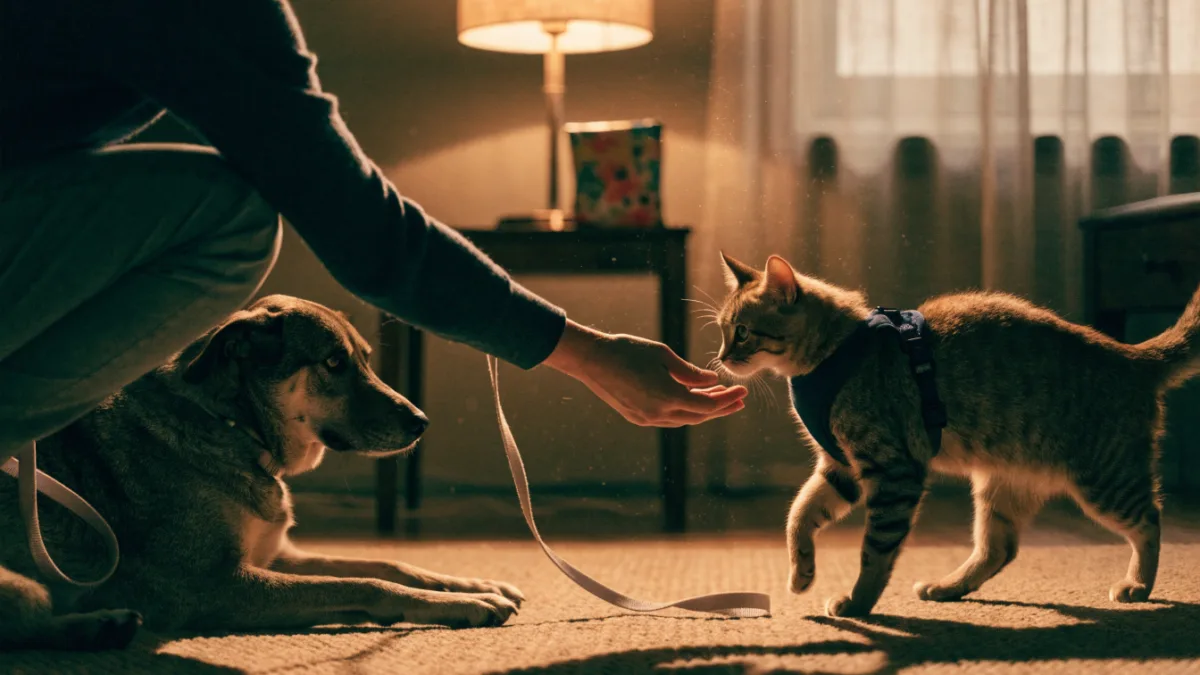
Here’s something that surprises people: the dog dragging you down the sidewalk and the cat who’s never once felt grass under her paws need the exact same thing from you. Neither species is born knowing what a leash means, and both learn it the same way — short sessions, good associations, and a human who stops accidentally rewarding the stuff they don’t want. Loose leash walking training and harness training a cat look like two different sports. Underneath, they’re the same game.
Why Your Dog Pulls — and Why Pulling Back Makes It Worse
Pulling works. That’s the whole problem. Your dog leans into the leash, the leash goes tight, you follow, and he reaches the fire hydrant he wanted. The pull got him paid. Do that twice a day for a year and you’ve rehearsed the behavior seven hundred times.
Now layer in what trainers call opposition reflex: dogs naturally lean into steady pressure. You pull back, he pulls harder. That’s not stubbornness — that’s physics meeting instinct. It’s why the tug-of-war approach to stop dog pulling on leash never wins, because he was quite literally built for it.
I worked with a Vizsla named Juno last year. Third-floor apartment, so the hallway was her starting gate — by the time they hit the lobby, she was already at threshold and the rest of the walk was damage control. Her owner thought she needed “more discipline.” She needed fewer rehearsals. We started training her in the hallway itself, five minutes at a time, before the walk ever began.
One core rule makes everything else work: a slack leash makes the walk happen; a tight leash stops it. Leash goes tight, you plant yourself like a tree and wait. The moment there’s slack, forward motion resumes. The dog learns the red-light, green-light system fast — but only if it’s consistent, which means everyone who walks the dog follows it. One family member letting him drag them to the park undoes a week of progress.
Two more management pieces. First, burn off some energy before training walks — a quick game of fetch or a sniff session in the grass takes the edge off. Second, put the retractable leash away. I know people love them, but they teach exactly the wrong lesson: constant steady pressure means constantly pulling. Use a standard four-to-six-foot leash in a material you can hold comfortably.
The Loose-Leash Plan, Step by Step
Step 1: Pay at the Seam
Before cues, before distractions, teach your dog where the money is. Deliver treats right at the seam of your pants, wherever you want the dog positioned. He learns the jackpot lives at your knee, not eight feet ahead. Use something better than kibble for this — real chicken, cheese, whatever makes his head snap around.
Step 2: Teach a “Let’s Go” Cue
“Let’s Go” means disengage from whatever’s interesting, swing back to my side, and we’ll change direction together. Say it once, take a step away, mark and reward the moment he reorients to you. This becomes your escape hatch in front of every squirrel and garbage day buffet.
Step 3: The Leash Pressure Game
Here’s where I’ll admit I changed my own approach. I used to open every pulling case with “be a tree.” Still a fine tool. But the pressure game gets results faster: you apply gentle leash pressure, the dog moves toward it, the pressure releases, and you reward. You’re teaching him to turn pressure off himself instead of waiting for you to win a contest he’s built to win. It works for puppies and adult dogs alike.
Step 4: Proof It Against the Real World
This is the longest phase — expect weeks to months, not one weekend. Build a distraction ladder: backyard, then a quiet street, then a busier block. Five-to-ten-minute sessions, a few times a day, beat one long frustrated march every time. If you want the full exercise progression on video,.[1] covers everything from fundamentals through real-world proofing. For gear, a front-clip harness redirects a puller without any discomfort, and a head halter can be a good management option for the genuinely strong — but equipment supports training, it never replaces it.
How to Leash Train a Cat (Yes, Really)
I rolled my eyes at cat leashes for years. Then I watched a shelter cat named Miso go from hiding under the couch to running to her harness at the sound of the Velcro. I stopped rolling my eyes.
Screen the Cat First
Not every cat is an adventure cat, and that’s fine. Confident, curious cats tend to opt in. A cat who flattens and freezes when the harness appears is telling you she’d rather stay in — so enrich her indoors instead. The whole framework only works when the cat is choosing it.
Harness First, Everything Else Later
Never a collar. Cats slip collars with alarming ease and risk serious neck injury. Get an escape-proof vest or H-style harness, snug enough to fit two fingers under and no looser. Day one is tiny: the harness comes out, she sniffs it, treats rain down, it briefly touches her back, more treats. Over days, work up to one second on, then off, then a full meal eaten while wearing it. Progress at her pace, not your schedule.
The Leash Comes Last, and Patience Comes After That
Once she’s comfortable wearing the harness around the house, clip the leash on and let it drag under supervision. Then hold the end loosely and follow her. Here’s the number that surprises everyone: experienced cat handlers figure it takes around thirty walks before a cat fully accepts the leash — and trainers are blunt that [2] It’s a marathon of small steps. For a full visual walkthrough, [3] is worth your time. He describes the payoff as cats coming home “tired in a 360-degree way” — mentally and physically spent from the sensory workout, not just marched around a block.
The First Outdoor Session
Pick somewhere quiet, enclosed, and honestly boring. Carry her out in a carrier rather than letting her walk out the door — that habit protects you from creating a door-dasher. Open the carrier, sit down, and let her decide when to step out. The cat leads. It’s a sniffari, not a march, and you are mostly furniture that dispenses treats. Watch for stress signals: flattened ears, tail flicking, crouching, freezing. Any of those, and you go back a step. And never, ever tie a cat out unattended — a harness is a walking tool, not a tether.
Same Rules, Different Species
Strip away the fur differences and the training is identical:
- Gear becomes a predictor of good things — for both animals.
- Sessions are short, frequent, and end on a win.
- The learner sets the pace, always.
- Calm choices get paid; nothing gets punished.
The reward-based approach isn’t just a style preference either. The American Veterinary Society of Animal Behavior’s 2021 position statement backs it across the board, citing the stress and fear fallout that comes with aversive methods.
If you’re in an apartment, this stuff matters double. The hallway, elevator, and lobby are your dog’s real proving grounds — Juno’s manners were built there before the sidewalk ever entered the picture. And for an apartment cat, leashed balcony or courtyard time is enrichment she simply can’t get otherwise. Vets commonly cite 10 to 20-year lifespans for indoor cats versus a fraction of that for free-roaming ones — the leash is the compromise that gets you both. Just clear the health prerequisites first: rabies and FVRCP vaccinations, parasite prevention, and a microchip or ID before paws touch grass.
There’s a bigger picture here than sore shoulders and enriched house cats. Free-roaming cats in the U.S. kill an estimated 1.3 to 4 billion birds and over 6 billion small mammals every year, according to the 2013 Loss, Will & Marra analysis in Nature Communications — one of the largest human-caused impacts on wildlife, period. A leashed cat kills nothing. A leashed dog on a trail stays out of shorebird nesting areas instead of flushing them. A solid “leave it” serves both species, and honestly, the planet. So no, this isn’t just about a polite walk. It’s about sharing the outdoors without trashing it — five minutes, one slack leash, one brave tabby at a time.
Sources
- this compilation of loose-leash walking drills — youtube.com
- your cat needs to be completely comfortable with the harness and leash before you introduce anything new — instagram.com
- Jackson Galaxy's harness-training video — facebook.com