
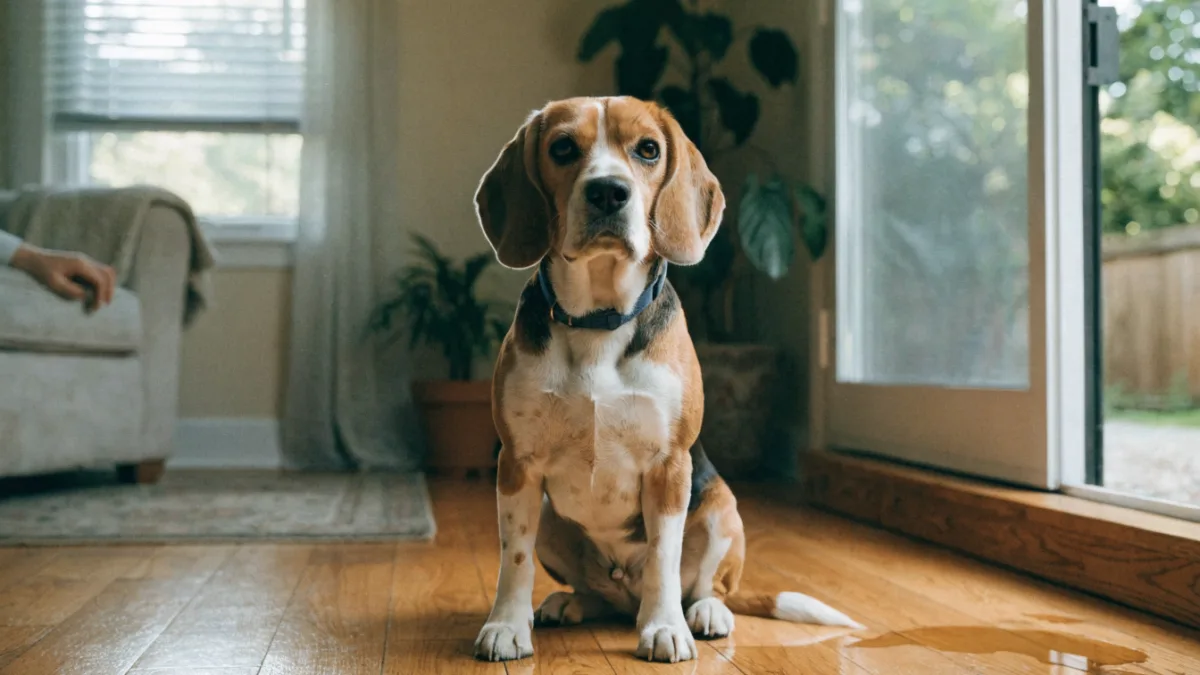
You finally threw out the last of the puppy pads. You moved the crate out of your bedroom, packed away the enzyme cleaner, and breathed a massive sigh of relief. You survived potty training. Then, a few weeks or months later, you walk into the living room and find a puddle on your favorite rug. Or maybe you wake up to a surprise on the kitchen floor.
Before you start questioning your sanity or your dog’s training, take a deep breath. You aren’t alone in this. What you’re dealing with is a potty training regression, and it is incredibly common. Dogs don’t suddenly forget their training just to spite you. A regression is almost always a symptom of something else going on—whether that’s a medical issue, a shift in their environment, or just a typical developmental phase. Let’s break down exactly why your potty-trained pet is suddenly having accidents, and more importantly, how to fix it.
Rule Out the Medical Stuff First
If your adult dog has been completely reliable for months and suddenly starts having accidents, put down the paper towels and call your vet. I cannot stress this enough. Veterinarians estimate that in sudden cases of adult potty regression, roughly 50% of the time, there is an underlying medical cause.
Dogs are masters at hiding discomfort. A urinary tract infection (UTI), bladder stones, kidney disease, or gastrointestinal issues can all cause sudden incontinence. I once worked with a family who had a perfectly trained three-year-old Golden Retriever who started dribbling urine on the couch. They were frustrated and assumed it was a behavioral issue. It turned out she had a severe UTI that required antibiotics. Once the infection cleared up, the accidents stopped entirely.
Don’t try to train your way out of a medical problem. If your dog is suddenly having accidents, straining to pee, drinking excessive amounts of water, or if you notice blood in their urine, get them to a vet’s office immediately. You can’t fix a bladder infection with a stricter routine.
Why is This Happening? The Common Culprits
Once your vet gives your dog a clean bill of health, it’s time to look at behavioral and environmental factors. Dogs thrive on predictability. When their world shifts, their habits often shift right along with it. Here are the most common reasons your dog is leaving surprises on the floor.
The Teenage Phase
Just like human teenagers, dogs go through adolescence. This usually hits between 6 and 18 months of age, depending on their breed and size. During this time, their brains are flooded with hormones. They start testing boundaries, they get easily distracted, and frankly, they sometimes just forget the rules. That perfectly behaved five-month-old puppy might turn into a chaotic eight-month-old teenager who gets so wrapped up in watching a squirrel out the window that he forgets to tell you he needs to go out.
Stress, Anxiety, and Routine Changes
Dogs are heavily reliant on routine. Moving to a new house, a change in your work schedule, a new baby joining the family, or even rearranging the living room furniture can trigger anxiety. Stress has a direct physical effect on a dog’s digestive and urinary systems.
We saw a massive wave of this with post-pandemic regression. Dogs adopted during the 2020 lockdowns never learned how to be alone. Their owners were home 24/7. When people suddenly started heading back to the office, these dogs were thrust into a completely new reality. The resulting separation anxiety caused a massive spike in potty training regressions. If your dog is stressed, their body will often override their training.
The “Incomplete Training” Illusion
Here is a hard truth I had to learn myself early on: sometimes, a dog isn’t actually fully potty trained. They are just heavily managed. If you kept your puppy on a strict crate rotation, watched them like a hawk every second they were loose, and rushed them outside every hour, you were managing their environment. You weren’t necessarily giving them the chance to make the right decision on their own.
Behavior experts often talk about the “Rule of 3.” It takes an average of 3 to 6 months of consistent training for a dog to become completely reliable in their potty habits. If your dog was never taught how to “hold it” for extended periods, or if they were never given the opportunity to generalize the behavior to all areas of the home, accidents are inevitable once that strict management fades.
The Great Pee Pad Debate
There is an ongoing debate in the dog training world regarding indoor potty solutions, like pee pads or patches of indoor grass. Some owners rely on them, while modern behaviorists often warn against them. Here’s why mixing indoor pads and outdoor potty training can cause a regression.
Dogs develop strong substrate preferences. If you teach a dog to pee on a soft, squishy pee pad indoors, don’t be surprised when they decide your living room rug or the guest bedroom comforter feels exactly the same. To a dog’s nose and paws, a rug can easily register as a giant pee pad. If you initially trained your dog to go indoors and are now transitioning them to go strictly outside, expect a few setbacks. You have to completely remove the indoor options to teach them that outdoors is the only acceptable bathroom.
How to Fix It (Without Making It Worse)
Fixing a potty regression isn’t complicated, but it does require patience and consistency. You have to go back to day one. Here is your action plan to get your dog back on track.
Go Back to Basics
Treat your dog exactly like you did when they were an eight-week-old puppy. Re-introduce the crate. If you can’t actively supervise them with your eyes on them, they should be in their crate or safely tethered to you with a leash. Take them outside frequently. When they do their business outside, throw a massive party. Give them high-value treats, lots of praise, and play a quick game. You have to remind them that going outside is incredibly rewarding.
Clean It Right
Standard household cleaners are a major reason why dogs keep peeing in the same spot. You might think your floor is clean, but a dog’s sense of smell is tens of thousands of times more sensitive than yours. If you clean a pee spot with bleach or ammonia, you are leaving behind microscopic scent markers that tell your dog, “This is the bathroom.” You absolutely must use a dedicated enzymatic cleaner. These cleaners use enzymes to physically break down and eat the uric acid crystals, completely erasing the scent marker. Without this step, the regression will continue.
Skip the Guilt Trip
Let’s talk about an outdated, harmful myth: rubbing a dog’s nose in their accident. There is an old-school debate where some owners still believe in scolding or physically punishing a dog for potty accidents. I used to think a firm scolding helped set boundaries. I was entirely wrong.
Punishment does not teach a dog to go outside. It only teaches the dog to be afraid of eliminating in front of you. If you scold your dog for peeing on the rug, they won’t learn “don’t pee inside.” They will learn “don’t pee inside when my owner is looking.” This will push them to start hiding their accidents behind the couch, under the bed, or in the basement. If you catch your dog in the act of having an accident, calmly interrupt them with a neutral sound, scoop them up, and rush them outside. No anger, no yelling. Just a quick redirection.
Modern Tools to Help You Out
If your dog’s regression is driven by anxiety, there are some fantastic modern tools you can lean on. Synthetic pheromone diffusers can be plugged into your wall outlets to release calming pheromones that mimic a nursing mother, helping to ease general household anxiety. Always consult your vet before trying calming treats or supplements, but many owners have seen success with these to take the edge off.
Smart tech is also a lifesaver. I recommend setting up an indoor pet camera with two-way audio and a treat dispenser. If you are back at the office, you can check your camera to see exactly when and why your dog is having accidents. Are they pacing anxiously at noon? Are they sleeping and suddenly waking up to pee? Knowing the trigger—like a mailman delivery or a sudden noise—makes it much easier to solve the underlying issue. You can even use the camera to interrupt an accident before it finishes.
Potty training regressions are frustrating, but they are temporary. Take a deep breath, grab your enzymatic cleaner, and go back to the basics. Your dog isn’t giving you a hard time; they are having a hard time. By ruling out medical issues, managing their environment, and reinforcing the good behavior without relying on outdated punishment, you’ll get your potty-trained pet back in no time. Remember, building trust and a strong bond with your companion animal is always the ultimate goal—patience is just part of the journey.