

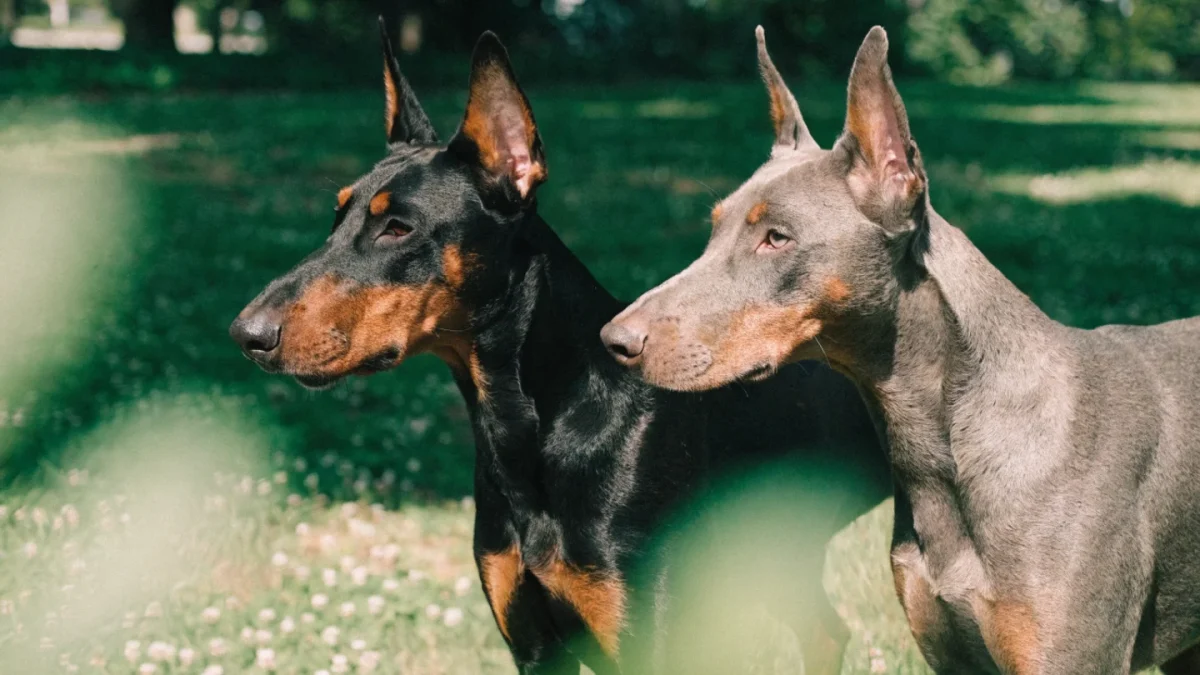
The Doberman Pinscher's genetic story reflects two opposing forces: a diverse founding gene pool from at least five breeds in the 1890s, and over a century of selective breeding that narrowed that pool considerably. Understanding the genetics matters because it directly shapes breeding decisions, health screening priorities, and what owners should demand from anyone selling this breed.
Coat Color Inheritance
Doberman color follows a two-gene system. The B locus (TYRP1) controls base color: dominant B produces black, recessive b/b produces red. The D locus (MLPH — melanophilin) controls dilution: dominant D gives full intensity, recessive d/d dilutes the color.
Four recognized combinations result: black and rust (B/- D/-), red and rust (b/b D/-), blue and rust (B/- d/d), and fawn/Isabella and rust (b/b d/d). Rust tan-point markings are controlled by the agouti signaling gene at the A locus — all standard Dobermans carry the at/at genotype.
White Dobermans trace to a single dog — Padula's Queen Shebah, born November 10, 1976, to two black-and-rust parents. A 2014 study published in PLOS ONE identified the cause as a 4,081 base pair deletion in the SLC45A2 gene, resulting in oculocutaneous albinism inherited as an autosomal recessive trait. They exhibit significant pigment reduction, blue eyes, photosensitivity, and higher rates of skin tumors. Most registries do not recognize white as standard, and responsible breeding programs avoid producing white offspring.
Color Dilution Alopecia
The d/d genotype carries consequences beyond appearance. Color dilution alopecia (CDA) results from abnormal melanin distribution that weakens hair shafts, causing progressive breakage and loss. CDA primarily affects blue and fawn Dobermans at rates that make it a likely outcome rather than a rare complication. A study by Miller published in Veterinary Dermatology reported CDA incidence of approximately 58% in blue and 90% in fawn Dobermans, while other dermatology sources cite rates as high as 93% in blues and 75% in fawns depending on the population studied.
Signs typically appear between 6 months and 3 years — dry, dull coat progressing to patchy hair loss along the back and flanks. Secondary bacterial skin infections in affected areas are common. The condition is manageable with moisturizing shampoos and topical therapies but not curable. This genetic reality is why many breed health advocates recommend against deliberately breeding for dilute colors. The aesthetic demand for blue or fawn Dobermans carries a documented health cost.
Dilated Cardiomyopathy: The Genetic Crisis
Two DCM-associated markers have been identified. The PDK4 mutation — a splice site change in the pyruvate dehydrogenase kinase 4 gene — was initially linked to increased DCM risk in North American Doberman populations. However, an attempt to replicate the association in European cohorts was unsuccessful, and a 2024 study in Scientific Reports identified additional markers on chromosome 16, further demonstrating that the genetic architecture of Doberman DCM extends beyond these two loci. A second marker on chromosome 5 shows similar partial predictive strength — not all carriers develop DCM, and some dogs without identified markers still develop the disease.
Practical meaning: genetic testing for DCM is useful but not definitive. Negative results do not eliminate risk. Positive results do not guarantee disease. The complexity likely reflects multiple contributing genes and gene-environment interactions that current testing cannot fully capture. Annual cardiac screening (echocardiogram plus Holter monitoring) starting at age 2 remains essential regardless of genetic test results.
Von Willebrand's Disease
Von Willebrand's disease type 1 (vWD1) follows autosomal recessive inheritance with variable penetrance. Affected dogs (two copies of the mutation) have reduced clotting factor — clinical significance ranges from no observable symptoms to prolonged bleeding after surgery or trauma. DNA testing reliably identifies three statuses: clear, carrier, and affected.
Testing is reliable, inexpensive, and non-negotiable for breeding stock. Affected-to-affected matings produce 100% affected offspring. Responsible programs test and select to reduce the mutation's frequency without eliminating otherwise excellent dogs from the gene pool.
Essential Genetic Tests
For anyone acquiring a Doberman, these represent current best practice:
- vWD1 DNA test: Simple, definitive, required
- DCM panel (PDK4 + chromosome 5): Recommended; results are probabilistic, not deterministic
- D locus (color dilution): Relevant for CDA risk assessment
- Annual cardiac screening (echo + Holter): Not genetic, but the essential clinical complement
The connection between the breed's foundation crosses in 1890s Apolda and today's genetic landscape is direct — diverse founding stock brought versatility, but subsequent breeding bottlenecks concentrated disease predispositions. The Doberman breed guide's health section covers the clinical implications for daily ownership.
Genetic testing narrows risk and informs decisions. It does not replace clinical screening, and it does not guarantee outcomes. For a breed carrying the genetic burden that Dobermans carry, both testing and screening are essential.