

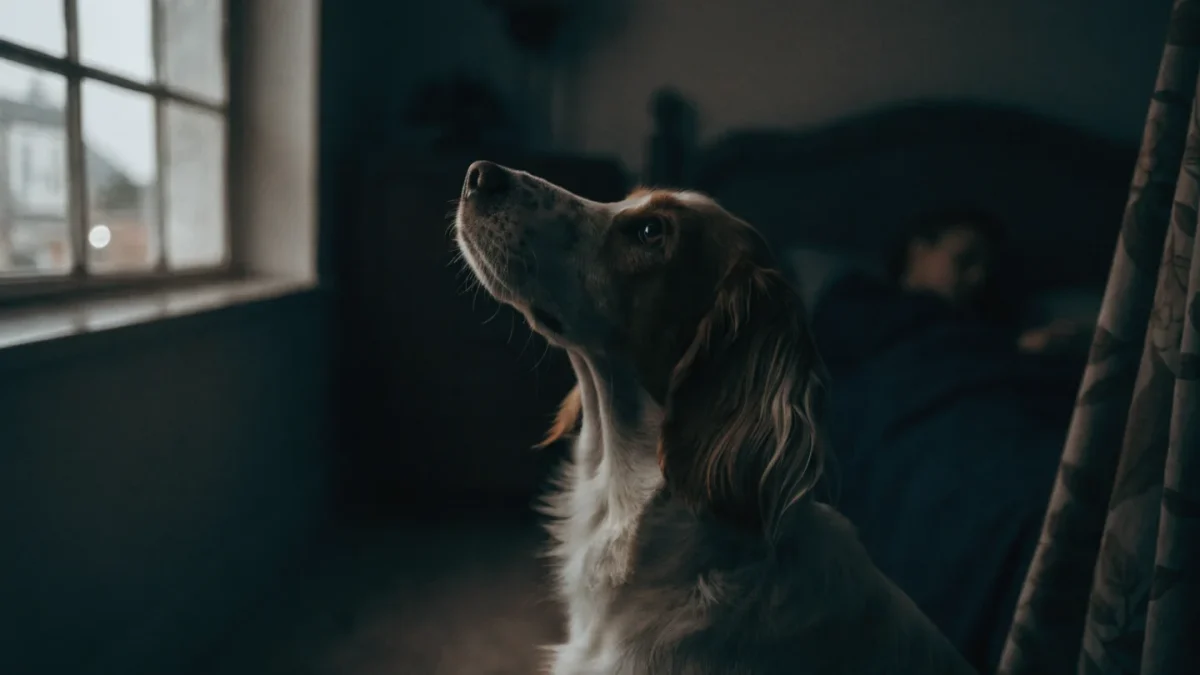
3am barking is one of the fastest ways to unravel a household. The dog wakes everyone up, no one can figure out why, and the next day everyone's exhausted and irritable. Getting this solved quickly matters.
The diagnosis determines the fix. Here's how to work through it.
Cause 1: Wildlife or Outdoor Sounds
Dogs hear things humans don't. A raccoon in the yard. Deer passing. An unfamiliar car door slam. Wind in trees. Many nighttime barking episodes are alert barking triggered by sounds or movements that are genuinely there — you just didn't hear them.
Signs: Barking is directional (at a window or door), the dog seems alert and focused rather than distressed, and the barking stops after the trigger moves on.
Fix: White noise machine or box fan near the bedroom drowns out many of the ambient sounds that trigger alert barking at night. If the dog has window access, block the sightlines. For wildlife in the yard, managing the yard environment (secured trash, motion-activated lights that startle rather than attract) can reduce the nighttime activity.
Cause 2: Separation or Anxiety
Some dogs that are fine during the day experience anxiety at night when things are quiet and they're in a different part of the house. This is especially common in dogs new to a household.
Signs: Barking starts when the dog is separated from you at night, or worsens when the household goes quiet. May be accompanied by pacing, whining, or restlessness.
Fix: Consider whether having the dog sleep in the bedroom (or closer to the bedroom) is workable. Many dogs that bark at night in another room are completely quiet when sleeping near their owner. If the dog needs to sleep separately, gradually increase the distance from the bedroom rather than starting with complete separation.
Cause 3: Medical Issues
Nighttime behavioral changes — especially in older dogs — can indicate physical causes. Cognitive dysfunction syndrome (the canine equivalent of dementia) often produces nighttime disorientation and vocalization. Pain can also disrupt sleep and cause nighttime restlessness. Thyroid disorders and other medical issues can increase nighttime anxiety.
Signs: This is a new behavior in an adult or senior dog, or the dog seems confused rather than alert or anxious, or nighttime disturbances are accompanied by other behavioral changes.
Fix: Vet check. Don't assume behavioral causes when a dog suddenly develops nighttime barking without any obvious trigger, especially in older dogs.
Cause 4: Insufficient Daytime Exercise
A dog that didn't get enough physical and mental stimulation during the day may not be tired enough to sleep through the night. This is especially true for high-drive dogs.
Signs: Barking is more generalized restlessness than directed at a specific trigger, and occurs at a relatively consistent time (like 5am when the dog is simply ready to start the day).
Fix: Increase daytime exercise and mental stimulation. Evening exercise (an hour before bedtime rather than right before, to allow the dog to settle) can improve nighttime sleep. Puzzle feeders and enrichment before bed can help burn mental energy.
FAQ
My dog started barking at night out of nowhere after months of sleeping quietly. What changed?
Sudden onset changes often mean something is different — a new neighborhood sound, wildlife, a change in routine, or a medical issue. Check for any environmental changes first (construction nearby, new neighbors with dogs, seasonal wildlife patterns). If nothing environmental explains it, vet check is warranted. (See also: dog anxiety.)
Should I go to my dog when they bark at night?
It depends. If the barking is anxiety-based, your presence may be genuinely helpful and not a problem. If the barking is demand-based (the dog is perfectly fine but wants company or entertainment), repeatedly going to them reinforces the barking. Observe first — is the dog genuinely distressed or just alert or bored?
My dog barks at 5am every morning without fail. Is this habit or something else?
5am barking is often the dog responding to first light or first neighborhood sounds — a habituated alarm clock response. Managing the environment (blackout curtains, white noise) can delay it. Exercise and enrichment help. You can also work on teaching the dog that the morning routine doesn't start until you decide it does — waiting for quiet before any morning interaction begins.
Nighttime barking is solvable in almost every case. The key is identifying the right cause rather than applying a generic fix.