

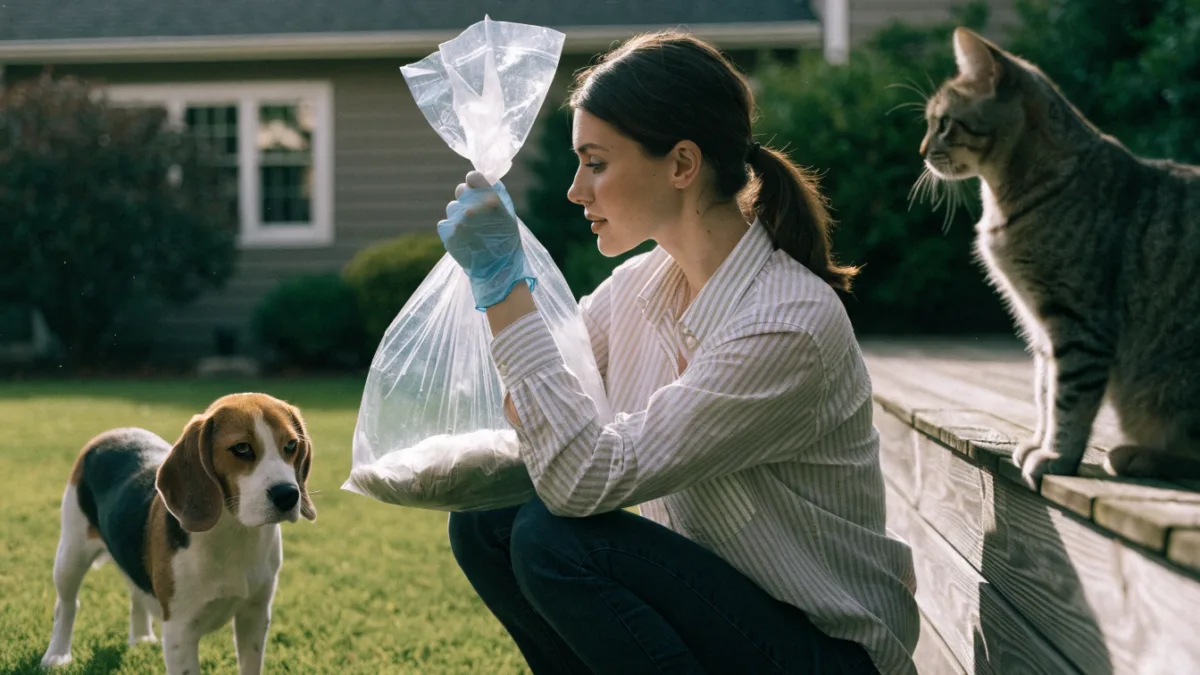
Let’s be honest: nobody gets excited about poop duty. But here’s the thing I tell every client on their first puppy or kitten visit — that daily scoop or backyard pickup is the single best health screening you’ll ever do for free. You’re already standing there. You might as well know what you’re looking at. Vets evaluate stool using four quick observations — color, consistency, content, and coating — and you can run through all four in about thirty seconds. If you learn nothing else from this article, learn this: a score 3 is what you’re aiming for, and anything that isn’t deserves a second look.
Your Thirty Seconds: The Four C’s
Veterinary training teaches some version of the Four C’s, and it translates perfectly to the backyard or litter box. You’re assessing:
- Color — healthy stool is a uniform chocolate brown.
- Consistency — firm enough to hold its shape, soft enough to pass comfortably.
- Content — anything that shouldn’t be there: worms, mucus, grass, hair, or fragments of that toy your dog swore he wasn’t destroying.
- Coating — a slimy mucus layer suggests colonic irritation (that’s the colon’s lining reacting to inflammation), while red coating means fresh blood.
For cat owners, this ritual matters even more. Cats are evolutionarily wired to hide illness — a cat who feels terrible will still saunter out to breakfast acting completely normal. The litter box is often the first place the mask slips. I had a client, Marisol, whose 9-year-old gray tabby Winston seemed perfectly fine until she noticed his stools turning pale and clay-colored over about a week. She brought him in, and imaging confirmed a bile duct obstruction. Because she caught it early, Winston did well. She told me later, “I only noticed because I scoop his box every single morning.” That’s the whole game.
The 1-to-7 Scale: What “Perfect” Looks Like
Most clinics use a fecal scoring system — the [1] — that rates stool from 1 to 7. It mirrors the Bristol Stool Scale your own doctor uses, so it’s intuitive once you’ve seen it:
- Score 1: Hard, dry pellets — constipation or dehydration.
- Score 2: Firm but dry and segmented.
- Score 3: The gold standard. Log-shaped, moist, holds together, easy to pick up, and leaves little to no residue on the grass or litter.
- Score 4: Soft, losing its shape.
- Score 5: Soft blobs with clear edges.
- Score 6: Fluffy, mushy blobs with ragged edges.
- Score 7: Pure liquid.
One 4 isn’t a crisis. A week of 5s and 6s is a conversation with your vet. For context on frequency: most dogs go one to five times a day and most cats once or twice, depending on diet, age, and fiber intake. A sudden change in frequency counts just as much as a change in appearance.
The Color Decoder, Shade by Shade
Color is where owners notice change first, so here’s your decoder, adapted from [2] and what we see clinically:
- Chocolate brown: Normal. Carry on.
- Black and tarry (melena): Digested blood from the upper GI tract — the stomach or small intestine. This is always a red flag. Call your vet.
- Red streaks or drops (hematochezia): Fresh blood, usually from the colon or irritated anal glands. An occasional streak with an otherwise normal stool may be minor, but blood plus diarrhea warrants a call.
- Yellow or orange: Food is moving through too quickly, or there’s a bile or food-intolerance issue. Persistent orange stools deserve a check.
- Gray, greasy, floating: Fat isn’t being digested properly — this pattern raises suspicion for maldigestion or exocrine pancreatic insufficiency (EPI), where the pancreas isn’t producing enough digestive enzymes.
- Green: Usually just grass-eating, which is often harmless. But some rodenticide baits contain green dye — if green stool comes with lethargy, bruising, or any chance of bait access, treat it as an emergency.
- White specks that look like grains of rice: Tapeworm segments. Gross, treatable, and your vet will want to know.
- Pale or clay-colored, especially in cats: Possible bile duct or liver obstruction. This is Winston’s story, and it’s a same-day phone call.
Dogs vs. Cats: Different Habits, Different Watchpoints
Dogs
Dogs get themselves into trouble by mouth. “Garbage gut” and dietary indiscretion — the technical term for eating things food was never meant to be — account for a huge share of the soft-stool calls I get. Moose, a three-year-old Labrador who treated the kitchen counter like an open buffet, came in with a score-6 stool, and his owner found chewed corn cob fragments during the content check. Corn cobs are a classic intestinal foreign body, so that discovery upgraded him from “bland diet” to “x-rays today.” His owner’s exact words were, “I almost didn’t call because it felt silly.” It wasn’t silly. It’s why the content check exists.
Cats
For cats, I worry about the opposite problem: stools that are too small, dry, and infrequent. Older cats are prone to constipation, and untreated, it can progress to megacolon — a stretched, weakened colon that becomes a serious management problem. Straining in the litter box, crying while defecating, or no stool for 48 hours all warrant a call. A bit of hair in the stool of a fastidious groomer is usually unremarkable, but increasing hair loads can preview constipation.
Wait It Out or Call? A Realistic Triage Guide
Here’s where I’ll admit I’ve changed my mind. Early in my career, I was firmly in the “give uncomplicated diarrhea 48 hours” camp. I’ve shifted toward 24 hours for small, young, or senior pets because they dehydrate so much faster — and honestly, the pets who did worst under my old advice were the little ones. Use this framework:
Usually harmless blips: one soft stool in a pet who’s otherwise eating, drinking, and acting normally; grass-flecked poop; a loose stool within a few days of a sudden food change (transition new foods over 7–10 days and this mostly disappears).
Call your vet:
- Diarrhea lasting more than 24–48 hours
- Diarrhea plus vomiting, lethargy, or loss of appetite
- Any black, tarry stool
- Visible blood, worms, or a suspected swallowed object
- No stool for 48 hours or more
- Any puppy or kitten with diarrhea — no exceptions
That last one isn’t alarmism; it’s math. Parvovirus in puppies causes foul-smelling, bloody diarrhea with a mortality rate around 90% untreated, but with prompt veterinary care that drops to roughly 10–15%. Consider a 14-week-old shepherd-mix puppy rushed in the same night symptoms started — he survived precisely because his owner didn’t take a wait-and-see approach. And if you’re seeing soft, pale, particularly foul stool with mucus, ask your vet about testing for Giardia; it’s one of the most common intestinal parasites in both dogs and cats, per Companion Animal Parasite Council prevalence data.
Before You Call: Document Like a Pro
Photograph the stool (your vet genuinely wants the photo), jot down when it happened and any recent diet changes or new treats, and if you’re heading in, bring a fresh sample — sealed, refrigerated, and collected within 24 hours. That one habit can save you a second trip and get parasite testing started immediately.
A Word on Pumpkin, Probiotics, and Medicine Cabinet Fixes
I understand the impulse to reach for something at home first — I really do. Plain canned pumpkin is a reasonable source of soluble fiber for a dog with a mild, transient soft stool, though the evidence is modest and it’s a helper, not a treatment. Probiotics have mixed but growing support. What I’d steer you away from is over-the-counter anti-diarrheal medication without guidance: certain human formulations are risky for dogs with the MDR1 gene mutation common in herding breeds, and they’re generally contraindicated for cats entirely. Always check with your vet before dosing anything. And if you feed a raw diet, know that firmer, smaller stools are real, but so is the documented Salmonella and E. coli risk — to your pet and to the humans in your house. It’s a genuine trade-off worth discussing with your vet rather than deciding from social media, as Normanhurst Veterinary’s digestive health guide and other clinical resources make clear.
So yes — score 3, chocolate brown, easy to pick up, nothing weird inside, no coating. That’s the target, and now you can spot a 7 from across the yard. And there’s one more reason to do this chore conscientiously: pet waste isn’t fertilizer. It carries parasites like roundworm and Giardia that can infect wildlife and people, and it washes into waterways where it does real ecological damage. Bag it, bin it, and never leave it near streams or storm drains. Thirty seconds a day for your animal’s health — and a small daily act of respect for the shared environment we all depend on. That’s a chore worth doing well.
Sources
- chart popularized by Purina and explained well by Sunstone Veterinary — sunstonevets.com
- Purina's color and consistency guide — purina.com