

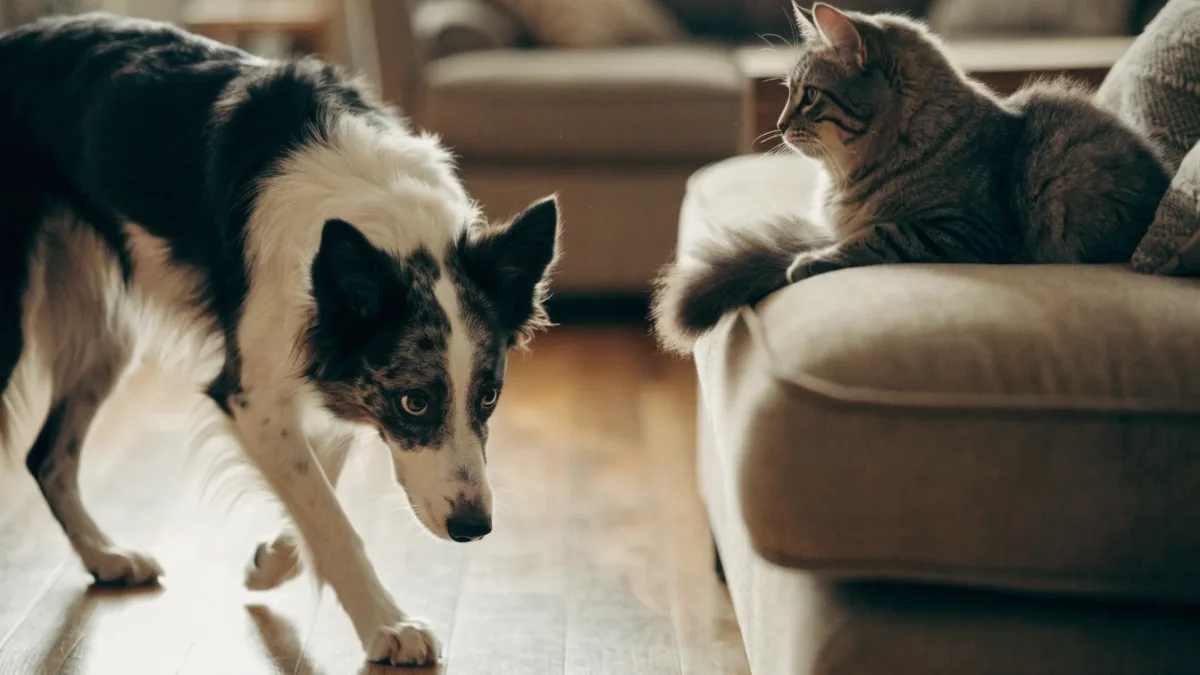
Picture this: you’re standing in your living room, your dog on one side, a friend’s cat on the other. Your dog locks eyes with the cat. Every muscle in their body goes rigid. Their ears snap forward, tail stops mid-wag, and you can practically feel the electricity running through them. That’s not aggression you’re looking at — it’s something older, deeper, and way harder to argue with. It’s prey drive, and it’s been hardwired into your dog’s DNA since before anyone had living rooms to stand in.
The good news? Understanding what’s actually happening in your dog’s brain when they spot a cat is half the battle. The other half is patience, management, and being honest with yourself about what your specific dog can and can’t handle.
Prey Drive vs. Predation: What’s Actually Going On
People use these terms interchangeably all the time, and it drives me nuts because they’re not the same thing at all. Getting this distinction right changes how you approach the whole situation.
Prey drive is the instinctual urge — the desire to chase, stalk, pursue. It’s the engine revving. Every dog has some level of prey drive because every dog descended from wolves who needed it to survive. Without it, there’d be no dogs. It’s not a flaw, a mistake, or a sign that your dog is broken.
Predation is the completion of that sequence — catching and killing. It’s what happens when the chase succeeds and instinct takes its natural course.
Here’s why this matters: a dog with high prey drive isn’t automatically going to kill a cat. Many dogs get stuck at the chase phase and have zero idea what they’d actually do if they caught something. But you absolutely cannot assume that’s the case, and you can’t know for sure until it’s too late. That’s why management is non-negotiable while you work through training.
I’ve seen terriers who’d chase a cat across three counties but wouldn’t know what to do with a cornered one. I’ve also seen supposedly “soft” family dogs catch squirrels with brutal efficiency. You don’t know which version of your dog you have until you’re in the situation, and that’s not a gamble you take with a living animal’s safety.
The Big Misconception: High Prey Drive Doesn’t Mean “Mean”
This one drives behaviorists up the wall. A dog with high prey drive gets labeled as aggressive, dangerous, or having a bad temperament. None of that is accurate.
A dog can be the sweetest, gentlest creature on the planet with humans — absolutely wonderful with kids, cuddly, responsive, the whole package — and still lose their mind when a cat streaks across the backyard. That’s not a contradiction. It’s not a sign of some hidden dark side. It’s instinct doing exactly what instinct does.
Think about it like this: you might love swimming but hate running. Different activities, different responses. Your dog’s brain processes a cat differently than it processes you, and that’s not a choice they’re making. It’s neural pathways and genetics doing their thing.
Modern rescue organizations have actually shifted how they talk about this. Instead of hiding a dog’s prey drive or downplaying it, responsible shelters are upfront: “This dog has high prey drive. Here’s what that means. Here’s what you’d need to manage it.” That honesty helps dogs find the right homes instead of getting returned three weeks later when the new owner discovers their rescue has a thing for the neighbor’s tabby.
Reading the Room: Canine Body Language Around Cats
If you’re going to have a dog and a cat in the same household, you need to become fluent in what your dog’s body is telling you. This isn’t optional. It’s the difference between a peaceful coexistence and an emergency vet visit.
Signs of Playful Curiosity
A dog who’s genuinely curious but not in predator mode tends to look like this:
- Loose, wiggly body language — muscles are relaxed, not coiled
- Soft eyes, possibly doing a “play bow” (front end down, rear end up)
- Tail wagging at a natural mid-height, not stiff or raised high
- Mouth relaxed, maybe slightly open
- Able to break eye contact and check in with you
- Responds when you call their name or make a sound
This doesn’t mean you let them rush up to the cat. But it’s a promising starting point.
Signs of Predatory Intent
This is where you need to pay very close attention. These signals mean your dog’s prey drive has been fully activated:
- Stiff, frozen posture — your dog looks like a statue. Weight shifted forward.
- Hard, unblinking stare — they’re fixated and can’t look away. This is called “eye-stalking” and it’s a predatory behavior, not a curious one.
- Trembling or quivering — that’s not fear. That’s barely contained excitement and muscle tension.
- Tail held high and rigid or tucked tight against the body
- Ears locked forward, not rotating to track other sounds
- Complete unresponsiveness to your voice, their name, food, anything
- Whale eye — you can see the whites of their eyes because they’re not looking away from the cat
If you’re seeing that second list, you’re not dealing with a training moment. You’re dealing with management and safety. Get the dog away from the situation immediately, calmly, and without making it worse.
Management and Training: The Long Game
Let’s be real about something: you cannot train prey drive out of a dog. It’s genetic. It’s part of who they are. Anyone who tells you they can eliminate it entirely is either lying or doesn’t understand animal behavior.
What you can do is manage it, redirect it, and teach your dog impulse control around their triggers. But this is not a weekend project. I’ve worked with owners whose dogs took months — sometimes longer — just to stop fixating on a pet mouse in a cage. That should give you a sense of the timeline you’re working with when a cat is involved.
Start With Barriers
Baby gates are your best friend. So are crates, separate rooms, and any physical separation that keeps both animals safe. Your cat should always have escape routes — high places they can reach that the dog cannot. A cat who feels cornered is going to either fight (which can injure both animals) or panic (which triggers more chasing).
During the initial weeks, your dog and cat should barely see each other. You’re building a foundation of calm before you ever ask for direct interaction.
Build Impulse Control First
Before you introduce the cat as a variable, your dog needs a solid “leave it” and a reliable recall in the face of distractions. Work on these skills with lower-level triggers first — toys, food, maybe squirrels at a distance. You’re building a pattern of: see exciting thing → look at human → get rewarded. That pattern needs to be strong before you add a cat to the mix.
Controlled Introductions
When you’re ready, keep the cat in a carrier or behind a baby gate. Have your dog on a leash — not because you’re expecting disaster, but because you’re setting up for success. Reward calm behavior. If your dog fixates, gently redirect and increase distance. The goal is for your dog to see the cat and remain emotionally regulated enough to hear you and respond.
Short sessions. Five minutes max in the beginning. End on a good note every single time. You’re better off doing ten three-minute sessions than one thirty-minute marathon that ends with both animals stressed.
The Honest Conversation About Safety
Here’s where I need to be straight with you: some dogs should never be trusted alone with a cat. That’s not a failure. It’s not a reflection on the dog or on your training. Some prey drives are so high, so deeply embedded, that coexistence means permanent management.
There’s genuine debate among trainers and behaviorists about whether certain individual dogs — regardless of breed — should ever have unsupervised access to a cat. Some behaviorists say it’s possible with enough training. Others say the risk is never worth it and that separate rooms or crates are the only responsible choice when you’re not actively supervising.
I land somewhere in the middle, leaning toward caution. If your dog has ever caught and harmed a small animal, the answer is probably permanent separation. If your dog shows intense predatory body language that doesn’t decrease with training over months of consistent work, same answer. Some instincts are stronger than any training protocol, and pretending otherwise puts cats at risk.
There’s no shame in management. Crates and baby gates aren’t giving up — they’re being responsible.
What Success Actually Looks Like
Success with a high-prey-drive dog and a cat doesn’t mean everyone cuddles on the couch together. Sometimes it does, and that’s great. But often, success looks like this: your dog and your cat can exist in the same room without incident. The cat walks past the dog and nobody reacts. You can redirect your dog’s attention when needed. Both animals are relaxed enough to sleep, eat, and live normally.
That’s a win. Celebrate it.
And if your version of success looks like permanent separation — a household where the dog has their space and the cat has theirs and everyone stays safe — that’s a win too. The goal isn’t a Pinterest-perfect interspecies friendship. The goal is that every animal in your home gets to live without fear, and you get to live without constant anxiety.
Prey drive isn’t a character flaw. It’s not something your dog chose. It’s a genetic inheritance from ancestors who needed it to stay alive. When we approach it that way — with respect for what it is and honesty about what we can and can’t change — we make better decisions for the animals who depend on us to keep them safe. Both of them.