
You've seen it. The dog takes two steps out the door, sits down, and looks at you with an expression that says: absolutely not. You pull gently on the leash, the dog digs in. You encourage, you coax, you wait — nothing.
Leash refusal is surprisingly common, especially in puppies, newly adopted dogs, and dogs that have had negative leash experiences. And unlike pulling, which is at least a dog going somewhere, leash shutdown means going nowhere.
Why Dogs Refuse to Walk
Fear of the environment. Sounds, traffic, unfamiliar surfaces — for a dog with limited exposure to the outside world, the sensory load can be overwhelming. The dog shuts down as a coping mechanism. This is especially common in puppies, dogs raised in low-stimulation environments, and newly rescued dogs.
Fear of the collar or leash. Some dogs have negative associations with leash equipment — from past rough handling, from collar corrections they didn't understand, or simply from the equipment appearing only during stressful events. The leash becomes a predictor of bad things.
Pain. A dog that has started refusing to walk after previously walking fine may be experiencing discomfort — joint pain, a skin irritation from the collar, something on a paw. Sudden behavioral changes warrant a veterinary check.
Learned helplessness from pressure. Dogs trained with leash corrections who weren't sure what was being asked sometimes generalize to "on a leash = I might do something wrong" and shut down preemptively.
The puppy freeze. Very young puppies sometimes freeze not from fear but from simply not yet understanding how to follow leash pressure. It's different from fear shutdown — the body language is more curious/confused than stressed.
How to Tell the Difference
Look at the body language. A fearful dog shows: lowered body, tail tucked, ears back, potentially trembling, scanning the environment anxiously. A puppy freeze often looks more like a puppy that's been presented with something new and is processing it. A pain-related stop often involves the dog being willing to go some directions but not others, or stopping at specific surfaces or distances.
What to Do
Rule out pain first. Especially for dogs that have changed behavior or that consistently refuse certain surfaces or terrain. A vet check before any training plan.
Build positive associations with the equipment. If the problem is the collar or leash, go back to basics: collar means great food, leash clip means treats happen. Spend several sessions just associating the equipment with good things before asking for movement.
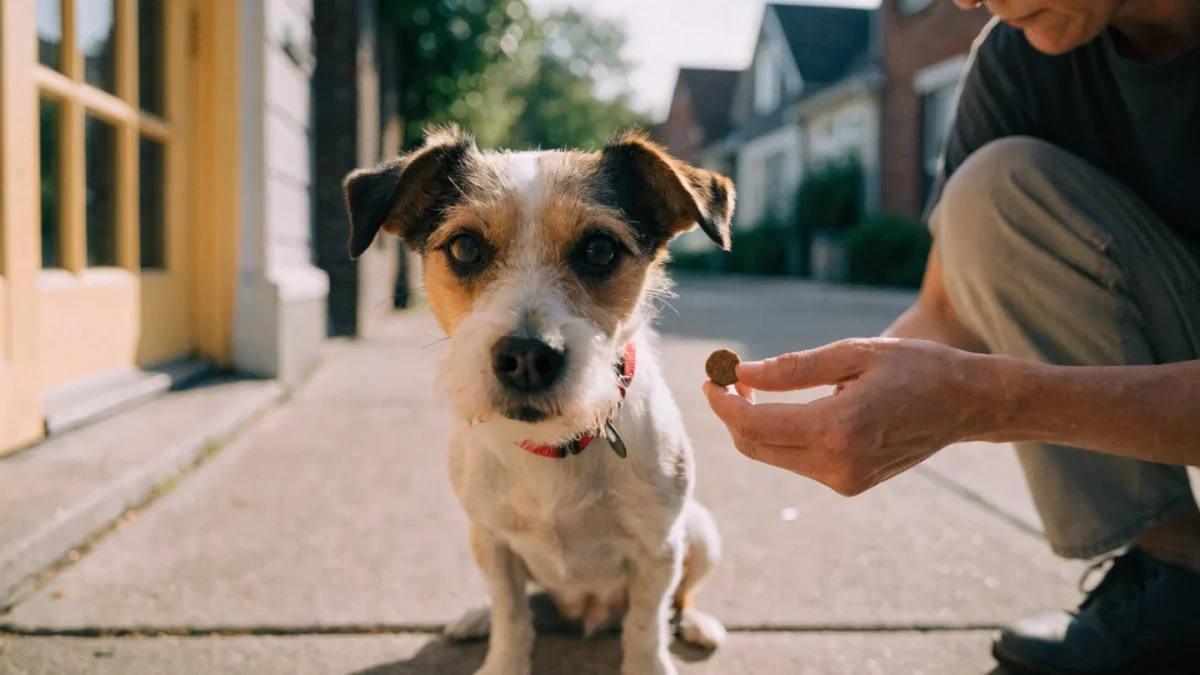
Lure rather than pull. For a dog that's frozen, gentle pulling on the leash is usually counterproductive — it intensifies the freeze through opposition reflex. Crouch down, offer a treat, let the dog move voluntarily toward you.
Don't go far at first. Success is measured in steps, not distance. Two steps, treat, end of session is a win. Build from there.
Carry the dog past the hard part temporarily. For fear-of-environment cases, sometimes carrying the dog away from the scary threshold and starting the walk in a calmer environment helps them engage. You're not solving the problem with this, but you're allowing sessions to happen while you build confidence through other means.
Check leash training fundamentals for the underlying approach, and if fear seems to be the core driver, understanding anxiety in dogs can provide helpful context. (See also: dog anxiety.)
The most important thing: never drag a frozen dog. You're confirming that the leash is something to fear and making the problem worse. Patient luring, short sessions, and building from tiny wins is slower — but it actually works.