
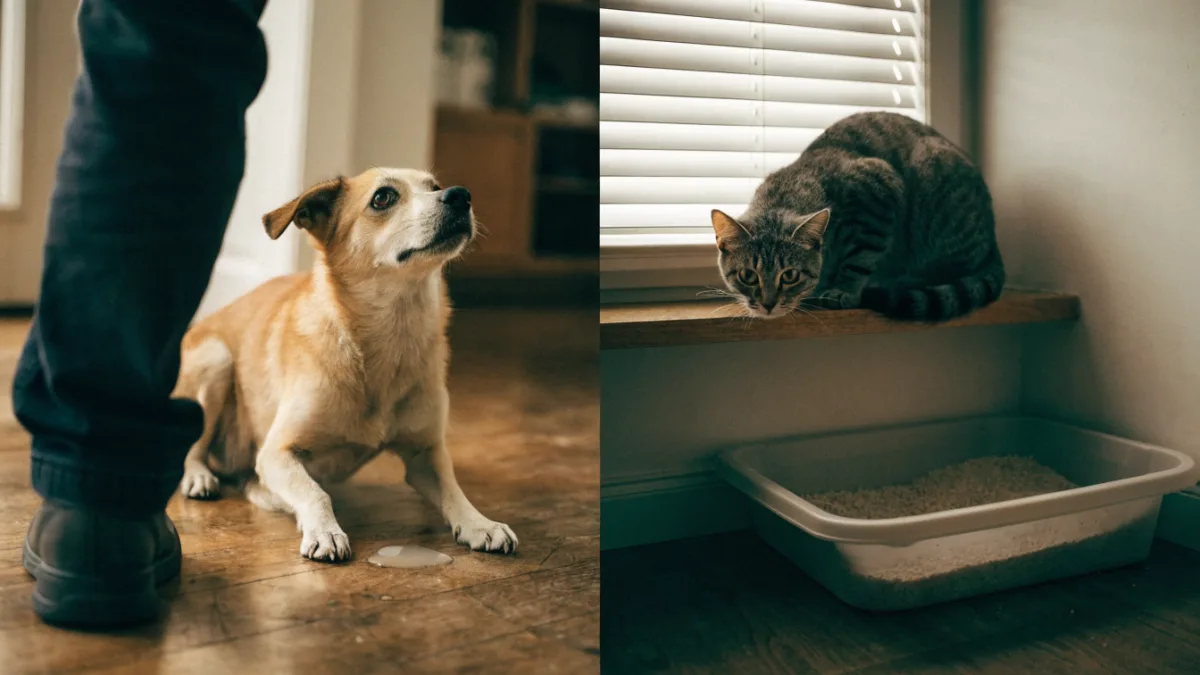
There are two phone calls I get more than any others. The first sounds like this: “Every time someone comes over, my rescue dog pees on their shoes. It’s embarrassing.” The second one goes: “My cat started spraying the hallway wall the week my nephew moved in, and I know she’s doing it to punish me.” Here’s the thing — both of those owners are wrong about what’s happening, and being wrong is exactly what keeps the pee coming. Vets have a clinical name for all of this: inappropriate elimination. And in both species, the engine driving it is usually the same — fear, anxiety, and stress. But a dog puddling during a greeting and a cat spraying your curtains are running completely different software underneath. Understanding which one you’re dealing with is the whole ballgame, because the fixes are not interchangeable.
Your Dog Isn’t Apologizing — He’s Overwhelmed
Dog submissive urination isn’t a behavior your dog chooses. It’s an instinctive, physical appeasement reaction that fires when a dog feels anxious or overpowered by human interaction. In dog language, a small leak of pee while crouching low says “I’m not a threat, please calm down.” It’s the same instinct that makes puppies pee when their mother returns to the nest. Most dogs grow out of it. Rescues often don’t, because a history of trauma or thin socialization keeps that circuit switched on well into adulthood.
I worked with a two-year-old shepherd mix named Birdie who leaked every single time a guest reached down to pet her. Her owner, Dana, told me “she knows she did wrong — she pees and then looks guilty.” No. The peeing and the “guilty” look were the same message, not a crime followed by remorse. Birdie wasn’t sorry. She was doing the canine equivalent of holding up a white flag while also, unfortunately, leaking on your floor.
Submission, Excitement, or Separation Anxiety?
Three different problems, three different body language scripts:
- Submissive urination: The dog cowers, tucks her tail, flattens her ears, averts her eyes, licks her lips, maybe rolls over. The pee happens while she’s low and shrinking. Triggered by direct approaches, looming humans, loud voices, or reaching over her head.
- Excitement urination: The dog is a happy missile — jumping, spinning, wagging so hard her whole back end swings. The pee happens mid-bounce, usually during greetings, and it’s most common in young dogs who simply haven’t developed bladder control yet.
- Separation anxiety: Accidents happen only when the dog is alone, often right by the exit door, alongside destruction — chewed doorframes, scratched paint, shredded crates. If that’s your dog, this isn’t a greeting problem at all, and trainers have seen a [1] as owners headed back to offices and pets lost their pandemic constant companionship.
Watch the whole body, not just the puddle. The posture tells you which problem you’re fixing. Veterinary behavior resources like [2] break these distinctions down in detail if you want a second opinion.
Your Cat Isn’t Spiteful — She’s Running a Territory Audit
Cats almost never pee outside the box to appease a human or to get back at you for working late. That’s anthropomorphizing — assigning human motives like spite to an animal — and it’s the single most damaging myth in cat ownership, because it sends owners looking for discipline when they should be looking for stressors. When a cat goes outside the box, it’s about territory, security, or fear, and it shows up in two distinct flavors.
Spraying vs. Box Avoidance
Spraying is marking. The cat backs up to a vertical surface — a wall, a door frame, your suitcase — stands tall, quivers her tail, and deposits a small amount of urine. She’s not emptying her bladder; she’s leaving a message that says “this territory is claimed.” Litter box avoidance is different: the cat squats and pees normal amounts, just in the wrong places, because the box itself has become associated with something bad — pain, a scary noise, or another cat blocking access.
My favorite example is Miso, a gray tabby whose owner hosted a weekly game night. Within a month, Miso was spraying the coat closet where guests dumped their jackets. Her owner was convinced Miso hated her friends. Reality: every jacket was carrying the scent of strangers directly into the heart of Miso’s territory, and she was answering in the only written language she has.
The triggers are usually changes in the household map: frequent visitors, a new pet, moving furniture or homes, construction noise, even a stray cat visible through the window. Cats don’t spray because they’re mad. They spray because their world shifted and they’re trying to shift it back.
When Company Comes Over: A Game Plan for Both Species
Households with frequent visitors get hit hardest by both problems, so here’s the protocol I hand out constantly.
For dogs: Guests ignore the dog completely for the first several minutes. No eye contact, no bending over her, no high-pitched “HI PUPPY!” — that voice is jet fuel for both excitement and submissive urination. Let the dog approach on her own schedule. When she does, have guests pet under the chin or on the chest, never over the top of her head, and keep their voices low and boring. If the dog is food-motivated, guests can casually drop a treat rather than handing it, which takes the pressure of direct interaction off the table. Dana put this plan in place for Birdie and the puddles went from every visit to rare within about six weeks — no corrections, just less pressure.
For cats: Set up a safe room before the doorbell starts ringing, not after the cat is already under the bed. One quiet room with a litter box, water, food, and a hiding spot. Close the cat in with everything she needs and let her sit out the chaos. This isn’t a punishment — it’s removing her from a situation her nervous system reads as an invasion. For more on reading these situations, this [3] covers the same ground from a veterinary angle.
What Actually Fixes It — and What Makes It Worse
First, the Vet. Always the Vet.
Before you label any of this behavioral, rule out medical causes. Urinary tract infections, bladder stones, and crystals can make peeing painful, and here’s the cruel loop: the cat associates the pain with the box, so she pees everywhere else instead. In older pets, cognitive decline causes genuine house-training breakdowns. And if you have a male cat straining and producing nothing, that’s an emergency — a blocked cat can die within a day. The behavior consult comes after the urine sample.
Punishment Backfires. Every Time.
Old-school owners still insist a rolled-up newspaper or a nose rubbed in the puddle teaches a lesson. Here’s what it actually teaches: that humans are scary when pee appears. Now the dog is anxious about you and about peeing, which produces more submissive urination, often now happening behind the couch where you can’t see it. In cats, punishment adds stress to an already stressed animal, which means more spraying, not less. I’ll own my part: early in my career I told a client to interrupt and correct her dog’s greeting accidents. It got worse within a week. That dog didn’t need more pressure. She needed less. That lesson stuck with me permanently.
What Building Confidence Looks Like
For dogs with submissive urination, the fix is confidence, not correction. Keep homecomings boring — walk in, ignore the dog for a minute, greet calmly once all four paws are on the floor. Teach a hand-target so greetings become a job the dog does to people instead of something that happens to her. For anxious cats, add resources so territory stops feeling scarce: multiple boxes (the classic guideline is one per cat plus one extra), spread across the house, uncovered and away from loud appliances, with at least one on every floor.
There are also legitimate tools now that didn’t get taken seriously a decade ago. Synthetic pheromone diffusers exist in species-specific versions for both dogs and cats and are mainstream veterinary recommendations, not gimmicks. Snug-fitting anxiety wraps help some dogs through triggering moments. Supplements containing L-theanine or colostrum have real research behind them. And increasingly, vets are prescribing anti-anxiety medication like fluoxetine earlier in a rescue’s rehabilitation — not as a cop-out, but to take the edge off the fear so behavior modification actually has room to work. You can’t train a panicking animal. You have to lower the panic first.
Every dog and cat is different, and I’ve seen two animals from the same litter react to the same stressor in opposite ways. But here’s the takeaway I’d want every rescue owner and every busy household to keep: inappropriate elimination is one of the leading reasons pets get surrendered to shelters or returned by adopters — not because these animals are broken, but because their humans read a stress signal as a moral failing. Your pet isn’t peeing on your floor to ruin your day. She’s asking for help in the only language she has. Learn to read it, and you don’t just save your floors — you keep a scared animal in the only home she’s got.
Sources
- massive spike in cases — facebook.com
- VCA's guide to house soiling — vcahospitals.com
- breakdown of why dogs and cats pee indoors — youtube.com