

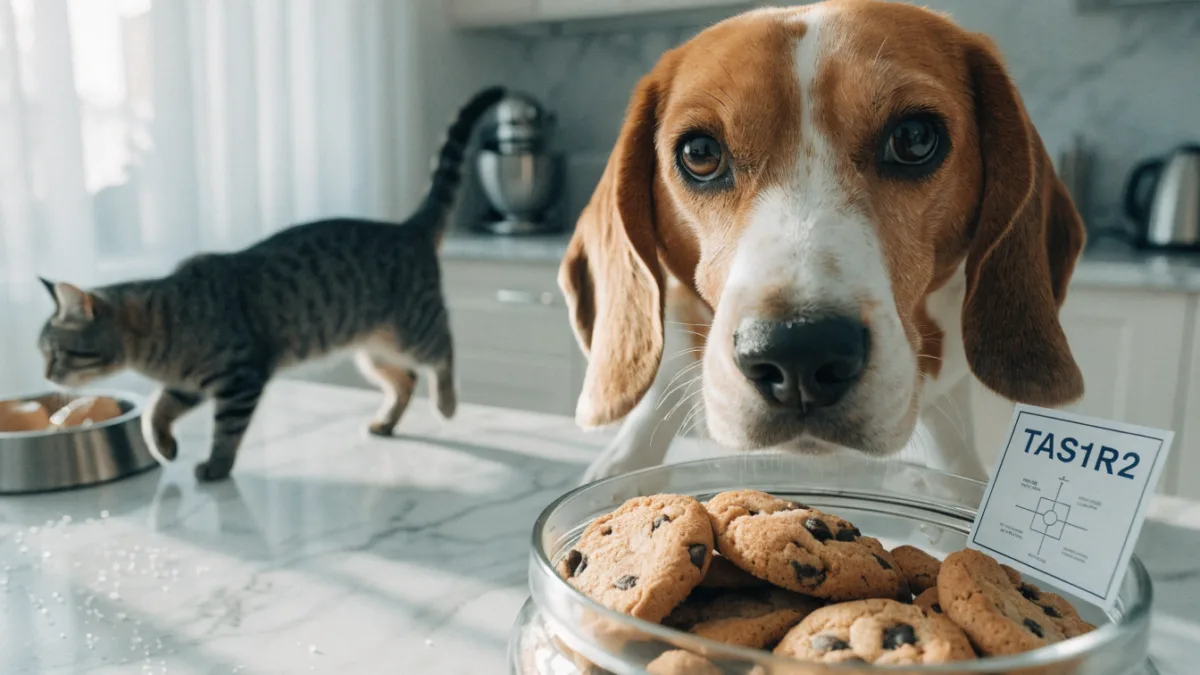
Picture a flustered owner rushing an eight-year-old Golden Retriever named Buster into a clinic. Buster hadn’t injured himself, but he had managed to pull a freshly baked batch of snickerdoodles off the kitchen counter and eat the entire plate. “He’s absolutely shameless,” his owner said, half-amused and half-exasperated. “He will do anything for sugar.” But when she mentioned offering a piece of cookie to her other pet, a sleek Siamese cat named Cleo, Cleo just sniffed it and walked away in complete disgust.
This behavioral difference is something I see constantly in clinical practice, and it brings up a fascinating question. Why do dogs obsess over sweet treats while cats act like sugar doesn’t exist? The answer isn’t just about individual preferences. It lies deep within evolutionary biology and the genetic makeup of our pets’ mouths.
The Genetics of the Sweet Tooth
To understand why Buster loves cookies and Cleo ignores them, we have to look at how taste actually works on a cellular level. When we eat something sweet, like a strawberry or a cube of sugar, the sweetness doesn’t just magically register in our brains. It requires a very specific biological handshake.
Mammals detect sweetness using specialized taste receptor cells located on the tongue. To taste sugar, two specific protein receptors—known as T1R2 and T1R3—must pair up to form a functional sweet receptor. These proteins are encoded by corresponding genes (Tas1r2 and Tas1r3). When a sugar molecule binds to this receptor pair, it sends a signal to the brain saying, “Hey, here is some quick energy!”
In most mammals, this system works flawlessly. But in cats, there is a biological roadblock. Felines possess the gene that should create the T1R2 protein, but a specific genetic mutation prevents it from forming or functioning properly. In the scientific world, we call this a pseudogene. A pseudogene is essentially a broken piece of DNA that looks like a gene but doesn’t work—it’s like a rusty lock where the key no longer fits. Because the T1R2 protein is misshapen or absent, the sweet receptor cannot form, and the signal never reaches the brain. Cats are, for all intents and purposes, functionally blind to sweetness.
Why Felines Are Evolutionarily “Sugar-Blind”
You might wonder why nature would turn off the ability to taste sugar for an entire species. It all comes down to their evolutionary path and their strict dietary needs.
Domestic cats, along with their wild counterparts like lions, tigers, and leopards, are obligate carnivores. This means their bodies are biologically hardwired to survive solely on animal tissue. They require a diet rich in animal protein and specific amino acids to thrive, and their natural ancestral diet contains almost zero carbohydrates or simple sugars. Because of this, they had absolutely no evolutionary pressure to maintain the genetic ability to taste sweetness. If you don’t eat fruit or grains to survive, you don’t need to know what they taste like.
It’s also worth noting that when we examine cat taste buds, we find they have far fewer of them overall than humans or dogs. While humans boast roughly 9,000 taste buds, cats only have about 470. Instead of being spread out across various flavor profiles like ours, feline taste receptors are highly concentrated on detecting amino acids—the building blocks of meat. They are incredibly sensitive to the savory flavors of animal proteins, effectively ignoring the carbohydrate spectrum entirely.
Can Dogs Taste Sweet? The Scavenger’s Advantage
If cats represent the picky specialists of the animal kingdom, dogs are the ultimate opportunists. When clients ask me, “can dogs taste sweet?”, my answer is always an unequivocal yes.
Dogs are natural omnivores and scavengers. Before they were domesticated and lived in our homes, their wild ancestors roamed the forests and plains, eating whatever they could find to survive. This included meat, but it also included fallen fruits, berries, and root vegetables. Being able to detect and crave the calorie-dense, sugary energy found in these plant materials provided a massive survival advantage. A dog that could smell and taste a ripe apple had a better chance of surviving a harsh winter than one that ignored it.
Just like humans, dogs possess the necessary functional taste receptors (intact Tas1r2 and Tas1r3 genes) that pair up to detect sugars. This is exactly why your dog will happily raid the cookie jar or beg for a piece of your banana. They taste that sugar, and their brain lights up with biological encouragement to consume those dense calories.
Despite having fewer taste buds than humans (around 1,700 compared to our 9,000), dogs share our biological ability to enjoy sweetness. And it isn’t just natural sugars; they can detect artificial sweeteners, too, which is why you have to be incredibly careful about what they manage to get into around the house.
The Great Ice Cream Debate: Feline Biology vs. Behavior
Here is where a friendly debate usually breaks out with pet owners. Someone will swear up and down that their cat loves sweets. “My cat begs for vanilla ice cream every single night,” they’ll say. “She loves the sugar!”
I’ve changed my mind on this topic over the years. Early in my career, I would have insisted the owner was simply mistaken, stubbornly citing the genetic evidence. But animal behavior doesn’t always align perfectly with a sterile reading of genetic theory. The truth is, the owner isn’t entirely wrong about their cat’s behavior—they are just misinterpreting the biological attraction.
“My cat ignores my fruit bowl completely, but the second I open a pint of heavy cream ice cream, she acts like she’s starving.” — a perfectly accurate observation from a client I spoke with last month.
If your cat is begging for ice cream, cake, or frosting, it is absolutely not the sucrose they are craving. They are actually attracted to the high fat content, the creamy texture, or the animal proteins (like dairy or eggs) present in those foods. This behavior aligns perfectly with their umami-focused biology. They want the amino acids and fats, not the sugar. Some researchers even suggest cats might be able to taste certain complex carbohydrates or amino acids that humans register as “sweet,” but the feline brain processes these flavors entirely differently than ours do.
What Pet Nutrition Science Tells Us About Feeding Our Pets
Understanding the genetics of taste isn’t just a fun trivia fact; it has completely revolutionized modern pet nutrition science.
Because we now know exactly how cat taste buds function, pet food manufacturers no longer waste time developing sweet flavor enhancers for feline diets. Instead, they use this genetic research to develop specialized flavor coatings that mimic the aromas and flavors of animal proteins, fats, and umami. If you ever wonder why dry cat food is coated in a liquid “digest” (a highly concentrated flavoring made from hydrolyzed animal proteins), it’s because that specific flavor profile is exactly what triggers a cat’s appetite.
On the canine side, pet nutrition science has had to pivot in the opposite direction. Because dogs can taste sweetness so well, many commercial dog treats are heavily flavored with sweeteners to make them highly palatable. This is a massive problem in modern veterinary medicine. We are seeing an epidemic of obesity and diabetes in domestic dogs, driven largely by overfeeding calorie-dense, sugary treats. Just because a dog biologically craves and enjoys a sweet potato treat or a sugary biscuit doesn’t mean it should make up a significant portion of their diet. Look for whole-food ingredients and single-source proteins rather than artificial sweeteners when choosing treats—and remember, always consult your veterinarian before making any major changes to your pet’s diet or treating routine.
Interestingly, this field of study is expanding beyond just dogs and cats. Recent genetic studies have proven that diet directly and rapidly alters mammalian DNA over evolutionary time. Scientists have discovered that other obligate carnivores, such as hyenas, sea lions, and dolphins, have also independently lost their ability to taste sweets. When your entire survival strategy revolves around eating meat, the genetic machinery required to taste sugar simply falls into disrepair.
Respecting Nature’s Blueprint
The next time your dog tries to steal your pastry, or your cat turns their nose up at a piece of fruit, take a moment to appreciate the millions of years of evolution at play. Our pets’ taste preferences are perfectly tailored to the environments their ancestors survived in. Dogs developed a sweet tooth to find scarce, calorie-dense foods in the wild, while cats refined their senses to become the ultimate, specialized hunters.
While we might view the ability to enjoy a sweet treat as a universal joy, nature clearly disagrees. Embracing this biology means we can feed them better, respect their natural instincts, and keep them healthier. Whether your companion is a sugar-loving scavenger or a strictly savory hunter, honoring their evolutionary design is the greatest act of care we can provide. And as we look to the wild counterparts of our domestic companions—from the big cats roaming the savanna to the wolves tracking through the forest—understanding their evolutionary biology reminds us of the delicate balance of nature. Preserving their natural habitats ensures that these incredible, specialized adaptations continue to thrive in the wild, exactly as nature intended.