

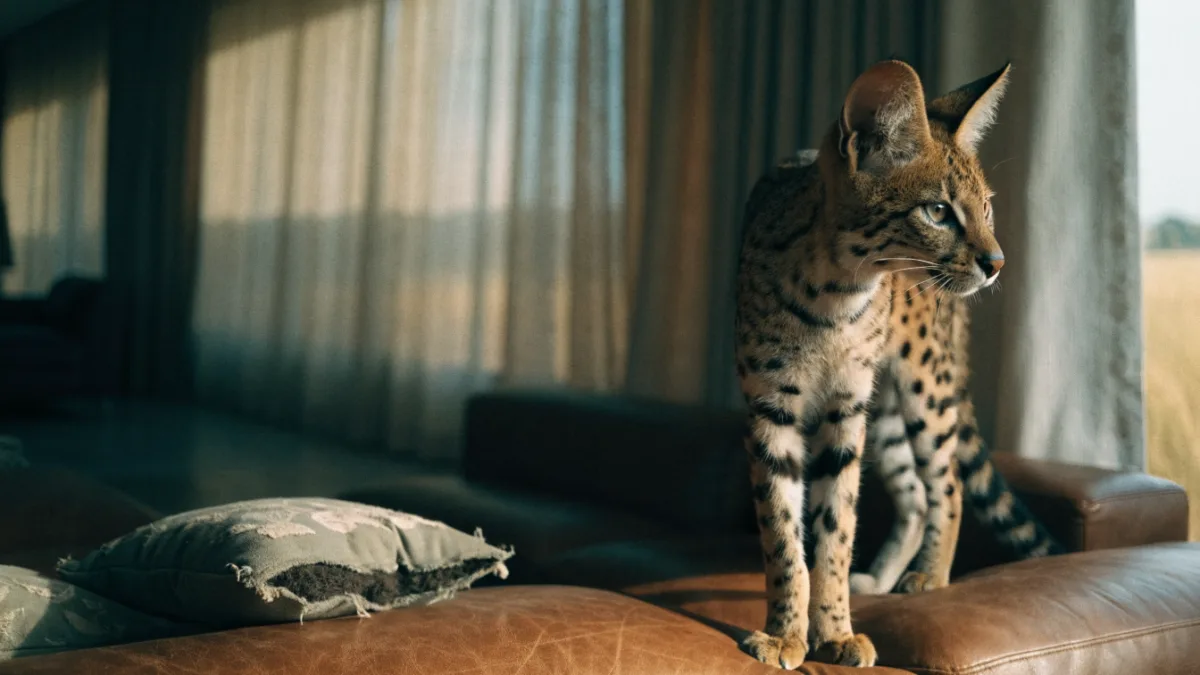
Watch the video and the appeal is instant. A tawny, spotted cat coils and launches straight up, plucks a toy from the air nearly nine feet overhead, and lands without a sound. Within hours the comments fill up: I need one. How much? Where do I get one? What the camera never shows is the same cat at 3 a.m., pacing and yowling. The curtains soaked in spray. The owner learning — usually from an animal control officer, not a breeder — that no rabies vaccine is approved for wild felids, so a single reported bite can end with the animal confiscated and euthanized for testing. Servals (Leptailurus serval) are extraordinary animals. That’s exactly why they fail as pets.
Built for the Savanna, Not the Sofa
A serval is a medium-sized African wild cat: 20 to 40 pounds of spring-loaded muscle with the longest legs, relative to body size, of any cat species on Earth. Its ears are proportionally the largest of any cat, and they’re working equipment, not decoration — a serval can hear rodents moving in tunnels beneath the soil, freeze, tilt its head like a satellite dish, then detonate upward in a pounce that’s more missile than mammal. In the wild, this is a solitary hunter patrolling a home range that can stretch across several square miles, hunting morning and evening for a life that spans roughly a decade — and in captivity, up to twenty years.
None of that hardware has an off switch. Tamed is not domesticated. A house cat carries some ten thousand years of selection for tolerance of humans, confinement, and crowded living; a bottle-fed serval tolerates handling, at best, and its instincts — to hunt, to roam, to spray, to stay solitary — remain the whole animal. As Panthera’s field biologists,[1] the wild behaviors that make servals suffer in captivity aren’t quirks to be trained away; they’re the cat itself. Buying one doesn’t shrink those square miles of territory into a two-bedroom apartment. It just removes every healthy outlet for them.
How a Wild Cat Ends Up for Sale Online
One distinction gets lost constantly: veterinarians file everything that isn’t a dog, cat, or farm animal under “exotic” — hamsters, ferrets, captive-bred geckos, and servals all share the label. That’s a linguistic disaster, and it’s the root of many exotic pet trade problems. My own spare room is full of reptiles whose ancestors were bred in captivity for generations, selected for life beside humans. A serval born in a breeder’s nursery is generation zero — a wild animal one handshake removed from the savanna. Lumping them together is how buyers convince themselves they’re simply adopting a spicier house cat.
The social media pipeline
Plenty of the trade now begins with a scroll. Caracals (Caracal caracal) got their viral moment through the “Big Floppa” meme; serval and caracal clips rack up millions of views, and breeders market directly in the comments. The videos capture the leap and the satellite-dish ears. They never capture the raw-prey dinners, the nighttime vocalizations, or the wall behind the couch.
The money is serious, too. Servals are commonly listed at $2,500 to $6,000, and first-generation Savannah cats — roughly half serval by blood — have reportedly sold for $12,000 to $20,000. That hybrid market runs on serval breeding stock, so the species gets monetized twice: as pets and as parents. And captive breeding never satisfies the demand it generates —,[2] when buyers outstrip captive supply, wild capture fills the gap, feeding an illegal wildlife trade estimated at $10 to $20 billion a year. The kitten in the carrier and the cat in the snare are connected.
A patchwork of laws with plenty of gaps
[LOCALIZATION CHECK: exotic pet laws vary drastically by country and region — verify current local rules before relying on any legality claim.] In the United States, whether you can keep a serval depends on your address: a few states require no permit, many require licenses, and a growing number ban ownership outright — a patchwork that makes interstate trafficking notoriously hard to police. The federal Big Cat Public Safety Act, signed in December 2022, ended private ownership of lions, tigers, and other big cats nationwide, but servals, caracals, and hybrids were left out, a gap welfare groups are pushing to close. Internationally, servals sit on CITES Appendix II: trade is regulated but permitted, and enforcement is uneven. In the UK, they require a Dangerous Wild Animals Act licence, a scheme welfare organizations say is widely flouted. And a permit guarantees nothing about welfare — paper doesn’t turn a living room into a territory.
What the Cute Videos Leave Out
Start with behavior. Even neutered servals spray — copiously, potently, and with enthusiasm for vertical surfaces you own. Litter training is unreliable at best. A 30-plus-pound animal built to climb, scratch, and mark will redecorate your home in ways no domestic cat could manage, and play that’s charming in a kitten becomes genuinely dangerous in an adult with the reflexes of a specialist predator.
Then diet: servals need whole prey — quail, rats, mice — to meet their nutritional requirements, including taurine. Kibble and grocery-store chicken don’t cut it, and improperly fed animals deteriorate visibly. Then medicine: very few veterinarians will or can treat wild felids, and the rabies question hangs over every interaction, since vaccines are off-label at best and a bite report can mean mandatory euthanasia so the animal can be tested. Then the mutilations performed to make wild animals “pet-safe”: declawing, which amputates the last bone of each toe, and pulling canine teeth. Many surrendered servals arrive at sanctuaries bearing both.
When it all falls apart, it falls apart in a predictable pattern:
- A viral video or a breeder’s kitten photos spark an impulse purchase.
- The cuddly kitten phase ends at maturity; spraying, marking, and unpredictability begin.
- The owner can’t find a vet, can’t rehome the animal, and often can’t legally sell it across state lines.
- The serval escapes, is surrendered, or is confiscated — escaped pet servals keep turning up loose in American suburbs, sometimes hit by cars, and one made national news after being found wedged into a car’s engine compartment in the Washington, D.C. area.
- A sanctuary inherits a traumatized, sometimes mutilated animal that may live another fifteen-plus years.
Picking Up the Pieces: The Sanctuary Bill
Organizations like The Wildcat Sanctuary in Minnesota and Turpentine Creek in Arkansas have watched serval and hybrid intakes climb — many animals arriving declawed, malnourished, or simply abandoned when the novelty wore off. Good sanctuaries operate by rules the trade never follows: accredited facilities (Global Federation of Animal Sanctuaries accreditation is the marker to look for) do not breed, buy, sell, or trade animals. Whoever walks through the gate is a lifetime commitment, and lifetime care for a single wild cat — purpose-built enclosure, specialized diet, exotic veterinary work — can run well into the tens of thousands of dollars. None of it gets billed to the person who caused the problem.
Some sanctuary staff will admit to an uncomfortable tension: does the safety net enable the trade? If surrender weren’t possible, would anyone buy at all? It’s a fair question, but the animal in front of them always outranks the philosophy. Teaching institutions absorb the fallout too — at America’s Teaching Zoo at Moorpark College, servals [3] live as ambassadors, and even with professional animal-care staff and institutional funding, they’re full-time educational commitments, not companions. If it takes a college program to care for one properly, “pet” was never the right word.
Servals are currently listed as Least Concern on the IUCN Red List, but the trend is downward, and the pressures stack: wetland degradation, habitat loss, killing for pelts, retaliatory killing, and capture for the pet trade — which bites hardest where populations are already thin. Every living room leopard represents demand that echoes back down that chain. So the takeaway is simple. Don’t buy wild cats, and don’t buy first-generation hybrids that keep serval breeding mills in business — the fundamental problem with wild animals kept as pets is that the animal pays for our fantasy. If you want a companion, shelters are full of cats who actually evolved for the job. And if it’s servals you love, put your money where the meme is: accredited sanctuaries and field conservation programs are doing the real work. The leap we all fell for is a hunting leap. It belongs on a floodplain at dusk, aimed at something wild — not performed in a spare bedroom for a camera.
Sources
- put it — panthera.org
- as Panthera notes — facebook.com
- Elsa and Naomi — facebook.com