

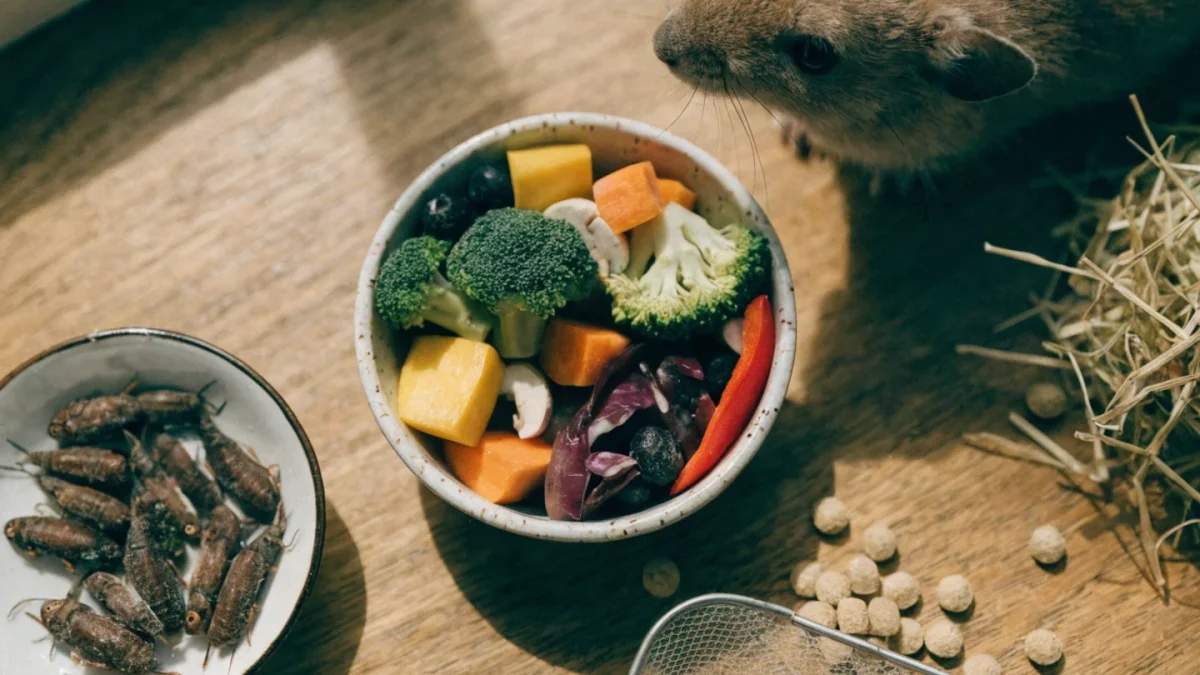
The most expensive reptile I've ever watched die cost its owner about forty dollars. It was a green anole — tiny, cheap, supposedly "easy." The keeper fed it dried cricket pellets from the pet store because that's what the label said. Within six weeks the anole stopped eating, its jaw softened, and by the time I saw it the damage was irreversible. Metabolic bone disease from zero calcium supplementation and no UVB. A forty-dollar lizard. A preventable death.
Exotic pet nutrition differs from dog and cat feeding in one fundamental way: there's no single bag of food that works. Each species has evolved to process specific nutrients, and the gap between "close enough" and "correct" can be the difference between a thriving animal and a slow decline you won't notice until it's too late. This exotic pet nutrition guide breaks down what reptiles, birds, fish, and small mammals actually need — not what's convenient, not what the pet store suggests, but what keeps them alive and healthy long-term.
If you're still in the decision phase, our guide on choosing your first exotic pet covers the commitment reality for each species group. And since nutrition and environment are deeply connected — temperature affects digestion in reptiles, lighting drives vitamin D3 synthesis — the habitat setup fundamentals matter just as much as what goes in the food bowl.
Reptile Nutrition: It Starts With Knowing Your Feeding Type
Reptiles fall into three broad dietary categories, and mixing them up is where things go wrong fast.
Insectivores — leopard geckos, most young bearded dragons, chameleons — eat live insects as their primary protein source. The insects themselves aren't nutritionally complete, which is why calcium and vitamin dusting exists. I dust every feeding for juveniles, every other feeding for adults, and I've had better results with that schedule than any care sheet recommendation I've tried. The insect is just a delivery vehicle for the supplements.
Herbivores — adult green iguanas, uromastyx, some tortoises — need fresh dark leafy greens, vegetables, and occasional fruit. The mistake I see constantly: iceberg lettuce. It's nutritionally empty. Collard greens, mustard greens, dandelion greens — those are the workhorses. Iguanas specifically need a calcium-to-phosphorus ratio around 2:1 in their overall diet, which means avoiding high-phosphorus foods like spinach as staples.
Omnivores — bearded dragons (adults), blue-tongued skinks, some species of turtles — eat both insects and plant matter, and the ratio shifts with age. A juvenile bearded dragon eats maybe 80% insects and 20% greens. By adulthood, that flips. I had a rescue beardie come in that was still being fed like a juvenile at three years old — overweight, fatty liver, the works. The owner didn't know the ratio was supposed to change.
The universal rule across all reptiles: calcium supplementation. Without adequate calcium — and without UVB light to metabolize it into usable vitamin D3 — reptiles develop metabolic bone disease. It's the most common nutritional disorder in captive reptiles, and it's entirely preventable.
Bird Diets: Beyond the Seed Myth
Seeds are to birds what fast food is to humans. They'll eat it eagerly. They'll choose it over anything else. And it'll slowly wreck their health.
An all-seed diet is high in fat and deficient in vitamin A, calcium, and most amino acids that parrots, cockatiels, and budgies need. I've seen cockatiels on seed-only diets for eight or nine years that looked fine externally but had fatty liver disease and were weeks from organ failure. The tricky part with birds is they hide illness extraordinarily well — an evolutionary survival strategy that works against captive keepers.
A balanced bird diet looks like this: 60-70% formulated pellets as the nutritional base, 20-30% fresh vegetables and fruits (with heavy emphasis on vegetables — dark leafy greens, carrots, bell peppers, cooked sweet potato), and 10% or less seeds and treats. Some species have additional requirements. Lorikeets and lories need a nectar-based diet. Eclectus parrots need higher fruit and vegetable ratios than most psittacines. African greys are particularly prone to calcium deficiency.
The conversion from seeds to pellets takes patience. Some birds switch within a week. I worked with a 14-year-old Amazon parrot that took four months. The owner nearly gave up twice. The bird is now thriving on a pellet-based diet and has more energy than it's shown in years.
Fish Nutrition: Matching Food to Mouth and Gut
Fish keeping is the one area where most people actually overfeed rather than underfeed. A fish's stomach is roughly the size of its eye — that's the per-meal volume you're targeting.
The food type depends on where in the water column your fish feeds and what its digestive system processes:
Surface feeders (bettas, guppies, many killifish) do well with flakes that float. Bottom feeders (corydoras, plecos, loaches) need sinking pellets or wafers. Mid-column swimmers often accept both. But the real distinction is herbivore versus carnivore versus omnivore. A pleco that doesn't get algae wafers or blanched zucchini will starve surrounded by carnivore pellets. A betta that only gets plant-based flakes is missing the protein it needs.
Frozen and live foods — bloodworms, brine shrimp, daphnia — are supplements, not staples for most community fish. They're useful for conditioning breeding fish or enticing sick fish to eat. I use frozen bloodworms about twice a week for my community tanks. More than that and you risk water quality issues, which circles back to nutrition in a different way: bad water means stressed fish that don't absorb nutrients properly.
One thing that doesn't get mentioned enough: fish food degrades. An opened container of flakes loses nutritional value within about three months as fats oxidize. If you're keeping a small tank, buy small containers.
Small Mammal Nutrition: Hay Is the Foundation
Rabbits, guinea pigs, and chinchillas share one dietary truth — unlimited grass hay should be 80% or more of their diet. Not alfalfa (too high in calcium and protein for adults), not hay cubes (not enough fiber length to promote proper tooth wear), but long-strand timothy, orchard grass, or oat hay.
I picked up a rabbit from a rescue situation a few years back. Four years old, severely overgrown molars, GI stasis, and the kicker — the previous owner had been feeding it primarily pellets with occasional hay "treats." This rabbit had never had unlimited hay access. The dental work alone cost more than everything I'd spent feeding my own rabbits in the previous year combined.
Guinea pigs have an additional non-negotiable: vitamin C. Like humans, they can't synthesize it internally. They need 10-30 mg per day from fresh vegetables (bell peppers are the gold standard) or a liquid supplement added to food — not to water, where a 2015 study in Redox Biology showed that less than 50% of ascorbic acid remained after just 24 hours in a water bottle, making water supplementation unreliable.
Hamsters, gerbils, and rats are omnivores with very different needs. A hamster's diet is roughly 15-20% protein from a quality seed-and-pellet mix plus small amounts of fresh vegetables and the occasional mealworm or piece of cooked egg. Rats need even higher protein and do well with a lab-block base supplemented with fresh food.
Ferrets sit in their own category entirely. They're obligate carnivores — yes, like cats — and need a diet that's 32-38% protein and 15-20% fat, almost entirely from animal sources. Fruit, vegetables, and grains can cause insulinomas and gastrointestinal blockages in ferrets. Every ferret rescue I've worked with has taken in animals with insulin problems from inappropriate diets.
Supplements: What Actually Needs Adding
Supplementation in exotic pets isn't optional, but it's also not universal. Here's where each group stands.
Reptiles need calcium powder (without phosphorus for most species) dusted on food. Insectivores need it on every insect for growing animals. They also need vitamin D3 supplementation if their UVB lighting isn't adequate — though proper UVB makes oral D3 supplementation less critical. A multivitamin once or twice a week rounds things out. Over-supplementing vitamin A is a real risk with reptiles because it competes with vitamin D3 absorption.
Birds on a pellet-based diet rarely need additional supplements because the pellets are formulated to be complete. The exception is calcium for laying hens or species prone to deficiency (African greys), and vitamin A for birds still transitioning off seed diets. If a bird is eating 60%+ pellets and a good variety of vegetables, extra supplements can actually cause problems — vitamin toxicity is real in small animals.
Fish get their supplements through their food and their water. Freshwater fish in soft water may benefit from mineral supplements in the water column. Herbivorous fish need food with spirulina or similar algae content. But honestly, if you're feeding a quality species-appropriate food and maintaining good water parameters, most freshwater community fish don't need additional supplementation.
Small mammals get their supplements primarily through variety. Guinea pigs need that external vitamin C. Rabbits and chinchillas generally don't need supplements if their hay and pellet quality is good — and in fact, supplemental calcium can cause bladder sludge in rabbits. More isn't better.
Reading Labels and Avoiding Junk
Exotic pet food labeling is poorly regulated compared to dog and cat food. I've seen reptile "complete diets" that would kill an iguana within a year if used as directed. Bird seed mixes marketed as "nutritionally balanced" that are 90% sunflower seeds.
What to look for: ingredient lists where the primary ingredients match the species' natural diet. Protein percentage that aligns with the animal's needs (high for carnivores and insectivores, moderate for omnivores, lower for herbivores). No artificial colors — your bearded dragon doesn't care if the pellet is red or brown, and the dyes serve no nutritional purpose.
What to avoid: foods marketed across multiple species groups with vague claims. A "small animal" food that works for rabbits and hamsters is compromised for both. Freeze-dried insects without any indication of calcium supplementation — they're not inherently bad, but they need the same dusting protocol as live insects, and the packaging rarely mentions this.
For fish, avoid the giant economy-sized containers unless you have a massive setup. You'll waste more money in degraded food than you save on the bulk price.
Transitioning Diets Safely
Sudden diet changes cause problems across every species group. Birds refuse new foods or develop GI upset. Reptiles may go on hunger strikes. Small mammals can develop fatal GI stasis from abrupt changes.
The universal approach: introduce new foods alongside current accepted foods, gradually increasing the ratio. For birds, this might mean offering pellets in one dish and seeds in another, slowly reducing the seed quantity over weeks. For rabbits, new vegetables should be introduced one at a time in small amounts, with a 48-hour watch for soft stool before adding the next one.
Reptiles are sometimes easier — many insectivores accept new feeder insects readily. The challenge is usually switching herbivorous reptiles to healthier greens when they've been raised on nutritionally poor options. I've had success mixing finely chopped target greens into accepted foods, gradually changing the ratio. Patience matters more than strategy here.
The one exception where you change diets fast: when the current diet is actively harming the animal. A ferret eating fruit-heavy food, a rabbit eating mostly pellets with no hay, a bird on pure seed with signs of fatty liver. In those cases, the risk of continuing outweighs the stress of a rapid switch, though I still transition over a few days rather than overnight when possible.
Common Nutritional Mistakes by Species Group
The patterns I see repeat endlessly.
With reptiles, it's almost always calcium-related. Not enough dusting, wrong calcium-to-phosphorus ratio, inadequate UVB to metabolize it. Second most common: feeding the same single feeder insect forever. Mealworms alone don't cut it — they're high in fat and have a poor calcium-to-phosphorus ratio. Variety matters.
With birds, seed addiction dominates. Owners feel guilty restricting seeds because the bird clearly prefers them. But preference isn't the same as need. The second mistake: avocado. It's toxic to birds. Period. I still encounter keepers who don't know this because it's not mentioned on every list of "safe bird foods."
With fish, overfeeding causes more deaths than malnutrition. Uneaten food decays, spikes ammonia and nitrites, and poisons the water. Feed what they can consume in two minutes, once or twice daily. The second issue: feeding tropical fish cold-water food formulations, or vice versa. Metabolism and protein requirements differ.
With small mammals, insufficient hay access causes dental disease and GI problems. The other recurring issue: too many treats. A rabbit doesn't need daily banana. A guinea pig doesn't need yogurt drops. These are high-sugar items that mess with gut flora and promote obesity in animals built for a high-fiber, low-calorie diet.
Frequently Asked Questions
Can I feed my exotic pet the same food as a similar species?
Sometimes, within narrow limits. A bearded dragon and a blue-tongued skink have overlapping omnivore diets, but their specific vegetable ratios and insect needs differ. A cockatiel and a budgie have similar seed/pellet needs but different vitamin A requirements. The safest answer: research the specific species, not just the group. I've seen leopard geckos fed crested gecko meal replacement powder because "they're both geckos." One is an insectivore, the other is a frugivore-omnivore. Completely different digestive systems.
How do I know if my exotic pet is malnourished?
Look for species-specific warning signs. In reptiles: rubbery jaw, kinked tail, trembling limbs (calcium deficiency). In birds: fluffed feathers, flaky beak, dull plumage, lethargy. In fish: faded colors, clamped fins, sunken belly. In small mammals: overgrown teeth, rough coat, lethargy, unexplained weight loss. By the time you see obvious signs, the deficiency has usually been developing for weeks or months. That's why prevention through proper diet matters more than recognition.
Should I give my exotic pet vitamins every day?
No — and for some species, daily supplementation of certain vitamins causes toxicity. Fat-soluble vitamins (A, D3, E, K) accumulate in tissue and become dangerous in excess. Water-soluble vitamins (C, B complex) are safer in larger doses because the body excretes excess amounts. Follow species-specific supplement schedules: calcium at most feedings for growing reptiles, multivitamins once or twice weekly for insectivores, vitamin C daily for guinea pigs only.
Is live food better than freeze-dried or pre-killed options?
Live food stimulates natural hunting behavior in insectivores and carnivores, which has enrichment value beyond just nutrition. But nutritionally, a well-dusted freeze-dried cricket isn't dramatically different from a live one. The real issue is gut-loading — live insects can be fed nutritious foods for 24-48 hours before offering them to your pet, transferring those nutrients up the food chain. You can't gut-load a freeze-dried insect. For keepers who can manage live insect colonies, live is ideal. For those who can't, freeze-dried with proper supplementation is a reasonable alternative.
Do exotic pets need fresh water or is tap water fine?
It depends on the species and your local water quality. Reptiles and small mammals can drink dechlorinated tap water in most municipalities. Fish are far more sensitive — chlorine and chloramines are directly toxic, and parameters like pH, hardness, and temperature must match species requirements. Amphibians absorb water through their skin and are extremely sensitive to contaminants. For any aquatic or semi-aquatic species, treat tap water with a dechlorinator at minimum, and test it regularly. Well water can also be problematic if it contains heavy metals.