

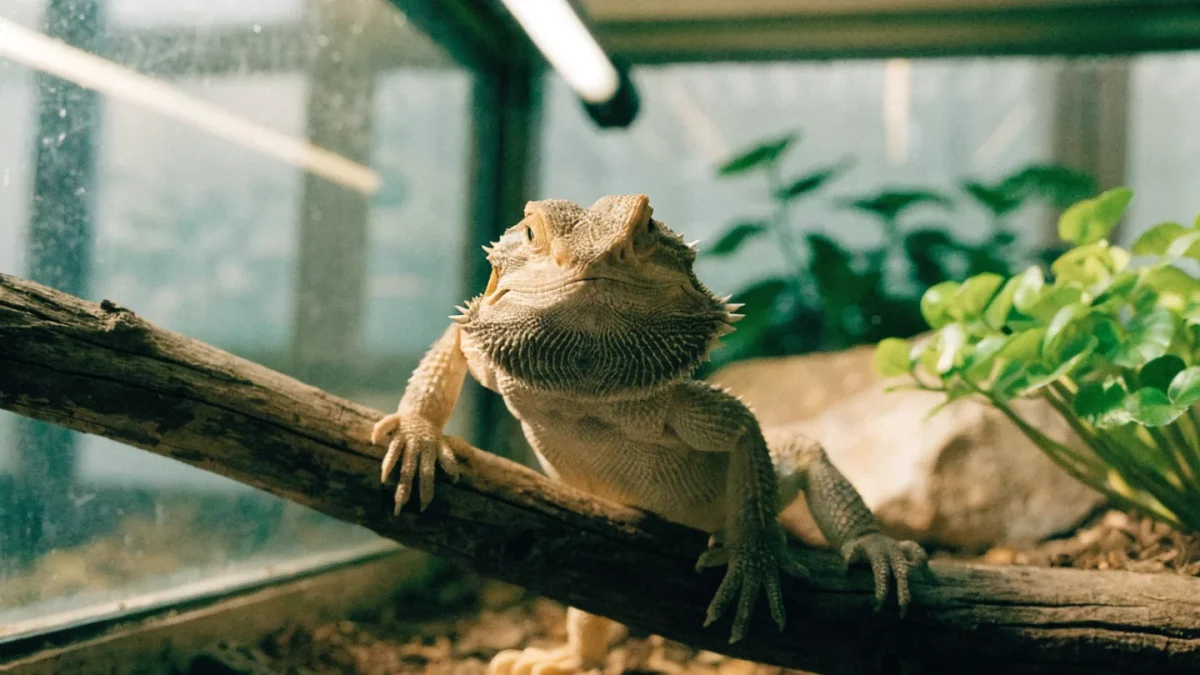
The bearded dragon looked perfect from across the room. Good weight, alert eyes, active. Then the owner picked it up, and its jaw bent like rubber.
I was helping assess a rescue intake — a two-year-old bearded dragon surrendered by a college student moving into a no-pets apartment. The previous keeper had a UVB bulb in the enclosure. It had been there since the animal was purchased. Eighteen months without a replacement. The bulb still glowed. It was producing virtually zero UVB. The dragon had advanced metabolic bone disease that no one caught because "the light was on."
UVB lighting is not optional for the vast majority of reptile species. It drives vitamin D3 synthesis, which controls calcium absorption, which keeps bones solid and organs functioning. Get it wrong — wrong bulb type, wrong distance, expired tube — and the damage is invisible until it's structural.
Tube Types: T5 HO vs T8 vs Compact
Linear fluorescent tubes come in two main diameters: T8 (1 inch / 26mm) and T5 HO (High Output, 5/8 inch / 16mm). The T5 HO has largely replaced the T8 in serious keeping for good reason — it produces roughly twice the UVB output at the same wattage and projects it further from the bulb surface.
What that means in practice: a T5 HO tube mounted on top of a mesh screen can still deliver usable UVB levels at the basking spot 30-40 cm below. A T8 struggles to push useful output past 20 cm, and mesh screens absorb 30-50% of the UV before it even reaches the animal.
Compact or coil UVB bulbs — the ones that screw into a regular lamp socket — have a troubled history. Earlier versions produced dangerously uneven UV output and were linked to photokeratoconjunctivitis (essentially UV eye burns) in some reptiles. Current-generation compacts are improved, but they illuminate a small area compared to a linear tube. I use them only in very small enclosures — quarantine bins or nano setups for dart frogs — where a 30 cm tube is overkill.
For most keepers, a T5 HO tube is the right choice. End of discussion, really.
Ferguson Zones and Percentage Selection
Not every reptile needs the same UVB intensity. The Ferguson zone system categorizes species by their natural UV exposure patterns:
Zone 1 — crepuscular or shade-dwellers. Leopard geckos, crested geckos, many snakes. Low UV exposure. A 2-5% UVB tube placed at the far end or filtered through dense foliage is usually sufficient. Some keepers skip UVB entirely for these species, though a 2020 study published in Comparative Biochemistry and Physiology demonstrated that leopard geckos — a classic Zone 1 species — synthesize vitamin D3 from UVB exposure, suggesting even shade-dwellers benefit from low-level access.
Zone 2 — partial sun, open shade. Blue-tongued skinks, corn snakes when basking. Moderate UV. A 5-7% tube works well.
Zone 3 — open or partial sun baskers. Bearded dragons, water dragons, many iguanid species. A 10-12% T5 HO is standard.
Zone 4 — full midday sun baskers. Some desert lizards, certain tortoises. May need a 12-14% tube or closer mounting distance.
The percentage on the packaging (5%, 10%, 12%) indicates UVB output relative to total light output at a reference distance. Higher percentage doesn't automatically mean better — a Zone 1 species under a 12% tube mounted too close will get UV overexposure, which is a real stress factor. Match the percentage to the animal, not the enclosure.
Placement: Distance Is Everything
UVB output follows the inverse square law — double the distance and the intensity drops to one quarter. This makes mounting height the single most important variable after bulb selection.
Manufacturer recommendations vary, but as a general framework for T5 HO tubes:
A 6% tube in a reflector delivers usable Zone 2 levels at about 25-35 cm. A 12% tube in a reflector can push Zone 3-4 levels to 30-45 cm. Without a reflector, cut those distances by roughly 30%.
Mount the tube so it covers one-third to one-half of the enclosure length, on the same end as the basking spot. The animal should be able to bask in the UV overlap zone and then retreat to a UV-free area when it's had enough. Full-length UV coverage with no escape is bad design.
If you're mounting on top of a metal mesh lid, expect 30-50% UV attenuation depending on mesh gauge. Fine aluminum mesh blocks more than wide-gauge steel mesh. I've started mounting T5 tubes inside the enclosure with a protective guard to eliminate mesh loss entirely — the output difference is dramatic.
And the basking branch or platform height matters as much as where you mount the tube. I measured the UV index at the basking spot in one of my setups recently and got 3.2 at the branch surface. Moved the branch 8 cm higher — UV index jumped to 4.8. That's the difference between adequate and excessive for a blue-tongued skink.
Replacement Schedules: The Silent Failure
This is where most keepers get caught. UVB tubes degrade continuously from the moment you turn them on. A tube that outputs a UV index of 4.0 on day one might read 2.5 at six months and 1.0 at twelve. It still glows. It still looks fine. It's just not doing its job anymore.
Replace T5 HO tubes every 12 months. Replace T8 tubes every 6 months. Replace compact UVB bulbs every 6 months.
Some manufacturers claim longer effective life. I don't trust claims I can't verify without a Solarmeter, which is a handheld UV meter that reads actual UVB output at a specific distance. If you keep more than three or four enclosures, buying a Solarmeter pays for itself in a year by telling you exactly when a bulb has dropped below useful levels instead of replacing on a calendar schedule.
Without a meter, stick to the conservative schedule. The cost of a new tube every year is trivial compared to treating metabolic bone disease.
Common Mistakes I Keep Seeing
Placing the UVB tube at the opposite end of the enclosure from the basking spot. The animal has to choose between warmth and UV — it'll pick warmth every time and still develop D3 deficiency.
Using glass between the bulb and the animal. Regular glass blocks virtually all UVB. If your enclosure has a glass top, the UVB tube needs to go inside or the glass panel above the basking area needs to be replaced with mesh.
Running UVB 24 hours a day. UVB should follow the same photoperiod as the basking lamp — 10-14 hours per day depending on species and season simulation. Constant UV exposure stresses the animal.
Forgetting that reflectors change everything. A T5 HO in a good reflector can double the effective output compared to the same tube mounted bare. If you're getting low UV index readings despite a fresh tube at correct distance, add a reflector before upgrading to a higher-percentage bulb.
FAQ
Do nocturnal reptiles need UVB?
Increasingly, the answer looks like yes — at low levels. A 2020 study in Comparative Biochemistry and Physiology found that leopard geckos given just two hours of daily UVB access nearly doubled their circulating vitamin D3 levels over 30 days compared to a control group with no UVB. A 2-5% tube at the far end of the enclosure, partially blocked by foliage or a hide, gives the animal the option without forcing exposure.
Can I use a regular fluorescent light for UVB?
No. Standard household fluorescent tubes produce minimal UVB. You need tubes specifically manufactured for reptile UVB output — they use different phosphor coatings designed to emit in the 290-315nm range.
What's the UV index target for my species?
Rough guide: Zone 1 species aim for UV index 0.5-1.5 at basking level. Zone 2: 1.0-2.6. Zone 3: 2.6-5.0. Zone 4: 4.0-8.0+. These are measured with a Solarmeter 6.5R at the animal's basking position. Your tube's percentage, distance, mesh interference, and reflector all affect the final number.
Should UVB be on during cloudy-day simulation?
If you're simulating seasonal light variation, dimming the basking lamp is reasonable. But UVB output from fluorescent tubes can't be dimmed — they either run at full output or they're off. On simulated overcast days, running the UVB for fewer hours achieves a similar effect to reduced intensity in the wild.