

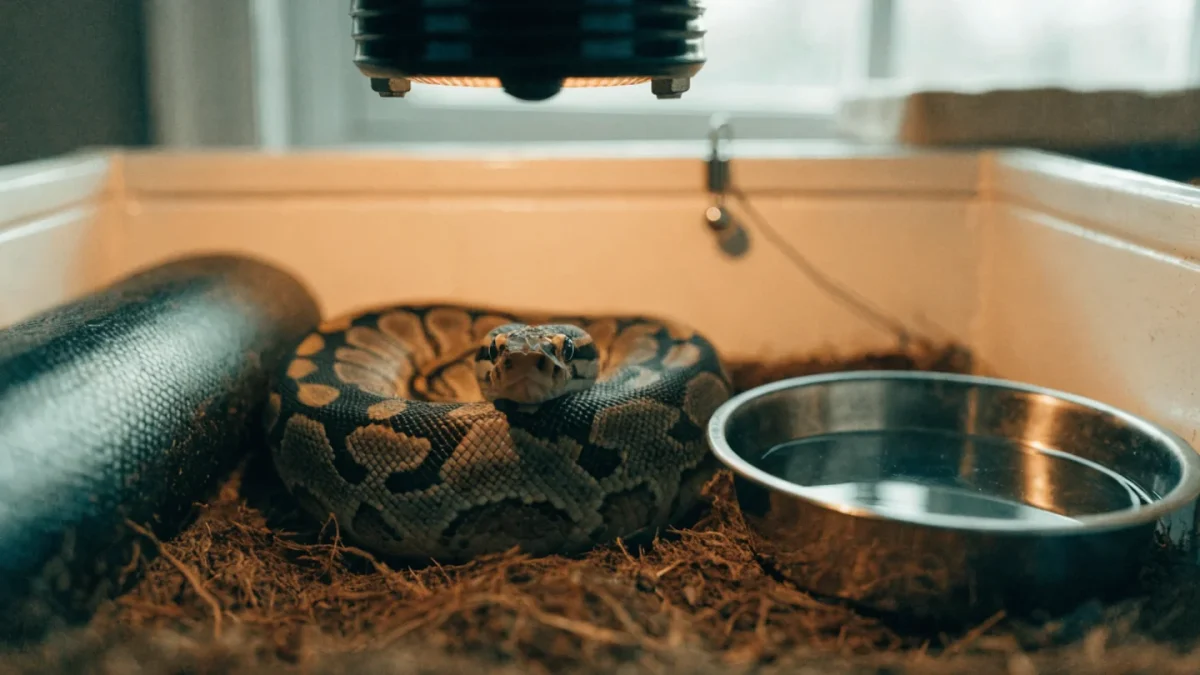
I spent my first year keeping ball pythons fighting humidity in a glass aquarium with a full-screen top. Every morning I'd mist the enclosure, watch the hygrometer climb to 65%, and come back four hours later to find it sitting at 38%. The snake shed in pieces every single time. When I finally switched to a PVC enclosure with restricted ventilation, my humidity problems disappeared overnight — and so did the bad sheds.
A ball python enclosure setup isn't complicated, but the details compound. Get the heating wrong and the snake stops eating. Get the humidity wrong and it sheds poorly. Get the hides wrong and it never settles. This guide covers every component, in the order I'd set them up if I were starting fresh today. If you need broader context on the species itself, the full ball python care guide covers feeding, handling, and health alongside habitat basics.
Step 1: Choosing the Enclosure Type
Three options dominate the market, and they're not equal.
PVC enclosures are the gold standard for ball pythons. They retain heat and humidity with minimal effort, they're lightweight, and most come with front-opening doors. The downside: they cost more upfront than glass, and visibility is limited to the front panel. For a ball python — an animal that hides 20 hours a day — limited visibility isn't a real loss.
Glass terrariums with front-opening doors work if you modify them. A full-screen top bleeds heat and moisture. Cover 60-75% of the screen with aluminum tape, HVAC foil, or a cut piece of plexiglass. Leave a strip uncovered near the heat source for ventilation. Without this step, you'll fight humidity forever.
Plastic tub setups (rack systems or standalone tubs) are functional, inexpensive, and widely used by breeders. Melt or drill ventilation holes — about 20-30 small holes on opposite sides for airflow. Tubs hold humidity naturally and heat efficiently. They don't look like much, but the snake doesn't care about aesthetics.
Sizing
| Snake Age/Size | Minimum Enclosure Footprint |
|---|---|
| Hatchling (under 200g) | 60 x 40 cm (24" x 16") |
| Juvenile (200-800g) | 90 x 45 cm (36" x 18") |
| Adult (800g+) | 120 x 60 cm (48" x 24") |
Can you put a hatchling in an adult-sized enclosure? Yes — if you add enough clutter and hides to make it feel secure. I do it routinely. The "too big is stressful" claim comes from empty enclosures, not large ones.
Step 2: Heating Equipment and Placement
Ball pythons need a thermal gradient, not uniform warmth. One end hot, one end cool, and the snake chooses where to sit based on its metabolic needs.
Overhead heating is my preference. Deep heat projectors or ceramic heat emitters mounted on the ceiling of the warm side, connected to a dimming or pulse-proportional thermostat, create a natural gradient that warms both the air and surfaces. The probe goes on the basking surface, not dangling in midair.
Under-tank heat mats work in tub setups. The mat covers roughly one-third of the floor on the warm side, thermostat probe taped directly to the floor surface above the mat. Never run a heat mat without a thermostat — I took in a rescue with third-degree belly burns from an unregulated mat, and the scarring was permanent.
Target temperatures:
- Warm side ambient: 30-33°C (86-91°F)
- Warm side surface (if basking): up to 35°C (95°F)
- Cool side ambient: 25-27°C (77-80°F)
- Night drop: can fall to 23°C (73°F) safely
Use a digital thermometer with a probe, or an infrared temperature gun for surface readings. Stick-on dial thermometers are inaccurate enough to cause real problems — I've tested them side by side with digital readers and found discrepancies of 3-5°C.
Step 3: Humidity Control
Target 60-80% relative humidity. During pre-shed (you'll notice the snake's colors dulling and eyes turning blue-grey), push it above 80%.
The three variables you control:
Substrate: Coconut fiber, cypress mulch, or a blend of both. These retain moisture when lightly dampened without becoming swampy. Avoid aspen shavings — they mold when wet and contribute nothing to humidity. Avoid pine and cedar entirely; the phenols are toxic to reptiles.
Ventilation: Less is more for ball pythons. PVC enclosures come with restricted vents. Glass tanks need screen covers partially blocked. The balance is enough airflow to prevent stagnant, bacteria-friendly conditions while retaining enough moisture to hold humidity.
Water dish size and placement: A large water dish on the warm side adds passive evaporation. On the cool side, it stays cooler and contributes less to ambient humidity. I use both strategies depending on the enclosure — warm side placement when I need more humidity, cool side when levels are already adequate.
If you're still struggling after all three adjustments, pour water directly into the substrate around the warm side. Not on top — into the lower layers. The heat draws it up as vapor.
Step 4: Hides and Interior Layout
Two hides minimum, and this isn't negotiable. One on the warm side, one on the cool side. The snake needs to thermoregulate without sacrificing security. If there's only one hide, it'll choose security over temperature regulation every time — and that leads to either chronic cold (immune suppression, feeding refusals) or chronic overheating.
Hides should be snug. The snake should make contact with the walls and ceiling when coiled inside. A hide that's too large doesn't provide the tactile feedback ball pythons rely on to feel safe. I've watched a snake bypass a spacious cork bark cave to squeeze behind the water dish because the dish gave it tighter contact.
Between the hides, add clutter: fake plants, cork rounds, branches. Ball pythons — especially juveniles and sub-adults — will climb more than their reputation suggests. A branch angled from the substrate to mid-enclosure height gets used surprisingly often.
The water dish should be heavy enough that the snake can't tip it. Large enough to soak in. Cleaned and refilled every two to three days, immediately if fouled.
Step 5: Lighting
Ball pythons are crepuscular — most active at dawn and dusk. They don't need intense lighting, and bright overhead lights can actually make them retreat deeper into hides.
Provide a consistent day-night cycle: 12 hours of light, 12 hours of dark, adjusted slightly by season if you want to mimic natural photoperiod. Ambient room light is often sufficient. If you're using an opaque PVC enclosure, a low-wattage LED bar on a timer provides the photoperiod cue without overwhelming brightness.
Low-level UVB (5-7% output, Ferguson Zone 1-2) is an emerging recommendation. The research is still developing, but early evidence suggests subtle benefits to D3 synthesis and naturalistic behavior. Ferguson et al.'s UV zone framework places ball pythons in Zone 1-2, and while one study failed to show significant D3 elevation in ball pythons under UVB, behavioral improvements are consistently reported by keepers and veterinarians. I've added UVB to all my ball python enclosures and have no intention of going back — but I won't claim it's required with the same confidence I have about heating and humidity.
Mistakes I See Constantly
The top three, in order of frequency:
No thermostat. People spend money on the enclosure, the snake, the substrate — and then skip the one piece of equipment that prevents injury. A thermostat costs the same as two bags of substrate. There is no valid reason to run a heat source without one.
Wrong humidity measurement. Analog hygrometers mounted at the top of the enclosure read air humidity at the wrong height. Your snake lives on the ground. A digital hygrometer with the probe at substrate level gives you the number that actually matters.
Insufficient hides. One hide, or hides that are too large, or hides made of transparent material. The snake can't relax if it can see out, and it can't thermoregulate if there's only one hiding spot. This single issue causes more feeding refusals than any other husbandry factor, based on what I've seen troubleshooting keeper setups over the years.
All three of these problems come down to the same gap: understanding how heating, humidity, and enclosure design interact. The exotic pet habitat setup fundamentals cover those core principles in detail.
Frequently Asked Questions
Can I use a glass aquarium for a ball python?
You can, but expect to modify it. A standard aquarium with a full-screen lid leaks humidity and heat. Cover most of the screen top, add a humid hide, and monitor your hygrometer closely. PVC is less work long-term, but a well-modified glass tank can sustain proper conditions. I kept my first ball python in glass for three years before switching — it worked, but it was a daily effort.
How often should I clean the enclosure?
Spot-clean feces and urates as they appear — ball pythons typically defecate once per feeding cycle, so you're looking at once every one to three weeks. Full substrate changes depend on the substrate type: coconut fiber every 4-6 weeks, cypress mulch every 6-8 weeks. Deep-clean the enclosure itself (empty, scrub with reptile-safe disinfectant, rinse, dry completely) every 3-4 months.
Do I need a thermostat for every heat source?
Yes. Every single one. Ceramic heat emitters, heat mats, deep heat projectors, radiant heat panels — all of them. An uncontrolled heat source in an enclosed space can reach temperatures that cause fatal burns. No exceptions.
What about bioactive enclosures for ball pythons?
Bioactive setups — live plants, springtails, isopods as a cleanup crew — work well for ball pythons once you get the drainage layer and plant selection right. The custodian bugs handle small waste, the live plants contribute to humidity, and the enclosure looks fantastic. But it's a more complex build, and I wouldn't recommend it as a first setup. Get the fundamentals dialed in with a standard enclosure first, then upgrade to bioactive once you're confident with the species' needs.