

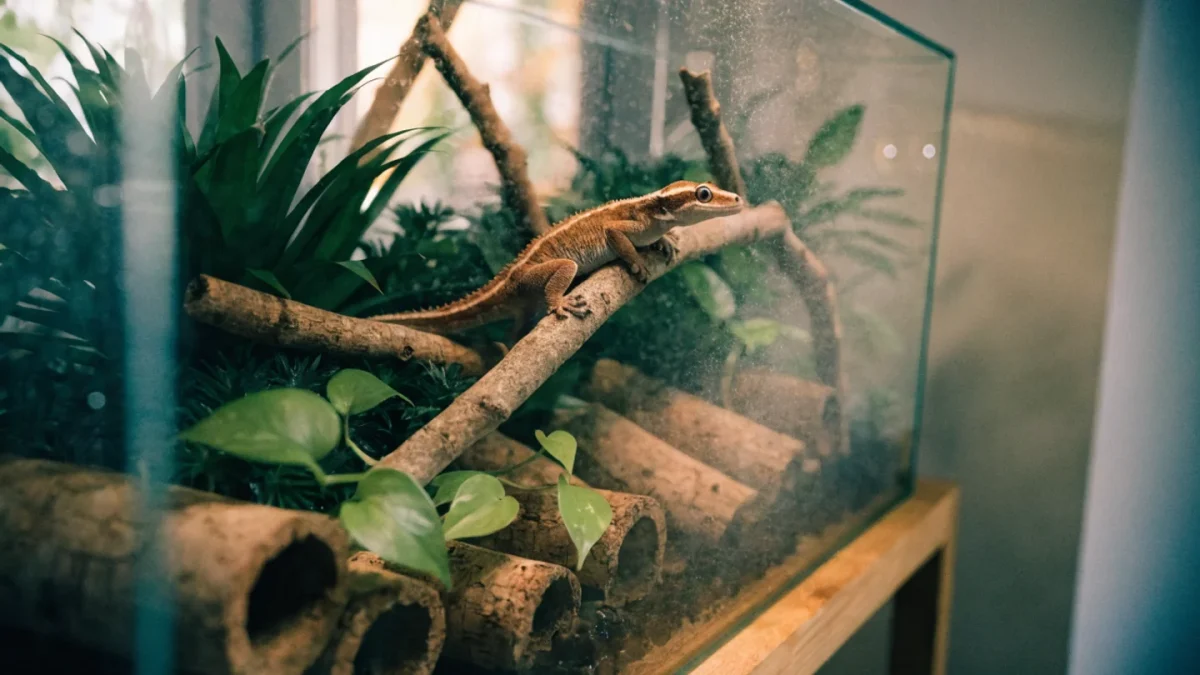
I rebuilt my crested gecko enclosures three times before I got something I was actually happy with. The first was a screen cage — humidity dropped to 30% within an hour of misting, and I was spraying six times a day just to keep up. The second was a glass aquarium turned on its side, which was ugly, unstable, and had no front access. The third attempt, a proper front-opening terrarium with a screen top and a drainage layer, is essentially the same design I still use ten years later.
A crested gecko habitat setup requires a vertical glass or PVC enclosure with front access, enough plants and branches to fill the vertical space without blocking airflow, a humidity-retaining substrate, and a misting routine that creates a daily wet-dry cycle. Get these four elements right and the enclosure practically maintains itself.
If you haven't read the full crested gecko care guide, start there for the broader picture. This article goes deep on the enclosure itself.
Choosing the Enclosure
Dimensions and Style
Height matters more than floor space. A 45 × 45 × 60 cm (18" × 18" × 24") front-opening terrarium is the minimum for a single adult. I prefer 45 × 45 × 90 cm — the extra height gives you room for taller plants and more climbing layers.
Front-opening doors are not a luxury. They're how you avoid stressing your gecko every time you reach in from above. Crested geckos aren't as prey-response sensitive as some species, but a hand descending from overhead is still more startling than one approaching from the side.
PVC enclosures hold humidity better than glass but cost more and tend to be heavier. Glass with a partial screen top is the sweet spot for most keepers — humidity retention is fine with proper substrate and misting, and you get visibility from all sides.
Full-screen cages are a mistake for crested geckos unless you live in a naturally humid climate. I've had people message me on keeping forums frustrated that their gecko is dehydrating despite misting four times a day. First question I ask: is it a screen cage? Almost always yes.
Juvenile Housing
Geckos under 15 grams go in smaller enclosures — a faunarium or a nano terrarium around 30 × 30 × 45 cm. Small geckos in big spaces have trouble finding food. I once spent two weeks wondering why a 3-gram hatchling wasn't eating before I downsized its enclosure and found it ate the very first night. It just couldn't find the food dish in a full-sized terrarium.
Move them to the adult enclosure once they're reliably eating and have hit about 15-20 grams.
Substrate Options
The substrate does two jobs: it holds ambient humidity between mistings, and — if you go bioactive — it houses your cleanup crew.
Simple Substrates
Paper towels work. They're ugly, they don't hold humidity well, and they need replacing every few days, but they're cheap and make it very easy to monitor droppings for health issues. I use paper towels for quarantine enclosures and juveniles.
Coconut fiber (coco coir) is the most popular substrate. It holds moisture well, looks natural, and is inexpensive. Replace it entirely every 4-6 weeks. The downside is that fine-particle coco coir can be accidentally ingested by geckos hunting insects on the floor. I haven't personally seen an impaction from it — crested geckos rarely eat off the substrate — but it's worth knowing.
Bioactive Substrate
This is my preferred approach for permanent adult setups. A bioactive substrate is a layered system designed to be self-cleaning:
- Drainage layer (2-3 cm): lightweight expanded clay balls or similar drainage medium
- Mesh barrier: fiberglass screen or weed barrier fabric to keep substrate out of the drainage layer
- Substrate mix (5-8 cm): roughly equal parts organic topsoil, coconut fiber, and orchid bark, with some sphagnum moss mixed in
- Leaf litter on top: dried magnolia or oak leaves
Add springtails and tropical isopods. They eat mold, break down droppings, and keep the substrate healthy. After the initial setup period — maybe a month for the microfauna to establish — a bioactive crested gecko enclosure barely needs maintenance beyond misting and removing uneaten food.
I've had one bioactive enclosure running for over four years without a substrate change. The plants grow, the springtails breed, and the whole thing smells like damp forest floor. That's the goal.
Furnishing the Vertical Space
An empty enclosure with just substrate is a waste of vertical real estate. Crested geckos use the full height of their habitat — they want surfaces to climb, places to sleep, and spots to hide.
Branches and Cork
Angled branches give geckos the climbing paths they'd naturally use in trees. Cork bark tubes are the single best addition to any crested gecko enclosure — they provide hiding spots, climbing surfaces, and they hold moisture from misting. I use a mix of natural grapewood branches and cork bark rounds in every setup.
Position branches at different angles. Horizontal for resting, diagonal for climbing routes, vertical for quick ascents. Avoid creating a single highway from bottom to top — you want the gecko to have choices and different routes through the enclosure.
Secure everything. A heavy cork tube falling on a 10-gram gecko can injure it. I use aquarium-safe silicone to anchor large pieces and zip ties on branches that might shift.
Live Plants
Live plants transform a crested gecko enclosure from a box into something that actually replicates their natural habitat. Good choices include:
Pothos (Epipremnum aureum) — nearly indestructible, grows in low light, drapes beautifully. The workhorse of gecko vivariums.
Bromeliads — hold water in their central cup, provide sleeping spots in their leaves, and look spectacular. Neoregelia and vriesea species both work well.
Ficus pumila (creeping fig) — covers backgrounds quickly and gives geckos endless climbing surfaces.
Sansevieria (snake plants) — tough, vertical leaves that juvenile geckos love sleeping behind.
Plant directly into bioactive substrate or keep plants in small pots hidden behind cork bark. Either approach works. Just avoid any plants treated with pesticides or systemic insecticides — these are toxic to geckos and the chemicals persist in the plant tissue for months after treatment.
Artificial Plants
Perfectly fine if you don't want the maintenance of live plants or if your enclosure doesn't get enough light for real ones. Silk plants look more natural than plastic. The main thing is coverage — your gecko should be able to hide behind foliage anywhere in the enclosure.
Misting and Humidity Management
Getting humidity right means understanding the cycle, not hitting a single number.
The Wet-Dry Cycle
Mist heavily in the evening. Humidity should spike to 80-90%. During the day, humidity drops naturally through ventilation to 50-60%. This cycle mimics New Caledonian forest conditions — damp nights, drier days.
Constant 80%+ humidity is worse than occasional dips to 40%. Stagnant moisture breeds mold and bacterial growth. The screen top portion of the enclosure provides the passive ventilation that drives this daily dry-down.
Manual vs. Automated Misting
A handheld pressure sprayer is fine for one or two enclosures. Pump it up, mist for about 30 seconds per enclosure, done. I did this for years.
If you have three or more setups, an automated misting system saves real time and delivers more consistent results. Set it for one or two evening mist cycles, calibrate the duration so the enclosure is wet but not flooded, and trust the timer. I switched to an automated system when I had seven crested gecko enclosures and the manual misting was eating twenty minutes of my evening.
Water Source
A shallow water dish on the floor is worth having as backup, but most crested geckos drink from water droplets on leaves and glass after misting. I've watched geckos lap droplets off pothos leaves for five minutes straight after a misting cycle. Change the standing water every day or two — stagnant water in a warm, humid enclosure gets funky fast.
What About Lighting?
Crested geckos are nocturnal, so they don't need intense lighting. But a low-output LED on a 12-hour timer establishes day-night rhythm and keeps live plants growing. A 2.0 or 5.0 UVB bulb can be added — a 2020 study on nocturnal leopard geckos in Comparative Biochemistry and Physiology confirmed that even nocturnal species synthesize vitamin D3 through cutaneous UVB exposure, though it's not strictly required if you're using a complete powdered diet with D3 included.
Avoid bright lights directly over the enclosure. Crested geckos actively avoid strong light and will spend all day in the darkest corner if the lighting is too intense.
Temperature: What Not to Do
I covered the temperature ranges in the main care guide, so I won't repeat every number. The principle: crested geckos are cool-temperature reptiles. Room temperature in a climate-controlled home is usually correct. The mistakes happen at the extremes.
Don't put the enclosure near a window that gets direct afternoon sun. Glass amplifies heat. I've measured surface temperatures inside a terrarium near a south-facing window exceed 35°C on a sunny afternoon — lethal territory for crested geckos.
Don't stack the enclosure on top of another heated reptile's tank. Heat rises. Your bearded dragon's basking lamp can warm the shelf above it enough to push the crested gecko enclosure out of the safe range.
If you need supplemental heat in winter, a ceramic heat emitter on a thermostat set to kick on below 20°C is the safest option. Heat mats are less useful here — crested geckos spend most of their time climbing, not sitting on the floor. For a deeper dive on heating methods, thermostat selection, and ventilation principles that apply across reptile species, check the exotic pet habitat setup fundamentals.
Frequently Asked Questions
Can I use a screen cage for a crested gecko?
You can, but you'll fight humidity constantly. Screen cages work in naturally humid environments — some keepers in tropical climates use them successfully. In a typical heated or air-conditioned home, glass or PVC enclosures make humidity management dramatically easier. If you already have a screen cage, wrapping three sides with plastic sheeting helps, but it's a workaround, not a solution.
How often should I clean a bioactive crested gecko enclosure?
Spot-clean uneaten food and visible droppings weekly. The springtails and isopods handle the rest. Full substrate replacement isn't necessary if the bioactive system is healthy — mine have gone years. Replace the leaf litter layer every few months as it breaks down, and trim or replace plants that outgrow the space.
Do I need a background for the terrarium?
Not strictly, but backgrounds give geckos more surface area to climb and make the enclosure look substantially better. Cork bark panels, expanding foam sculpted to look like bark, and commercially available 3D backgrounds all work. My geckos sleep on the background as much as they sleep on plants. If you skip the background, you'll likely find your gecko sleeping on the bare glass back wall — functional, just less interesting for both of you and linked to floppy tail syndrome over time.