

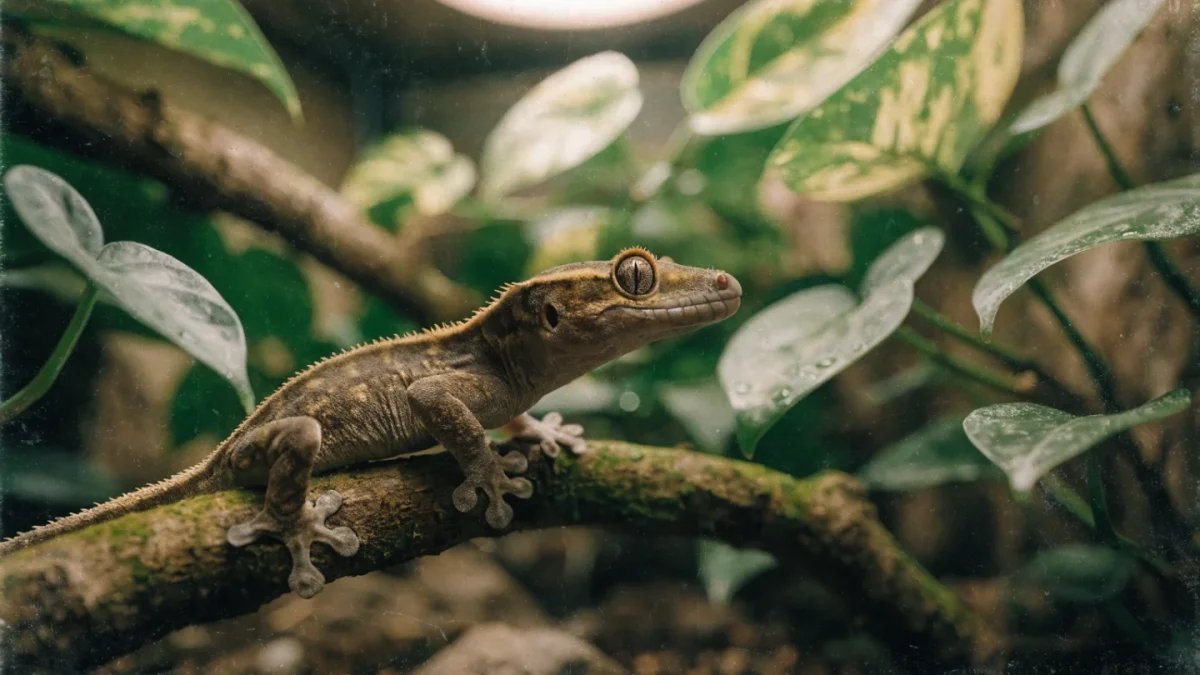
The first crested gecko I ever held was supposed to be extinct. That sounds dramatic, but it's true — Correlophus ciliatus wasn't described by science until 1866, then essentially vanished. Nobody saw one for over a century. Rediscovered in New Caledonia in 1994, they went from "probably gone forever" to one of the most popular pet reptiles on the planet in roughly twenty years. I picked up my first pair at a reptile expo in 2011 from a breeder who'd been working with them since nearly the beginning of the captive population, and I've kept them continuously since.
Crested geckos need a tall, humid enclosure with plenty of climbing surfaces, temperatures that stay below 27°C (80°F), nightly misting, and a diet built primarily around powdered complete gecko food mixed with water. They're nocturnal, handleable with patience, and can live 15-20 years. They are genuinely one of the easiest reptiles to keep — but "easy" still means doing it right.
What Makes Crested Geckos Different From Other Beginner Reptiles
If you've looked into leopard gecko care, you already know the basics of reptile keeping. Crested geckos flip several expectations. They don't need supplemental heating in most homes. They climb vertically instead of roaming a floor. Their primary diet comes from a powder you mix with water rather than live prey.
That last point is a huge deal for a lot of keepers. I've talked to dozens of people who want a reptile but can't stomach handling crickets three times a week. Crested geckos solve that problem almost entirely.
But the differences cut both ways. Crested geckos are more sensitive to heat than most reptiles. Sustained temperatures above 29°C (85°F) can kill them. If you live somewhere with hot summers and no air conditioning, that's a problem you need to solve before buying one.
They also drop their tails permanently. Unlike leopard geckos, crested geckos don't regenerate a lost tail. It's purely cosmetic — a tailless crested gecko lives just as long and just as happily — but it surprises people who aren't expecting it.
Choosing a Healthy Crested Gecko
Buy captive-bred. The entire pet trade population descends from animals collected in New Caledonia in the 1990s, and there's zero reason to purchase wild-caught specimens — they're protected in their native habitat anyway.
Look for a gecko with clear eyes, straight toes, and a body that feels solid rather than bony when you hold it. Juveniles should have visible fat reserves at the base of the tail. Check inside the mouth if the seller allows it — healthy mouth tissue is pink, not pale or cheesy-looking.
I'd avoid buying crested geckos under about 4 grams. They're fragile at that size, dehydrate quickly, and can be difficult to get feeding reliably. A gecko in the 5-10 gram range gives you a much smoother start. At expos I sometimes see breeders selling hatchlings at two weeks old. Technically possible. Not a great idea for a first-time keeper.
One thing worth asking the breeder: what food has this animal been eating? A gecko raised on one powdered diet formula may refuse a different one initially. Knowing what it's used to saves you a stressful first week of watching an animal ignore its food dish.
Setting Up the Enclosure
This is where you either set yourself up for years of easy keeping or create a slow-motion disaster. The enclosure dictates almost everything about your gecko's health.
Size and Orientation
Crested geckos are arboreal. They climb. Your enclosure needs to be taller than it is wide. The minimum for a single adult is 45 × 45 × 60 cm (18" × 18" × 24"), but I keep mine in enclosures that are 45 × 45 × 90 cm (18" × 18" × 36") and they use every bit of that vertical space.
Front-opening terrariums with screen tops work best. Full glass or PVC retains humidity better than screen cages, but you still need some ventilation — stagnant air in a humid enclosure grows mold fast.
Juveniles under about 15 grams do better in smaller enclosures. A large faunarium or small terrarium around 30 × 30 × 45 cm works well. Big enclosures make it harder for small geckos to find their food, and I've seen juveniles fail to thrive simply because they couldn't locate their food dish in a 60-cm-tall tank.
Furnishing
Think vertically. Cork bark tubes, branches at various angles, and plants — live or artificial — create the kind of environment where crested geckos actually behave naturally. They want to sleep wedged behind a leaf during the day and patrol the branches at night.
Live plants do double duty: they hold humidity and they look fantastic. Pothos, bromeliads, and ficus are all safe options that tolerate the humidity range crested geckos need. I run bioactive setups in most of my crested gecko enclosures now, with a drainage layer, substrate mix, and a cleanup crew of springtails and isopods. It's more work upfront but almost no maintenance after that.
If you go artificial, that's completely fine. Just make sure you have enough coverage that the gecko can hide during the day without feeling exposed.
Temperature
This is where crested geckos deviate from almost every other reptile. They don't want it hot.
- Daytime ambient: 22-26°C (72-78°F)
- Nighttime: Can drop to 18°C (65°F) without issue
- Danger zone: Sustained temperatures above 29°C (85°F) can cause heat stress and death
In most homes, room temperature is fine year-round. No basking lamp needed. No heat mat needed. If your house gets cold in winter — below about 18°C at night — a low-wattage ceramic heat emitter on a thermostat can prevent it from dropping too far.
I lost my first crested gecko to heat. Left for a weekend, the air conditioning failed, and the room hit 32°C for probably two days. The gecko was dead when I got home. That was twelve years ago and I still check temperatures obsessively. If you're in a warm climate, a backup plan for cooling isn't optional.
Humidity and Misting
Crested geckos need humidity that fluctuates through the day — this mimics their natural environment in New Caledonian forests.
Mist the enclosure thoroughly once in the evening, bringing humidity up to 80-90%. Let it dry down to 50-60% during the day. This wet-dry cycle prevents respiratory issues that come with constantly saturated air while keeping the gecko hydrated.
Most crested geckos drink water droplets off leaves rather than from a standing dish. Misting provides their primary water source. I keep a small dish in there anyway as backup, but I rarely see my geckos use it.
A pressure sprayer works fine for one or two enclosures. If you're keeping multiple animals, an automated misting system pays for itself in convenience within a month.
Lighting
Crested geckos are nocturnal, so they don't need the intense UVB lighting that diurnal reptiles like bearded dragons require. That said, low-level UVB — a 2.0 or 5.0 UVB bulb — does benefit them. A 2020 study in Comparative Biochemistry and Physiology demonstrated that nocturnal leopard geckos synthesize vitamin D3 cutaneously when exposed to UVB — their plasma 25-hydroxyvitamin D3 levels were significantly higher than controls — and the finding likely applies across nocturnal gecko species.
I run a low-output LED light on a 12-hour cycle to give my crested gecko enclosures a day-night rhythm. The geckos hide during the light period and become active when it shuts off. Consistent light cycles matter more than light intensity.
Diet
Crested gecko nutrition has gotten remarkably simple thanks to powdered complete diets. Before those products existed, keeping crested geckos meant constantly juggling fruit, insects, and supplements to hit the right nutritional balance. Now, a powdered meal replacement mixed with water provides complete nutrition.
Mix the powder with water to a smoothie-like consistency and offer it in a small elevated dish — crested geckos prefer to eat off the ground level only reluctantly. Replace the food every 24-48 hours. In warm weather, it spoils faster.
Insects are supplemental, not the main course. Offer appropriately sized crickets or dubia roaches once or twice a week. Dust them with a calcium supplement. The insects provide enrichment and exercise as much as nutrition — watching a crested gecko stalk and pounce on a cricket is one of the genuine pleasures of keeping these animals.
Fresh fruit can be offered occasionally as a treat. Mashed banana, mango, or papaya in small amounts. But fruit alone doesn't provide adequate nutrition. I've seen geckos raised primarily on fruit develop metabolic bone disease because fruit doesn't contain enough calcium or protein.
Overfeeding isn't common with crested geckos — they self-regulate pretty well — but obesity does happen in animals that get heavy insect supplementation on top of their powdered diet. If your gecko's belly is dragging when it walks, cut back on the bugs.
Handling
Crested geckos tolerate handling well once they're acclimated, but they're fast and jumpy compared to bearded dragons or ball pythons. New geckos will leap. They'll leap off your hand, off your shoulder, off whatever surface they're on. This is normal.
Start with short sessions — five minutes, in a small room with the door closed. Let the gecko walk from hand to hand. Don't grab. Don't squeeze. Their skin is more delicate than it looks, and a panicked gecko can drop its tail.
After a few weeks of consistent short sessions, most crested geckos calm down considerably. Some become genuinely docile. Others remain flighty their entire lives. Personality varies. I've got one female who'll sit on my hand for thirty minutes while I watch TV, and another from the same clutch who still launches herself at the wall the moment the enclosure door opens.
Never handle a crested gecko that's in shed. Their skin is tight and fragile during this time, and handling can cause tears or stuck shed.
Common Health Concerns
The most frequent health issue I encounter in crested geckos is metabolic bone disease (MBD) from inadequate calcium. Symptoms include a soft, rubbery jaw, kinked tail, and difficulty climbing. By the time you notice these signs, the problem has been developing for weeks or months. Prevention is straightforward: use a complete powdered diet and dust feeder insects with calcium.
Stuck shed is second on the list. Crested geckos shed their skin in one piece and eat it — you may never actually see a shed. But if humidity is consistently too low, shed can stick around the toes and tail tip, eventually restricting blood flow. A gecko missing toe tips almost certainly has a humidity problem.
Respiratory infections show up as wheezing, bubbles around the nostrils, or open-mouth breathing. Usually caused by constantly high humidity with poor ventilation — the difference between a rain-forest mist and a stagnant swamp. Fix the airflow and see an exotic vet.
Floppy tail syndrome affects some crested geckos that spend too much time sleeping upside down on glass walls. The tail gradually falls to one side under its own weight. It doesn't hurt the gecko, but in breeding animals it can make mating difficult. Providing enough plant cover usually prevents it — geckos sleep on leaves instead of glass.
Breeding Considerations
I won't cover breeding in depth here — that's its own topic. But the basics: crested geckos are sexually mature at about 35-40 grams, females should ideally be at least 18 months old before breeding, and they lay two eggs roughly every 30-45 days once paired. Females can retain sperm, so a single pairing can produce fertile eggs for months.
If you're keeping a male and female together for any reason, you will almost certainly get eggs. Plan for that. Incubation at room temperature works — unlike many reptiles, crested gecko eggs don't need a dedicated incubator. But raising hatchlings requires space, time, and a plan for rehoming.
Quick-Reference Parameter Table
| Parameter | Range |
|---|---|
| Enclosure (adult) | 45 × 45 × 60 cm minimum (taller is better) |
| Daytime temp | 22-26°C (72-78°F) |
| Nighttime temp | 18-22°C (65-72°F) |
| Heat stress threshold | Above 29°C (85°F) |
| Humidity (after misting) | 80-90% |
| Humidity (daytime low) | 50-60% |
| Diet | Powdered complete diet + occasional insects |
| Lifespan | 15-20 years |
| Adult size | 20-25 cm (8-10") including tail |
| Temperament | Handleable, somewhat jumpy, nocturnal |
Frequently Asked Questions
Do crested geckos need a heat lamp?
In most homes, no. Room temperature between 22-26°C works perfectly. They're one of the few reptiles that thrive without supplemental heating. If your home drops below 18°C regularly, a low-wattage ceramic heat emitter on a thermostat is the safest solution.
Can I keep two crested geckos together?
I don't recommend it. Two males will fight — sometimes causing serious injuries. A male-female pair will breed constantly, which exhausts the female. Two females can sometimes cohabitate in a large enough enclosure, but even then I've seen aggression over food dishes and sleeping spots. Solo housing eliminates the risk entirely.
How often should I feed my crested gecko?
Offer fresh powdered food every evening and replace what's uneaten every 24-48 hours. Insects once or twice a week. Juveniles eat more frequently — I leave food available nightly for growing geckos and find their dishes are licked clean by morning.
My crested gecko dropped its tail — is it okay?
Yes. Tail loss is permanent in crested geckos (they don't regrow it), but it doesn't affect their health or lifespan. The wound typically heals cleanly within a week or two. Keep the enclosure clean while it heals. Most long-term keepers end up with at least a few tailless geckos — it's extremely common.
Are crested geckos good for kids?
They can be, with supervision. Crested geckos are small, jumpy, and have delicate skin, so young children need to learn gentle handling. I'd say they're appropriate for kids around 10 and up who are patient enough to let the gecko set the pace. The habitat maintenance — misting, feeding, cleaning — is simple enough for an older kid to manage with some oversight.