

Somebody at a reptile expo last year asked me which turtle was "like a hamster but cooler." I appreciated the honesty. He wanted something low-maintenance, interesting to watch, and small enough for an apartment. I told him that no turtle is like a hamster — they're all more work — but some species are genuinely manageable if you're willing to invest in the setup.
The best pet turtles for beginners are species that tolerate minor husbandry mistakes, eat readily available food, stay a reasonable size, and have established captive-bred populations. The setup still matters enormously — UVB, heat, filtration, water quality — but some species give you wider margins than others. I covered the full habitat and diet requirements in the full turtle and tortoise care guide, so here I'm focusing on which species to actually consider and why.
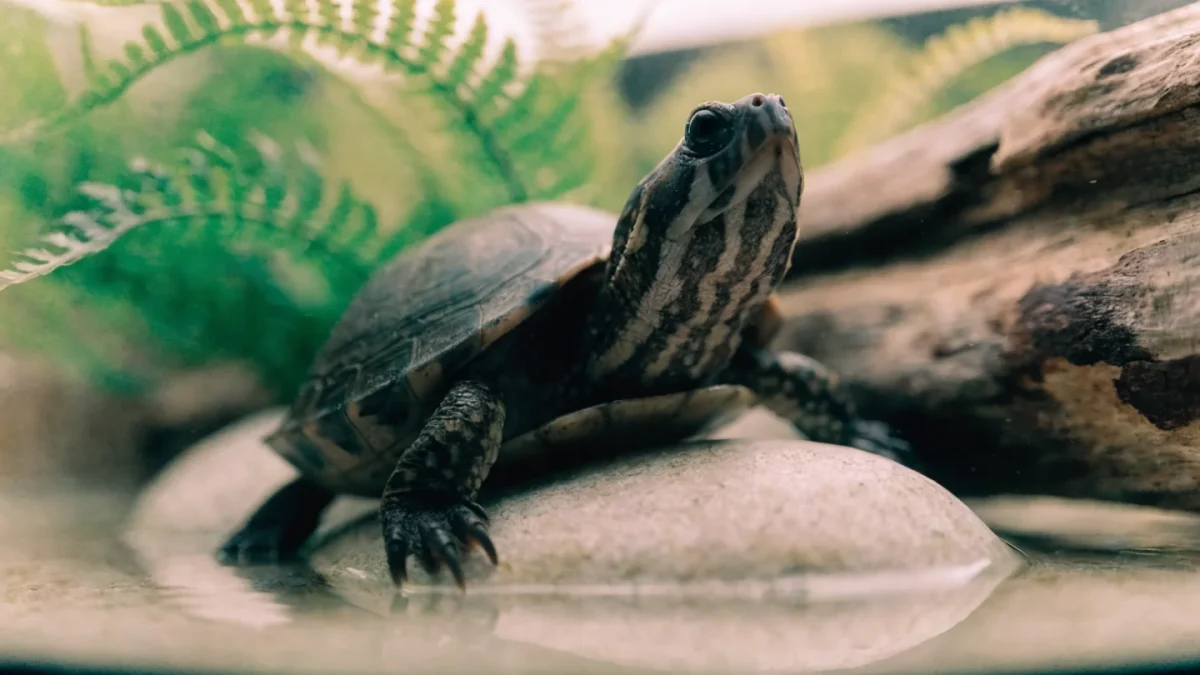
1. Common Musk Turtle (Sternotherus odoratus)
This is my go-to recommendation for someone with limited space. Adults max out at 10-13 cm (4-5 inches), which means a single adult can thrive in a 150-liter (40-gallon) tank. That's an achievable setup for most people.
Musk turtles are bottom-walkers — they spend more time crawling along the substrate than swimming at the surface. They don't need deep water. In fact, 15-20 cm (6-8 inches) of water depth suits them fine, with plenty of submerged structures to climb on. I keep mine in a heavily planted tank with driftwood that reaches near the surface so they can stretch up and breathe without actually swimming.
The "musk" name comes from their defensive odor glands, which they rarely use once established in captivity. I've been bitten by a defensive musk turtle exactly once — at a rescue intake — and it was more startling than painful.
Diet is straightforward: commercial turtle pellets, earthworms, bloodworms, the occasional small snail. They're carnivorous-leaning omnivores who'll eat most things offered. Supplemental greens aren't as critical as with sliders, though I still offer duckweed and anacharis in the tank for grazing.
Why they work for beginners: Small adult size, modest tank requirements, hardy constitution, and they eat without fuss.
The catch: They're not flashy. If you want a turtle you can easily see basking and swimming laps, musk turtles are more of a "watch them explore the bottom" kind of animal.
2. Painted Turtle (Chrysemys picta)
Painted turtles are stunning. The western painted subspecies especially — the red and yellow plastron markings against the dark carapace look like someone hand-painted them. And they're active, visible turtles that bask readily and swim in the open.
Adults reach 15-25 cm (6-10 inches) depending on subspecies and sex (females are larger). A single adult needs about 300 liters (75 gallons), which is a significant tank but not as massive as what sliders demand.
I had a female western painted turtle for eleven years. She'd swim to the front glass every morning when I walked into the room, clearly food-motivated but also just… engaged. She was one of the most interactive turtles I've kept. Painted turtles tolerate cooler water than tropical species — 22-25°C (72-77°F) is comfortable — which means slightly lower heating costs and more resilience if your heater fluctuates.
Diet is omnivorous, similar to sliders: insects, worms, commercial pellets, and increasing amounts of leafy greens as adults. They're not picky eaters.
Why they work for beginners: Beautiful, active, cold-tolerant, interactive.
The catch: Females get bigger than most people expect. And they need outdoor basking with strong UVB — a dim lamp won't cut it for shell health over the long term.
Painted turtles are native to North America. In some regions outside the US and Canada, keeping native turtle species requires permits or may be prohibited.
3. Red-Eared Slider (Trachemys scripta elegans)
I'm putting sliders at number three, not because they're bad turtles, but because they're the species most likely to outgrow a beginner's expectations. Hatchlings are sold at maybe 3 cm (just over an inch). Adults — particularly females — reach 25-30 cm (10-12 inches) and need 300-450 liters (75-120 gallons) of filtered water.
That said, there's a reason they're the world's most popular pet turtle. They're incredibly hardy. They eat everything. They become genuinely tame with regular interaction — my friend's slider will climb into her hand for feeding. They bask conspicuously, swim actively, and display clear body language. For someone who can commit to the tank size, sliders are fantastic.
I've rescued more sliders than any other turtle species, and the story is always the same: bought small, grew fast, owner wasn't prepared for the tank upgrade. If you plan for the adult size from day one, that cycle doesn't happen.
Why they work for beginners: Bulletproof hardiness, widely available captive-bred, extremely interactive.
The catch: They need large tanks, produce heavy bioloads (meaning expensive filtration), and live 20-30+ years. Not a short commitment.
4. Mud Turtles (Kinosternon species)
Mud turtles are the musk turtle's slightly larger cousins. The eastern mud turtle (K. subrubrum) and striped mud turtle (K. baurii) are the ones you'll most commonly find in the trade. Adults stay around 10-13 cm (4-5 inches) and share the musk turtle's bottom-walking habits.
I've kept striped mud turtles in a relatively simple setup — 150 liters, shallow water, lots of leaf litter and hiding spots on the bottom. They're less visible than sliders and painteds, but they've got a quiet charm. Watching a mud turtle methodically hunt down a worm in the substrate is like watching a tiny dinosaur on a mission.
Why they work for beginners: Tiny, undemanding, hardy.
The catch: Shy. If you want a turtle you'll see every time you glance at the tank, mud turtles might frustrate you. They hide.
5. Map Turtles (Graptemys species)
Map turtles — named for the contour-line patterns on their skin — are beautiful swimmers and active baskers. Males stay around 10-15 cm (4-6 inches), making them manageable. Females can reach 25+ cm (10+ inches) depending on species.
The catch with map turtles: they're more sensitive to water quality than sliders or painteds. They need clean, well-oxygenated, moderately flowing water. A sluggish tank with poor filtration will stress a map turtle much faster than it would a slider. I recommend map turtles for someone who's comfortable maintaining water quality — maybe someone who's kept fish before.
Why they work for (slightly experienced) beginners: Active, beautifully patterned, males stay small.
The catch: Water quality demands are higher. Females get large. Not as forgiving of lapses as musk turtles or sliders.
What About Box Turtles?
I get asked about box turtles constantly. They're semi-terrestrial, they don't need a full aquatic tank, and people think that makes them easier. In practice, box turtles are among the harder species to keep well. They need specific humidity (60-80%), a complex diet, and access to shallow water for soaking — but not swimming. Wild-caught animals often refuse food in captivity. Captive-bred box turtles are better candidates but still demand more nuanced husbandry than the species listed above.
If you want a land-dwelling chelonian, I'd steer you toward tortoises. Check out the best pet tortoises for first-time owners — species like Russian and Hermann's tortoises are more straightforward than box turtles for most keepers.
Before You Buy Any Turtle
Find an exotic vet first. Not after you notice a problem — before. Aquatic turtles are prone to respiratory infections, shell infections, and vitamin deficiencies that a standard dog-and-cat vet isn't equipped to diagnose or treat. Having a vet relationship before an emergency saves money, time, and lives.
Budget for the full setup before you buy the animal. Enclosure, filter, heater, basking platform, UVB bulb, water test kit, food variety. The turtle itself is the cheapest part — even captive-bred specimens rarely exceed $50-100 for the species listed here.
And plan for the adult size. That cute hatchling fits in your palm today. In three years, it'll need a tank the size of a bathtub. If that sounds like too much, musk turtles and mud turtles give you a genuinely smaller alternative.
Frequently Asked Questions
Do pet turtles smell?
The turtle doesn't smell. The tank smells if it's poorly filtered or not cleaned regularly. Turtles produce more waste than fish, so underpowered filtration and infrequent water changes lead to ammonia buildup fast. A properly maintained tank shouldn't have any noticeable odor from across the room.
Can I keep a turtle in an outdoor pond?
In warm climates, yes — and many species thrive outdoors. But the pond needs to be predator-proof (herons, raccoons, cats), escape-proof (turtles are better climbers than you'd think), and deep enough that it doesn't freeze solid in winter if you're in a temperate area. Not every species tolerates outdoor conditions year-round.
How many turtles can I keep together?
Same-species, similarly sized turtles can sometimes cohabitate in a sufficiently large tank, but aggression is always a risk — especially between males. I've seen turtles that lived together peacefully for years suddenly start biting. A single turtle in an appropriate tank is the safest approach for beginners.
Do turtles recognize their owners?
They absolutely learn to associate you with food, and many display behavior that goes beyond simple feeding response. My painted turtle used to swim to whichever side of the tank I was standing on, even when I wasn't holding food. Whether that's "recognition" in the way a dog recognizes you is debatable, but there's a real behavioral response there.