

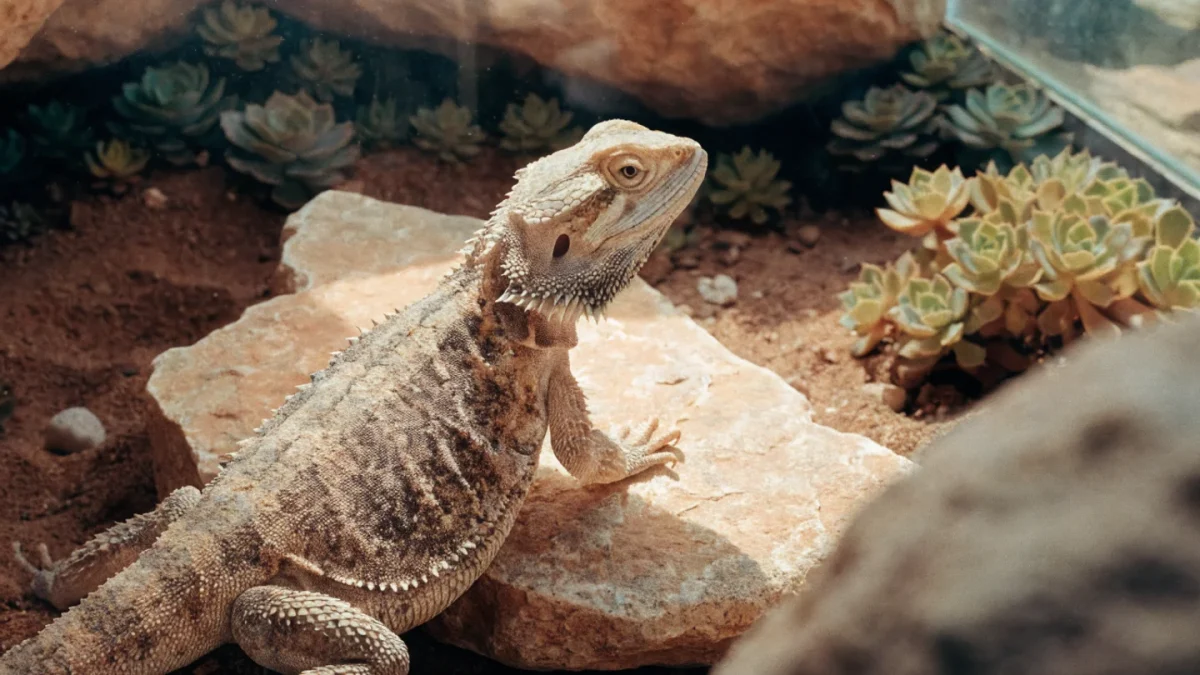
I watched a bearded dragon eat a dandelion green for the first time about fourteen years ago — my own first beardie, a juvenile I'd picked up at a reptile expo in a deli cup with a care sheet that turned out to be almost entirely wrong. The care sheet said a 40-gallon tank was fine for life, that mealworms were a complete diet, and that a regular household bulb would handle basking needs. The dragon survived my early mistakes because bearded dragons are remarkably tolerant animals, but "surviving" and "thriving" aren't the same thing.
Bearded dragons — Pogona vitticeps, originally from the arid woodlands and scrublands of central Australia — need a properly heated enclosure with full-spectrum UVB lighting, a diet that changes dramatically as they grow, and consistent handling to stay tame. They're genuinely one of the best reptiles for first-time keepers, but that reputation leads people to underestimate the setup.
Why Bearded Dragons Work for Beginners (And Where People Still Go Wrong)
The reason bearded dragons have earned their beginner-friendly reputation is real: they tolerate a wider range of handling than most reptiles, they eat readily available food, they're diurnal so you actually see them being active, and they display body language that's relatively easy to read. A stressed ball python looks almost exactly like a relaxed ball python. A stressed beardie flattens its body, darkens its beard, and gapes its mouth. You know where you stand.
But "beginner-friendly" gets misunderstood as "easy." I tell people at expos the same thing every time: the animal is forgiving. The setup is not optional. You can't cut corners on lighting and heat and expect a healthy dragon five years from now.
The most common mistake I see — and I've seen it hundreds of times — is people buying the dragon first and the equipment second, then trying to retrofit a cheap setup around an animal that's already home. Start with the enclosure. Get everything dialed in. Then bring the dragon home.
Choosing Your Bearded Dragon
Buy captive-bred. Always. Wild-caught bearded dragons are uncommon in the trade these days because Australia banned exports decades ago, but occasionally you'll encounter animals of questionable origin. Captive-bred dragons are healthier, calmer, and already adapted to enclosure life.
Look for a dragon that's alert, has clear eyes, and has a full tail with no kinks. Check for stuck shed on the toes — chronic retained shed on digits can cut off circulation and cause toe loss. The animal should be responsive when you approach but not panicked. Lethargy in a juvenile is a red flag.
Age matters for your setup timeline. Juveniles under six months are more fragile — they dehydrate faster, need more frequent feeding, and can be housed in a smaller temporary enclosure. But they tame down faster with consistent handling. Adults are hardier but may take longer to settle if they've been handled infrequently.
One thing I always mention: don't buy two and house them together. Bearded dragons are solitary animals. Two dragons in one enclosure almost always ends with one dominating the other — hogging the basking spot, intercepting food, and creating chronic stress that isn't always obvious until the subordinate animal stops eating entirely.
Setting Up the Enclosure
This is the section that saves animals. Get this right and you'll solve about 80% of the health problems I see keepers dealing with.
Size
An adult bearded dragon needs a minimum of a 120-gallon enclosure — roughly 120 cm × 60 cm × 60 cm (48" × 24" × 24"). Bigger is better. Juveniles can start in a 75-gallon, but they'll outgrow it within a year, so buying the adult-size enclosure from the start saves money.
Front-opening enclosures are vastly better than top-opening aquariums. Reaching down from above triggers a predator response — something swooping in from the sky. Approaching from the front is less stressful and makes daily interaction smoother.
The Temperature Gradient
This is the most critical piece of bearded dragon care, and it's where I see the most expensive mistakes.
Bearded dragons are ectotherms. They regulate body temperature by moving between warmer and cooler areas. Your enclosure needs to provide both ends of that range simultaneously:
- Basking spot surface temperature: 40-43°C (105-110°F)
- Warm side ambient: 32-35°C (90-95°F)
- Cool side ambient: 24-27°C (75-80°F)
- Nighttime: Can drop to 18-21°C (65-70°F) — no supplemental heat needed unless your room gets colder than that
Measure surface temperatures with an infrared temperature gun, not a stick-on dial thermometer. Those dial thermometers measure air temperature at whatever height they're mounted and are routinely off by several degrees. An infrared gun costs roughly the same and tells you what the dragon actually feels when it sits on its basking spot.
I can't count how many times someone has told me their temperatures are "perfect" based on a dial thermometer, then we check with a temp gun and the basking spot is 10 degrees too cold. The dragon looked healthy for a while because bearded dragons compensate for poor conditions longer than most reptiles — until they can't.
UVB Lighting
Non-negotiable. This isn't a preference item.
Bearded dragons need high-output UVB — specifically a tube-style fixture that spans at least two-thirds of the enclosure length, mounted inside the enclosure (not on top of a mesh screen, which filters out a significant percentage of UVB). The tube should produce UVB in the 10-12% range.
Why UVB matters: without adequate UVB exposure, bearded dragons cannot metabolize calcium. Dietary calcium without UVB is essentially useless. The result is metabolic bone disease — MBD — which causes softened bones, deformities, tremors, and eventually death. It's the single most common health problem in captive bearded dragons, and it's entirely preventable.
Replace UVB tubes every six months even if they still produce visible light. UVB output degrades long before the bulb burns out. A tube that looks fine to your eyes might be producing a fraction of its original UVB. I mark replacement dates on a calendar.
Substrate and Decor
Substrate is one of the more debated topics in beardie keeping, and I've changed my own position on it over the years.
For juveniles under twelve months, I use solid substrate — tile, paper towel, or textured reptile liner. Young dragons are clumsy eaters and will ingest loose substrate while snapping at insects. Impaction from substrate ingestion is a real risk in juveniles, and it's not worth the gamble.
For adults, I've moved toward a bioactive setup with a mix of washed play sand and organic topsoil — roughly 70/30. Adults are more precise eaters and the impaction risk drops substantially if temperatures and hydration are correct. A properly heated, well-hydrated beardie passes substrate without issue. A cold, dehydrated one doesn't. That distinction matters more than the substrate itself.
Every enclosure needs:
- A basking platform that gets the dragon within the proper distance of the heat source
- At least one hide on the cool side (bearded dragons thermoregulate by retreating from heat too, not just seeking it)
- Climbing opportunities — branches, ledges, cork rounds. Bearded dragons are semi-arboreal and use vertical space more than people expect
- A shallow water dish, though most dragons won't drink from standing water consistently
Bearded Dragon Diet
Diet is where the learning curve lives, because feeding a bearded dragon properly means changing the diet ratio as the animal ages.
Juveniles (0-12 months)
Juvenile bearded dragons are growth machines. Their diet should be approximately 70-80% insects and 20-30% vegetables. They need to eat insects two to three times daily — as many appropriately sized insects as they'll consume in a 10-15 minute feeding window.
Appropriate feeder insects: dubia roaches, black soldier fly larvae, crickets, silkworms. Variety matters. I rotate between at least three species weekly.
Avoid mealworms as a staple for juveniles. The chitin-to-nutrition ratio is poor and they're harder to digest for small dragons. They're fine as an occasional item for adults, but not as a dietary foundation.
Every insect feeding should be dusted with calcium powder (without vitamin D3 if your UVB is adequate, with D3 if you're supplementing — but adequate UVB is the better solution). A multivitamin dust once or twice a week covers the remaining micronutrients.
Sub-Adults and Adults (12+ months)
The diet flips. Adults should eat roughly 70-80% vegetables and greens, with insects offered a few times a week rather than daily.
Staple greens: collard greens, mustard greens, turnip greens, endive, escarole, dandelion greens (leaves and flowers). These form the daily base.
Occasional additions: butternut squash, bell pepper, snap peas, grated carrot, cactus pads (with spines removed).
Avoid: spinach (binds calcium), lettuce of any kind (nutritionally empty), avocado (toxic), citrus fruits.
The transition from insect-heavy to plant-heavy is gradual and often frustrating. Many juvenile dragons become so fixated on insects that they refuse greens entirely. I've dealt with this dozens of times — both with my own animals and when advising other keepers. The solution isn't starvation (never withhold food from a growing animal), but rather offering greens first, before the insect feeding, when the dragon is hungriest. Mixing finely chopped greens with a few moving insects on top also works. Patience. It can take weeks.
Hydration
Bearded dragons get most of their water from food, but they still need access to water. A shallow dish works. Some dragons prefer to drink from water droplets misted onto surfaces or dripped onto their nose. Others will soak in their water dish — which also means they'll defecate in it, so clean it daily.
I mist my dragons lightly once or twice a week, more during shed cycles. Warm baths (lukewarm, belly-deep) once a week help with hydration and shedding, though not every dragon tolerates this — if your dragon panics in water, skip the bath and focus on misting and a proper diet.
Handling and Taming
One of the genuine pleasures of bearded dragons: they're among the few reptiles that actually seem to tolerate — and in some cases seek out — human interaction. Leopard geckos are the other common beginner reptile people compare them to, but beardies are in a different league when it comes to daytime interaction and visible personality.
Start handling within the first week of bringing your dragon home, but keep sessions short. Five to ten minutes, once or twice daily. Support the body from below — scoop, don't grab. A beardie perched on your forearm with its legs supported feels secure. A beardie dangling by its midsection does not.
Read the body language. A relaxed dragon has normal coloring, a flat body against your hand, and may close its eyes during handling (a sign of comfort in bearded dragons — the opposite of what it means in most reptiles, where closed eyes indicate stress or illness). A stressed dragon puffs up, darkens its beard to black, opens its mouth wide, and may hiss. If you see that display, put the animal back and try again tomorrow.
Glass surfing — repeatedly scratching at the enclosure walls — is usually not excitement to see you. It's a stress behavior that indicates something in the enclosure isn't right: temperatures off, enclosure too small, reflection stress, or the dragon can see another reptile. I had a juvenile that glass-surfed constantly for two weeks before I realized he could see his own reflection in the side panel. Covered the outside of the glass with a background. Problem solved overnight.
Young dragons are fast and jumpy. They calm down substantially between six and twelve months with consistent handling. An adult that's been handled regularly is one of the calmest reptiles you'll ever hold — content to sit on your shoulder for an hour without moving. That said, they're still animals with individual temperaments. I've had the occasional beardie that never fully relaxed with handling despite months of patient work. Uncommon, but it happens.
Common Health Issues
I'm not going to pretend this section is a substitute for a veterinarian who specializes in reptiles. Find an exotic vet before you need one. The middle of an emergency is the worst time to start searching.
Metabolic bone disease is the biggest preventable problem. It comes from inadequate UVB, insufficient calcium, or both. Early signs: lethargy, reluctance to move, trembling limbs, a jaw that looks rubbery or misshapen. Advanced MBD involves visible skeletal deformities and fractures from normal movement. Early-stage MBD is reversible with proper husbandry corrections. Advanced MBD is not fully reversible — the damage stays.
Impaction — a blockage in the digestive tract — shows up as constipation, loss of appetite, a swollen abdomen, and sometimes dragging of the hind legs. Causes include loose substrate ingestion (especially in cold enclosures where digestion slows), feeding insects that are too large, and chronic dehydration. The rule of thumb on insect size: nothing wider than the space between the dragon's eyes.
Respiratory infections present as wheezing, mucus around the nostrils, open-mouth breathing, and lethargy. Usually caused by temperatures that are too low, humidity that's too high, or both. Bearded dragons are arid-climate animals — persistent humidity above 40% in the enclosure is a problem. If you notice these signs, check your temperatures first, then get to a vet.
Parasites — both internal and external — are common enough that a fecal exam within the first month of ownership is a good idea. Captive-bred animals can still carry low parasite loads from the breeder. A vet can identify what's present and whether treatment is needed.
Yellow fungus disease — caused by the fungus Nannizziopsis guarroi (formerly classified under CANV) — is a serious infection that causes discolored, crusty patches of skin and can invade deeper tissues including fat, muscle, and organs. A 2010 study in the Journal of Herpetological Medicine and Surgery found that voriconazole treatment showed better survival rates than itraconazole, but advanced systemic cases still carry a very poor prognosis. Early detection is everything — any unexplained skin discoloration or texture change warrants a vet visit immediately.
Shedding
Bearded dragons shed in patches, not all at once like snakes. Juveniles shed frequently — sometimes every few weeks during rapid growth phases. Adults shed less often, maybe a few times a year.
Don't pull shed off. Even if it's hanging and looks ready, pulling can tear new skin underneath. Increase misting, offer a warm soak, and let it come off naturally. Stuck shed on toes and tail tips is the exception — if it's been more than a week and the shed is constricting a toe, a warm soak and gentle work with a damp cotton swab can help. Chronic retained shed in the same area needs a vet check.
Brumation
Brumation is the reptile version of hibernation — a period of reduced activity, appetite, and metabolic rate during cooler months. Not all captive bearded dragons brumate, but many do, and it catches first-time keepers off guard.
Signs: your dragon becomes sluggish, stops eating, hides more, and sleeps for extended periods. This is normal seasonal behavior, not illness — but it looks alarming if you're not expecting it.
Before allowing brumation, get a fecal exam done. Parasites that are manageable in an active, eating dragon can become dangerous in a brumating one that isn't eating or passing waste.
During brumation, keep the enclosure temperatures and lighting normal. Offer water regularly. Don't force food — if the dragon isn't interested, that's fine. Brumation can last a few weeks to several months. The dragon will resume normal activity on its own schedule.
I'll be honest — brumation still makes me slightly nervous every time, even after all these years. There's always that moment when you're watching a completely still dragon and wondering if everything's okay. It is. But that worry never fully goes away.
Quick-Reference Parameter Table
| Parameter | Juvenile (0-12 months) | Adult (12+ months) |
|---|---|---|
| Enclosure size | 75 gal minimum (temporary) | 120 gal minimum |
| Basking surface temp | 40-43°C / 105-110°F | 38-40°C / 100-105°F |
| Cool side temp | 24-27°C / 75-80°F | 24-27°C / 75-80°F |
| Night temp | 18-21°C / 65-70°F | 18-21°C / 65-70°F |
| UVB | 10-12% tube, 2/3 enclosure | 10-12% tube, 2/3 enclosure |
| Photoperiod | 12-14 hours | 12-14 hours (reduce in brumation) |
| Humidity | 30-40% | 30-40% |
| Diet ratio | 70-80% insects / 20-30% veg | 20-30% insects / 70-80% veg |
| Feeding frequency | 2-3x daily (insects) + daily greens | Insects 3-4x/week + daily greens |
| Calcium dusting | Every insect feed | Every insect feed |
| Multivitamin | 1-2x/week | 1-2x/week |
| Lifespan | — | 10-15 years |
Frequently Asked Questions
How long do bearded dragons live as pets?
With proper care, 10-15 years. I've personally kept dragons that made it past 12. Lifespan is heavily influenced by husbandry — animals with poor UVB and calcium supplementation develop health problems that shorten their lives considerably, even if they appear functional in the short term.
Can bearded dragons eat fruit?
Small amounts, occasionally. Berries, melon, and mango are fine as rare treats — maybe once every week or two. Fruit is high in sugar relative to what bearded dragons encounter in the wild, and too much contributes to obesity and digestive issues. Think of fruit as dessert, not a meal component. And never citrus.
Do bearded dragons need a heat lamp at night?
No — unless your room temperature drops below 18°C (65°F). Bearded dragons experience temperature drops at night in the wild and it's part of their natural cycle. A nighttime heat source that produces light will disrupt sleep. If supplemental heat is genuinely needed, a ceramic heat emitter (no light output) is the way to go.
How often should I clean the enclosure?
Spot-clean daily — remove feces and uneaten food. Full substrate change and disinfection monthly for non-bioactive setups. Bioactive enclosures need less frequent full cleanups if the cleanup crew (isopods, springtails) is established, but still require spot-cleaning and monitoring. Water dishes get cleaned and refilled daily regardless.
Is it true you shouldn't use red or colored heat bulbs?
Yes. Colored bulbs — especially red ones — were marketed for years as "nighttime heat" that wouldn't disturb the animal. Research has shown that reptiles — including bearded dragons — possess photoreceptor cells sensitive to red wavelengths up to 702 nm, and nighttime light exposure suppresses melatonin production, disrupting their circadian rhythm and sleep quality. White basking bulbs during the day and darkness at night. If you need nighttime heat, ceramic heat emitters produce warmth without any light.
That parameter table covers the numbers, but the numbers only work when you understand the reasoning behind them — which is the whole point of reading beyond a care sheet. Bearded dragons aren't difficult animals, but they reward attention to detail. The difference between a beardie that's surviving and one that's genuinely thriving shows up in their color, their activity level, and the way they respond to you when you open the enclosure. Get the habitat right, feed appropriately for the life stage, handle consistently, and find a reptile vet before you need one. That's the whole framework.