

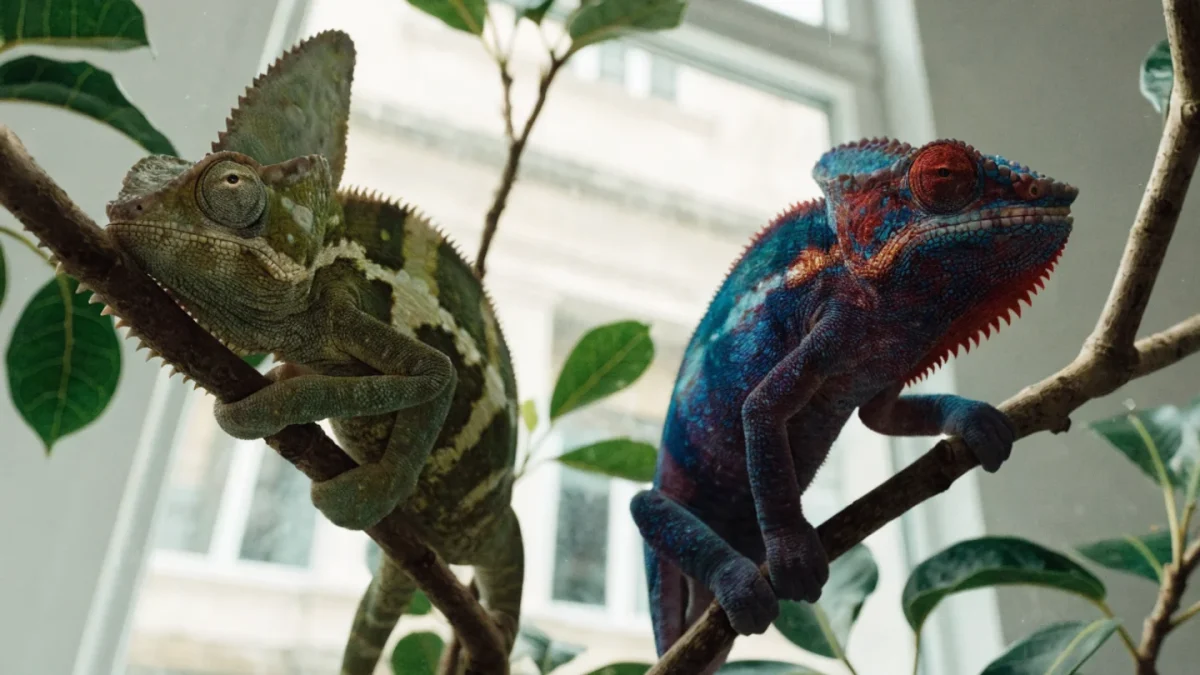
A guy at a reptile expo last spring walked up to my table holding a printout he'd made — a pros and cons list for veiled versus panther chameleons that he'd pulled from three different care websites. Half the "facts" contradicted each other. Panthers were listed as both "beginner-friendly" and "advanced only" depending on the source. Veileds were described as "aggressive" on one sheet and "docile" on another.
Both species make rewarding captive chameleons, but they differ in temperament, price, color potential, and how much room they give you to make mistakes. Veileds are hardier and cheaper, making them better suited for someone keeping their first chameleon. Panthers offer stunning locale-specific colors and often calmer dispositions, but they punish husbandry errors faster and cost three to five times more upfront.
Appearance and Size
The visual difference between these two species is immediately obvious.
Veiled chameleons (Chamaeleo calyptratus) are named for the tall, blade-like casque on top of their head — it can grow 5-8 cm tall in adult males. Their base coloring runs through greens, yellows, and browns, with banding patterns that shift with mood and temperature. They're impressive animals, but the color palette is more limited than what you'll see in panthers. Males reach 45-60 cm total length, including tail. Females are smaller, maxing out around 30-35 cm, and their casques stay much shorter.
Panther chameleons (Furcifer pardalis) are the species that ends up on magazine covers. Males display wildly different color patterns depending on their locale — the geographic region in Madagascar their lineage originates from. An Ambilobe male might show electric blue bars with red or orange between them. A Nosy Be male can be an almost uniform turquoise. Sambava males lean toward red and orange. The variation is staggering, and it's the primary reason panthers command premium prices. Males reach 40-55 cm. Females are smaller and typically display muted pink, peach, or brown tones regardless of locale.
Temperament
I've kept both species extensively, and there's a real behavioral difference, though individual variation matters more than most care sheets admit.
Veileds have a reputation for being feisty. That reputation is earned. Not every veiled will hiss and gape when you open the cage, but a higher percentage of them will compared to panthers. I've had veiled males that would launch themselves at the cage door and others that calmly walked onto my hand. The hissing, though — veileds hiss more than any other chameleon species I've kept. It sounds alarming if you're not expecting it.
Panthers tend to be more measured. They're not "friendly" — no chameleon really is — but many panther keepers describe their animals as more predictable and less reactive. A well-socialized panther male will often sit on a hand or a free-range plant without much protest. That said, I've met aggressive panthers too. Breeding plays a role. Hand-raised animals from breeders who prioritize temperament produce calmer offspring than mass-produced imports.
If handling matters to you — and be honest with yourself about whether it does — a panther from a reputable breeder gives you better odds of a tolerable experience.
Care Difficulty
Both species need the same basic setup: tall mesh enclosure, UVB lighting, basking spot, misting system, live plants. If you understand chameleon care fundamentals, the day-to-day husbandry is similar. But the margin for error differs.
Veileds are more tolerant of imperfect conditions. They handle a slightly wider temperature range, adapt to lower humidity spells better, and are generally more robust feeders. When I get consultation emails from panicked first-time owners, the ones with veileds usually have more time to correct the issue before it becomes a veterinary emergency.
Panthers react faster to environmental stress. Humidity drops below 50% for a few days? A veiled might look unbothered. A panther may stop eating and develop dull, dark coloring within 48 hours. Temperature swings, inconsistent misting schedules, and even changes in room placement affect panthers more noticeably. This isn't fragility — it's a species adapted to more stable conditions in the wild that simply demands you maintain those conditions in captivity.
One thing that catches new keepers off guard with veileds specifically: females produce eggs regardless of whether a male is present. An unfertilized clutch of 20-80 eggs is a significant physical event, and females need a laying bin with moist soil or sand at the bottom of the cage. Without an appropriate laying site, females can become egg-bound — a potentially fatal condition. Panther females also lay unfertilized eggs, but the clutches are smaller and the process is less frequently problematic.
Cost Breakdown
This is where the gap gets wide.
| Veiled Chameleon | Panther Chameleon | |
|---|---|---|
| Animal purchase | 30-75 | 150-400+ |
| Initial setup | 300-500 | 300-500 |
| Monthly feeders/supplements | 25-40 | 25-40 |
| Annual UVB replacement | 25-50 | 25-50 |
| Exotic vet visit (basic) | 50-150 | 50-150 |
The enclosure costs are identical because both species need the same size cage and equipment. Where you feel the difference is in the animal itself and in replacement cost if something goes wrong. Losing a 50 veiled to a preventable husbandry mistake is devastating. Losing a 350 panther is devastating and expensive.
For panthers, locale matters for pricing. Ambilobe males — the most popular locale — typically run 250-450 for a well-started juvenile from a reputable breeder based on current market listings. Rarer locales like Nosy Mitsio or high-color Sambava lines can exceed 500. Females of any locale are cheaper, typically 150-300, because the dramatic color displays are male-only.
Availability
Captive-bred veileds are everywhere. They're produced in large numbers, readily available at reptile expos and through online breeders, and rarely out of stock. Finding a healthy juvenile veiled is straightforward.
Panthers require more shopping around. Quality captive-bred panthers from reputable breeders often have waitlists — especially for specific locales. The difference between a well-bred panther from a keeper who tracks lineage and a cheap import of uncertain origin is enormous in terms of health, color potential, and temperament. Spend the time finding a good breeder. Ask about their breeding stock, parasite testing, and what they feed.
I'd rather wait three months for a well-bred panther than buy one on impulse from a vendor I don't know. That patience pays off in years of keeping.
Lifespan
Roughly comparable. Veileds average 5-8 years, with males on the longer end. Panthers average 5-7 years. In both species, females tend to have shorter lifespans because of the metabolic demands of egg production.
These numbers assume proper husbandry. I've seen well-kept veileds hit 8 years and panthers approach 7-8. I've also seen both species die within a year from setups that never should have housed a chameleon.
Which Should You Choose?
If you've never kept a chameleon, start with a veiled. They're more affordable, more forgiving, and widely available. When — not if — you make a mistake in your first few months, a veiled gives you more room to correct it.
If you've kept reptiles before (even non-chameleons), you understand setting up a chameleon enclosure with proper lighting, misting, and drainage, and you're willing to invest more upfront, a panther is a genuinely spectacular animal to keep. The color displays alone make the extra cost and effort worthwhile.
And if you've kept a veiled for a year or two and you're confident in your husbandry? That's the perfect time for a panther. You'll appreciate the differences between the two species, and you'll already have the infrastructure and instincts to keep the more demanding animal thriving.
One more thing: don't buy either species based on color potential alone. A healthy, well-cared-for chameleon of either species will develop its best colors naturally. Stressed, sick, or improperly kept chameleons display muted, dark coloring regardless of genetics. The best way to see beautiful colors is to provide excellent care.