

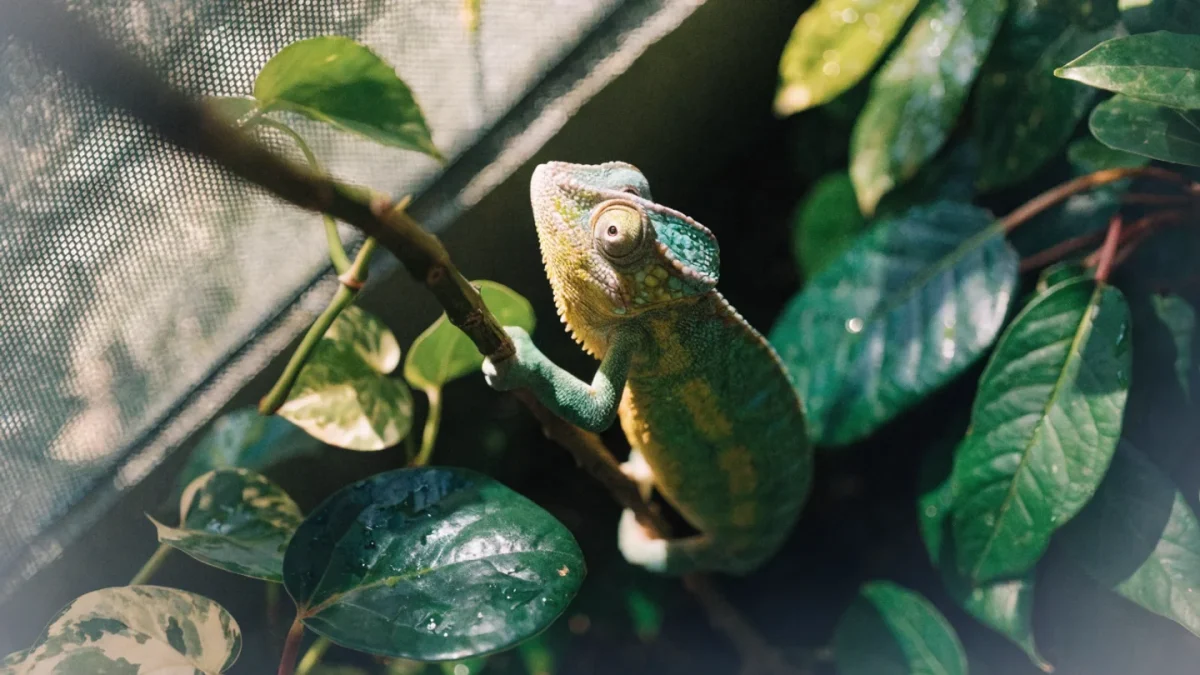
The first chameleon I ever kept died within four months. I was nineteen, had done what I thought was plenty of research, and set the animal up in a glass aquarium with a screen lid, a single heat bulb, and a water bowl on the floor. That chameleon — a juvenile veiled — never drank from the bowl, slowly dehydrated despite me misting once a day, and developed a respiratory infection from the stagnant air in the glass tank. I didn't know enough to recognize the signs until it was too late.
Chameleons require a tall, well-ventilated mesh enclosure, species-appropriate temperature gradients, UVB lighting that actually reaches the animal, a reliable misting or drip system they'll drink from, and a steady supply of gut-loaded, calcium-dusted insects. They don't tolerate the same shortcuts that hardier reptiles can survive. That's not meant to scare anyone off — it's meant to save the animal.
I've kept veiled, panther, and Jackson's chameleons for over a decade since that first failure, and I've helped hundreds of people set up their first chameleon enclosures. The patterns of what goes wrong are remarkably consistent, and almost all of them trace back to the initial setup.
Choosing the Right Species
Three species make up the vast majority of chameleons in the pet trade, and for good reason.
Veiled chameleons (Chamaeleo calyptratus) are the most commonly recommended for beginners — though "beginner" is relative when we're talking about chameleons. They're hardier than panthers, tolerate a slightly wider range of conditions, and are readily available as captive-bred animals. Males develop a tall casque (the helmet-like ridge on their head) and can reach 50-60 cm total length. They're also the most likely species to eat plant matter occasionally, which is unusual for chameleons. Temperament varies, but they're often feistier than panthers. Budget around 30-75 for the animal itself.
Panther chameleons (Furcifer pardalis) are the showstoppers. Males display incredible locale-specific color patterns — Ambilobe, Nosy Be, Sambava — and they tend to be slightly calmer in temperament than veileds once established. They're also more expensive, running 150-400+ depending on locale and lineage, and they're less forgiving of husbandry mistakes. If your humidity drops too low or your temperatures drift, a panther will show stress faster than a veiled.
Jackson's chameleons (Trioceros jacksonii) are the three-horned species that catches everyone's eye. They need cooler temperatures than the other two — a basking spot around 29-30°C versus 32-35°C — and higher ambient humidity. They're live-bearers rather than egg-layers, which changes the breeding calculus entirely. I'd put them at intermediate difficulty.
Other species — carpet chameleons, pygmy chameleons, Meller's chameleons — show up in the trade occasionally, but availability and captive-bred stock vary enormously. For a first chameleon, stick with veiled or panther.
The Enclosure
This is where most problems start and where I spend the bulk of my time when consulting with new keepers.
Mesh, Not Glass
Chameleons need airflow. A glass terrarium traps humid, stagnant air and creates conditions for respiratory infections — exactly what killed my first animal. Screen or mesh enclosures allow air to circulate while still holding enough humidity if you mist properly. The minimum size for an adult veiled or panther male is 60 cm × 60 cm × 120 cm tall (24" × 24" × 48"). Females can manage slightly smaller, but bigger always serves the animal better.
There's a caveat here. If you live somewhere with very low ambient humidity — below 30% — an all-mesh cage makes it genuinely difficult to maintain adequate humidity levels. Some keepers in dry climates use hybrid enclosures with solid sides and a mesh front panel. That's a valid approach, but the ventilation has to remain adequate. If you can smell stale air when you open the cage, there's not enough airflow.
Live Plants
Fake plants are decorative. Live plants are functional. Pothos (Epipremnum aureum), ficus, and schefflera are the standards because they're non-toxic to chameleons, tolerate the humidity, and collect water droplets on their leaves — which is how chameleons prefer to drink. A well-planted cage also gives the animal hiding spots and climbing routes that reduce stress. I've seen dramatic behavioral differences between chameleons in bare cages versus planted ones.
Drainage
Water is going to collect at the bottom of the cage. A lot of it. Between misting sessions and drippers, you'll be putting significant moisture into the enclosure daily. Without drainage, you get standing water, mold, and bacterial growth. A drainage tray with a drain hole or a substrate-free bottom with a collection pan is the standard approach.
Temperature and Lighting
Chameleons are ectotherms — they regulate their body temperature by moving between warmer and cooler zones in the cage. Your job is to provide a gradient that actually works.
Basking Temperature
For veiled and panther chameleons, the basking spot should sit around 32-35°C (90-95°F). Jackson's chameleons need it cooler — 29-30°C (85-87°F). The ambient temperature in the rest of the cage should drop to around 24-27°C (75-80°F) during the day, and nighttime temperatures can fall to 16-21°C (60-70°F) depending on species. A nighttime drop is natural and healthy. Don't use heat lamps at night.
A regular incandescent bulb or a halogen flood bulb works for basking. Position it above the mesh so the chameleon can't make direct contact — burns from sitting on hot fixtures are one of the most common injuries I see.
UVB Lighting
Non-negotiable. Without adequate UVB, chameleons can't synthesize vitamin D3, which means they can't metabolize calcium, which means metabolic bone disease. MBD is the single most common health problem in captive chameleons, and it's entirely preventable.
Use a linear UVB tube (T5 high-output, 6% UVB for forest species like Jackson's, or 12% for more sun-exposed species like veileds). The tube should span at least two-thirds of the cage length. Mount it on top of the mesh, not inside — mesh filters some UV, so the fixture needs to be close, within 15-20 cm of the nearest basking branch.
Replace UVB bulbs every 6-12 months. They continue to produce visible light long after their UVB output has degraded below useful levels. I mark the installation date on every bulb with a marker. Simple habit, saves animals.
Photoperiod
Twelve hours on, twelve hours off. Chameleons don't need complex seasonal light cycling in captivity unless you're attempting to breed them. Consistency matters more than mimicking wild conditions.
Diet
Chameleons are insectivores. Some species will nibble on plant matter (veileds especially), but the bulk of their nutrition comes from live insects.
Feeder Insects
Crickets and dubia roaches form the base diet for most keepers. Silkworms, hornworms, black soldier fly larvae, and blue bottle flies add variety. I rotate through at least three feeder types per week. A chameleon eating only crickets for months on end is like you eating only chicken — technically survivable, nutritionally incomplete.
Mealworms and superworms are fine as occasional treats but shouldn't be staples. Their chitin-to-nutrition ratio is less favorable, and chameleons sometimes struggle to digest the harder exoskeletons.
Gut-Loading
This is the part that separates adequate care from good care. The nutritional value of a feeder insect is directly tied to what that insect ate in the 24-48 hours before being fed to your chameleon. Feeding empty crickets — ones that have been sitting in a container with nothing but a potato slice — delivers almost nothing.
Gut-load feeders with dark leafy greens (collard greens, mustard greens, dandelion greens), squash, carrots, and a quality dry gut-load formula. No citrus. No spinach (the oxalates bind calcium). I gut-load feeders in a separate container for 24 hours before offering them.
Supplementation
Dust feeders with plain calcium (no D3) at every feeding. Calcium with D3 twice a month. A multivitamin twice a month, on a different schedule from the D3. Over-supplementation with D3 is toxic, so don't guess — follow a schedule and stick to it.
The exact dusting schedule gets debated endlessly online. What I've found works over years of keeping: plain calcium every feeding, D3 and multivitamin each twice monthly, alternating weeks. So week one: calcium + D3 on one feeding, plain calcium the rest. Week two: calcium + multivitamin on one feeding, plain calcium the rest. Repeat.
Misting and Hydration
Chameleons don't drink from water bowls. I know I said it already, but I need to say it again because I still get messages from people asking why their chameleon ignores its water dish. They drink by lapping droplets off leaves, branches, and cage walls.
You need to mist the enclosure at minimum twice daily for 2-5 minutes per session — enough that water pools on leaves and runs down surfaces. Many keepers use automated misting systems on timers, which is the single best equipment investment you can make for a chameleon. A drip system — slow dripping onto a leaf over a few hours — supplements misting and gives the animal a sustained water source.
Watch for signs of dehydration: sunken eyes, loss of skin elasticity, orange or dark yellow urates (the white/yellowish part of their droppings should be white, not colored). Dehydration kills slowly and quietly. By the time most keepers notice, the animal has been struggling for weeks.
Handling
I need to be direct about this: most chameleons do not enjoy being handled. They tolerate it at best. Unlike a bearded dragon, which can genuinely seem to relax in your hands, a chameleon on your hand is almost always in some degree of stress. Some individuals — particularly hand-raised panthers — become remarkably calm with regular gentle interaction. But "calm" and "enjoying it" aren't the same thing.
If you're going to handle your chameleon, let it walk onto your hand rather than grabbing it. Never restrain it. Never pull it off a branch — their grip is powerful and you'll hurt the animal or the branch. Watch the colors: darkening, flattening the body laterally to appear larger, gaping, or hissing all mean "back off." Five minutes of handling a few times a week is plenty for animals that tolerate it.
Common Health Issues
Three problems account for the majority of what I see in chameleons:
Metabolic bone disease shows up as soft, rubbery jaws, difficulty gripping branches, tremors, and limb deformities. It's caused by insufficient UVB, inadequate calcium supplementation, or both. Caught early, it's treatable with corrected husbandry and veterinary calcium supplementation. Advanced MBD causes permanent damage.
Respiratory infections present as gaping, mucus around the mouth or nostrils, wheezing, and lethargy. Almost always linked to poor ventilation, excessive humidity without airflow, or cold temperatures. Glass enclosures and cold rooms are the usual culprits. Requires veterinary treatment — usually antibiotics.
Dehydration is the silent problem. I've taken in rescue chameleons that were kept in rooms with a misting bottle used once a day for thirty seconds. Their eyes were so sunken the turrets barely moved. Chronic dehydration damages the kidneys and can be fatal even after you correct the husbandry, because the organ damage is already done.
Eye infections, parasites, egg-binding in females (particularly veileds), and thermal burns round out the list. An exotic vet — not a dog-and-cat vet who "also sees reptiles" — is worth finding before you need one.
The Monthly Cost Nobody Mentions
People budget for the animal and the enclosure and forget about the ongoing costs. Feeder insects run 15-40 per month depending on the size of your chameleon and local prices. Supplements add another 5-10 monthly, amortized over the life of each container. UVB bulbs need replacing annually — 25-50 each time. Automated misting systems need replacement nozzles and tubing. And exotic vet visits aren't cheap — a basic exam runs 50-100 at most clinics, with diagnostics like fecal tests and X-rays adding 50-200 on top of that. Treatment for MBD or respiratory infections can easily hit 200-500+ once you factor in medication and follow-ups.
Plan for 50-100 per month in ongoing costs after the initial setup. The initial setup itself — enclosure, lighting, misting system, plants, thermometer/hygrometer — runs 300-600 for a decent configuration.
Quick-Reference Parameters
| Parameter | Veiled Chameleon | Panther Chameleon | Jackson's Chameleon |
|---|---|---|---|
| Adult enclosure (minimum) | 60×60×120 cm | 60×60×120 cm | 60×60×120 cm |
| Basking temp | 32-35°C (90-95°F) | 32-35°C (90-95°F) | 29-30°C (85-87°F) |
| Ambient temp (day) | 24-27°C (75-80°F) | 24-27°C (75-80°F) | 21-26°C (70-78°F) |
| Night temp | 16-21°C (60-70°F) | 18-22°C (65-72°F) | 10-18°C (50-65°F) |
| Humidity | 50-70% | 60-80% | 60-80% |
| UVB | 12% T5 HO | 12% T5 HO | 6% T5 HO |
| Diet | Insects + occasional greens | Insects | Insects |
| Lifespan | 5-8 years | 5-7 years | 5-10 years |
| Difficulty | Intermediate | Intermediate-Advanced | Intermediate |
Frequently Asked Questions
Do chameleons change color to match their surroundings?
No. That's one of the most persistent myths in the reptile world. Chameleons change color in response to temperature, light, mood, health, and social signals — not to camouflage against their environment. A stressed chameleon darkens. A cold chameleon darkens to absorb more heat. A male displaying to another male brightens to the most vivid colors he can produce. The background color of the branch he's sitting on has nothing to do with it.
Can I keep two chameleons together?
Don't. Chameleons are solitary and territorial. Two males will fight. A male and female housed together permanently creates chronic stress for the female, who can't escape the male's attention in an enclosure. Even visual contact between cages — one chameleon seeing another through the mesh — can cause prolonged stress responses. If you keep multiple chameleons, position cages so they can't see each other, or use visual barriers.
How long do chameleons live?
It depends heavily on species and sex. Veiled chameleons average 5-8 years in captivity. Panthers are similar at 5-7 years, though females often have shorter lifespans due to the physical toll of egg production — even unfertilized clutches. Jackson's chameleons can reach 5-10 years with proper care. These numbers assume good husbandry. Chameleons kept in inadequate setups often die within 1-2 years, and that statistic drags down a lot of the averages you'll see quoted online.
Is a chameleon a good first reptile?
Honestly, no. I love chameleons — they're among the most fascinating animals I've ever kept — but they're not forgiving of mistakes the way a bearded dragon or leopard gecko is. If you're set on a chameleon as your first reptile, commit to getting the enclosure fully set up and running for at least a week before bringing the animal home, and find a local reptile community or online group where you can get species-specific help quickly.
Do chameleons need live insects or can I feed dried ones?
Live insects only. Chameleons are visually-triggered hunters — their feeding response is activated by the movement of prey. A dried cricket sitting on a leaf won't register as food. Some keepers have had limited success with tong-feeding freshly killed insects by wiggling them, but this isn't a substitute for a regular live insect supply. If the idea of keeping live bugs in your house is a dealbreaker, a chameleon isn't the right pet.