

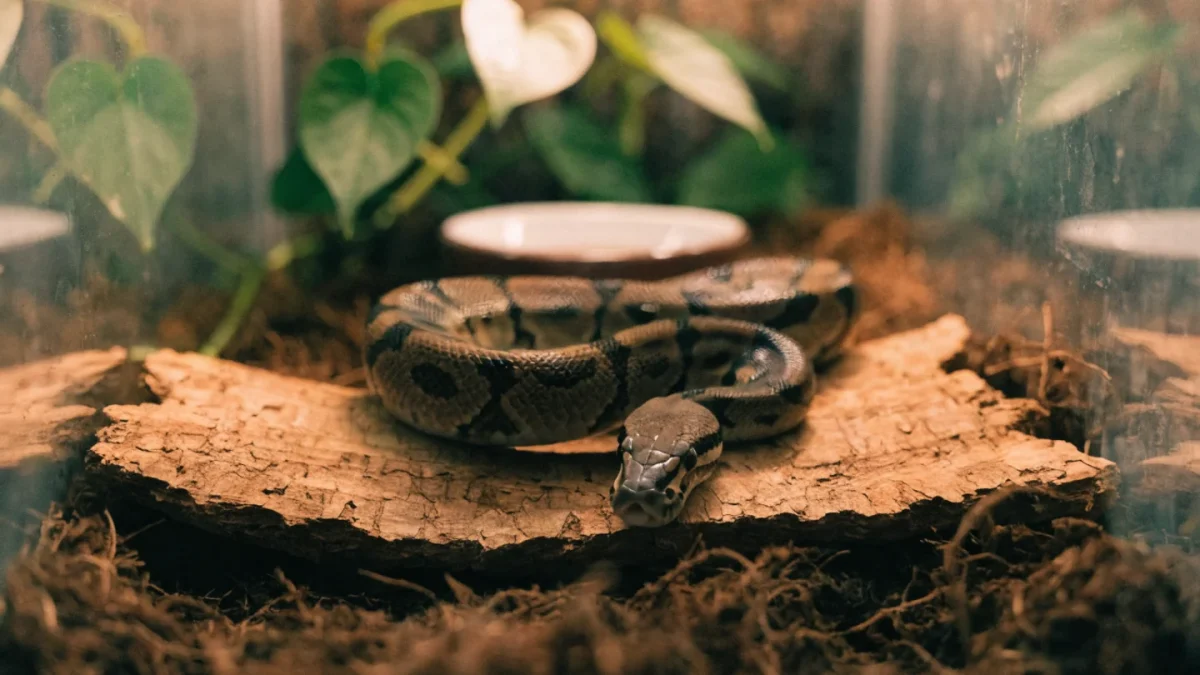
The first ball python I ever kept arrived in a plastic tub at a reptile expo in 2011 — a normal morph female, about 300 grams, with the calmest demeanor of any snake on the table. The seller told me she'd eat "anything you put in front of her." She refused her first six meals in my care.
Ball pythons — Python regius, native to the grasslands and open forests of West and Central Africa — are often the first snake people consider, and for decent reasons. They stay a manageable size, they're typically docile, and they don't require the massive enclosures that some popular species demand. But the gap between "easy first snake" and "actually thriving ball python" is wider than most care sheets acknowledge.
What Makes Ball Pythons Different from Other Beginner Snakes
Every snake has a personality qualifier, and the ball python's is stubbornness. Not aggression, not flightiness — stubbornness. They curl into a tight ball when stressed (that's where the common name comes from), they go off food for seemingly arbitrary reasons, and they can hold a grudge against an enclosure that doesn't feel right for months.
Compare that to a corn snake, which eats reliably, explores actively, and forgives environmental mistakes faster. Ball pythons are less work in some ways — they move less, eat less often, and don't attempt escapes with the same determination — but they demand more precision in their setup. I've had keepers come to me panicked because their ball python hasn't eaten in eight weeks. In about half those cases, nothing was wrong. The snake just… wasn't hungry. The other half? Something in the enclosure was off by a degree or two.
That's the trade-off. Get the husbandry right and a ball python is genuinely low-maintenance. Get it wrong and you'll spend months troubleshooting.
Setting Up the Enclosure
Enclosure Size and Type
Adults need a minimum enclosure footprint of 120 cm x 60 cm (48" x 24"). Height should be at least 30-45 cm (12-18"). PVC enclosures hold humidity better than glass aquariums, and front-opening doors reduce the overhead approach that triggers a defensive response. If you're using a glass tank, covering three sides with an opaque background helps the snake feel less exposed.
Hatchlings and juveniles can start in smaller enclosures — a 60 cm x 40 cm (24" x 16") tub works fine for the first year. But a large enclosure does not stress a ball python if it has enough cover. I've moved 200-gram juveniles into full adult enclosures with four hides and a clutter of fake plants, and they used every inch within a week.
The "too much space causes stress" myth comes from people putting a small snake in a big empty box. It's the emptiness that's the problem, not the size.
Heating
Ball pythons need a temperature gradient across the enclosure:
- Warm side ambient: 30-33°C (86-91°F)
- Basking surface (if using overhead heat): 35°C (95°F) max
- Cool side ambient: 25-27°C (77-80°F)
- Night drop: temperatures can fall to 23-24°C (73-75°F) without issue
Every heat source must be connected to a thermostat. Not optional. An unregulated heat mat or ceramic heat emitter can reach temperatures that cause thermal burns — and ball pythons will sit on dangerously hot surfaces without moving away. I took in a rescue once, a beautiful pastel morph, with a belly burn scar that ran nearly a third of her length. The previous owner had used a heat mat without a thermostat "because the pet store said it was fine."
Overhead heating (deep heat projectors, ceramic heat emitters, or radiant heat panels) is preferable to under-tank heat mats because it creates a more natural gradient and warms the air, not just the floor. That said, heat mats work adequately in tub setups if thermostat-controlled.
Humidity
This is where most ball python keepers struggle, and it's where most shedding problems originate.
Target: 60-80% relative humidity, measured by a digital hygrometer placed at substrate level (not mounted on the wall at human eye height). During pre-shed, bump it to 80% or above.
Achieving this depends on your enclosure type. PVC enclosures with restricted ventilation hold humidity naturally. Glass tanks with screen tops lose moisture fast — you may need to cover 50-75% of the screen with aluminum foil or a towel, or switch to a substrate that retains moisture better.
Substrate choice matters enormously here. Coconut fiber, cypress mulch, or a mix of the two holds moisture well. Aspen shavings — popular because they're cheap — mold quickly when damp and do nothing for humidity. I stopped recommending aspen for ball pythons years ago.
Hides and Clutter
Two hides minimum: one on the warm side, one on the cool side. Both should be snug — the snake should touch the walls and ceiling when coiled inside. A hide that's too spacious doesn't provide the contact pressure ball pythons need to feel secure.
Add clutter between the hides: fake plants, cork bark pieces, branches (ball pythons are semi-arboreal despite their reputation — younger animals especially will climb if given the opportunity). The goal is to let the snake move between temperature zones without crossing open space.
A water dish large enough for the snake to soak in goes on the cool side. Change the water every two to three days, or immediately if soiled.
Feeding
Ball pythons eat whole prey — rodents, almost exclusively. Hatchlings start on fuzzy or hopper mice, juveniles graduate to small rats, and adults eat medium to large rats. The prey item should be roughly 10-15% of the snake's body weight, leaving a visible but not dramatic lump after swallowing.
Schedule
- Hatchlings and juveniles (under 1 year): every 5-7 days
- Sub-adults (1-3 years): every 7-10 days
- Adults (3+ years): every 10-14 days, sometimes longer
These are guidelines, not gospel. I've kept adult females that maintain perfect body condition eating every 21 days. The snake's body condition — visible spine means too thin, round cross-section with no visible spine means ideal, excessive folding skin at bends means too heavy — matters more than a calendar.
Frozen-Thawed vs. Live
Feed frozen-thawed prey. Always. Live rodents can bite, scratch, and inflict serious injury on a snake that isn't immediately interested. I've seen puncture wounds, lost eyes, and deep lacerations from live feedings gone wrong. Thaw the prey in warm water until it reaches body temperature, offer it with tongs, and give the snake 15-20 minutes of privacy if it doesn't strike immediately.
The Fasting Reality
Ball pythons fast. It's normal. Males commonly go off food during breeding season (roughly November through March, though captive animals aren't always predictable), and some individuals fast for 2-4 months with no weight loss and no health consequences. Females may refuse food during follicle development.
If a ball python refuses food, check the enclosure parameters first. Nine times out of ten, the answer is there. If everything checks out, wait a week and try again. Panic starts around the 10% body weight loss mark — that's when a vet visit makes sense.
Handling
Ball pythons tolerate handling well once established — which is one of the main reasons they're so popular. But "tolerate" doesn't mean "enjoy." They accept it. There's a difference.
Wait at least 72 hours after bringing a new snake home before the first handling session, and don't handle within 48 hours of a meal. Pick the snake up from underneath — scooping rather than grabbing. Support the body at two points and let it move through your hands. Five to fifteen minutes per session, a few times a week, is plenty.
Some signs the snake has had enough: sustained tight gripping (not just holding on, but constricting around your wrist), repeated attempts to flee, or curling into a ball. Put it back. No handling during pre-shed — they can't see well, they feel vulnerable, and they're more likely to strike defensively.
Common Health Concerns
Respiratory infections show up as wheezing, bubbles around the nostrils, mouth-gaping, or excessive mucus. Almost always caused by temperatures too low or humidity too high combined with stagnant air. Adjust the environment and see an exotic vet.
Retained shed is a humidity problem. A healthy ball python in proper humidity sheds in one piece, start to finish. If you're getting patchy sheds, especially stuck eye caps, your humidity is too low or inconsistent.
Mites present as tiny black or red dots that move, particularly visible around the eyes, heat pits, and under scales. They're contagious and common in collections. Treat aggressively — an exotic vet can prescribe appropriate medication, and the enclosure needs a complete teardown and disinfection.
Scale rot appears as discolored, mushy, or blistered scales on the belly. Caused by prolonged contact with damp, dirty substrate. Keep the enclosure clean, ensure the substrate isn't waterlogged, and provide a dry resting area.
Inclusion body disease (IBD) is a viral condition that primarily affects boas and pythons. Symptoms include stargazing (the head tilting upward involuntarily), corkscrewing, inability to right themselves, and chronic regurgitation. There's no cure. Veterinary guidelines recommend quarantining any new snakes for a minimum of 90 days — and ideally up to six months — before introducing them to an existing collection.
Lifespan and Commitment
Ball pythons live 20-30 years in captivity. The oldest ball python with verified birth records — a male at the Philadelphia Zoo — reached 47 years, and a female at the Saint Louis Zoo was estimated at over 60.
That's the part nobody emphasizes at the reptile expo. You might buy this snake at twenty and still have it at fifty. Think about that — it may outlive your dog, your cat, and your interest in keeping reptiles. I say this not to discourage ownership but to make sure the commitment is understood.
Quick-Reference Care Table
| Parameter | Target |
|---|---|
| Enclosure size (adult) | 120 x 60 cm minimum (48" x 24") |
| Warm side temp | 30-33°C (86-91°F) |
| Cool side temp | 25-27°C (77-80°F) |
| Humidity | 60-80% |
| Feeding (adult) | Medium-large rat every 10-14 days |
| Lifespan | 20-30+ years |
| Temperament | Docile, shy, stress-prone |
Frequently Asked Questions
Do ball pythons need UVB lighting?
Ball pythons don't strictly need UVB the way diurnal lizards do — they're crepuscular and spend most daylight hours hiding. But emerging research suggests low-level UVB (Ferguson Zone 1-2) benefits their vitamin D3 synthesis and overall activity levels. Research from Ferguson et al. (2010) established UV exposure zones for reptiles, placing ball pythons in Zone 1-2 as crepuscular shade-dwellers. I've added UVB to my ball python enclosures over the past few years and noticed subtle but real behavioral changes — more willingness to bask openly, slightly better feeding responses. The evidence isn't as clear-cut as it is for diurnal lizards — one study on ball pythons didn't find significant D3 elevation — but most keepers and veterinarians who've tried it report positive behavioral changes. I consider it a best practice now.
Can I house two ball pythons together?
No. Ball pythons are solitary animals. Cohabitation creates chronic stress, competition for resources, and the risk of one snake cannibalizing the other — yes, it happens, even with similarly sized animals. The "but they're always cuddled together" observation is misread: they're competing for the same hide or warm spot, not bonding.
How do I know if my ball python is stressed?
Sustained hiding (more than usual), repeated attempts to escape, refusing food for extended periods, defensive striking, and spending excessive time soaking in the water dish are all stress indicators. One of these alone isn't always alarming — ball pythons hide a lot. But multiple signs together, or sudden behavioral changes, mean something in the environment needs adjustment.
Is a ball python good for someone who's never had a snake?
They can be, but only if you do the setup research before buying. The common recommendation of ball pythons as "the best beginner snake" skips the asterisk: they're beginner-friendly in temperament but intermediate in husbandry compared to something like a corn snake or kingsnake. If you're willing to invest in proper heating, humidity control, and a thermostat, and you can handle the occasional feeding refusal without panicking, a ball python is a great first snake.
My ball python hasn't eaten in a month — should I be worried?
Probably not, especially during winter months or if the snake is maintaining body weight. Weigh your snake every two weeks. If weight holds steady and the animal looks alert with clear eyes and normal posture, wait it out. If you start seeing visible weight loss — spine becoming prominent, skin folding loosely — or if the fast extends beyond three months with weight loss, schedule an exotic vet appointment. Don't try force-feeding without veterinary guidance.