

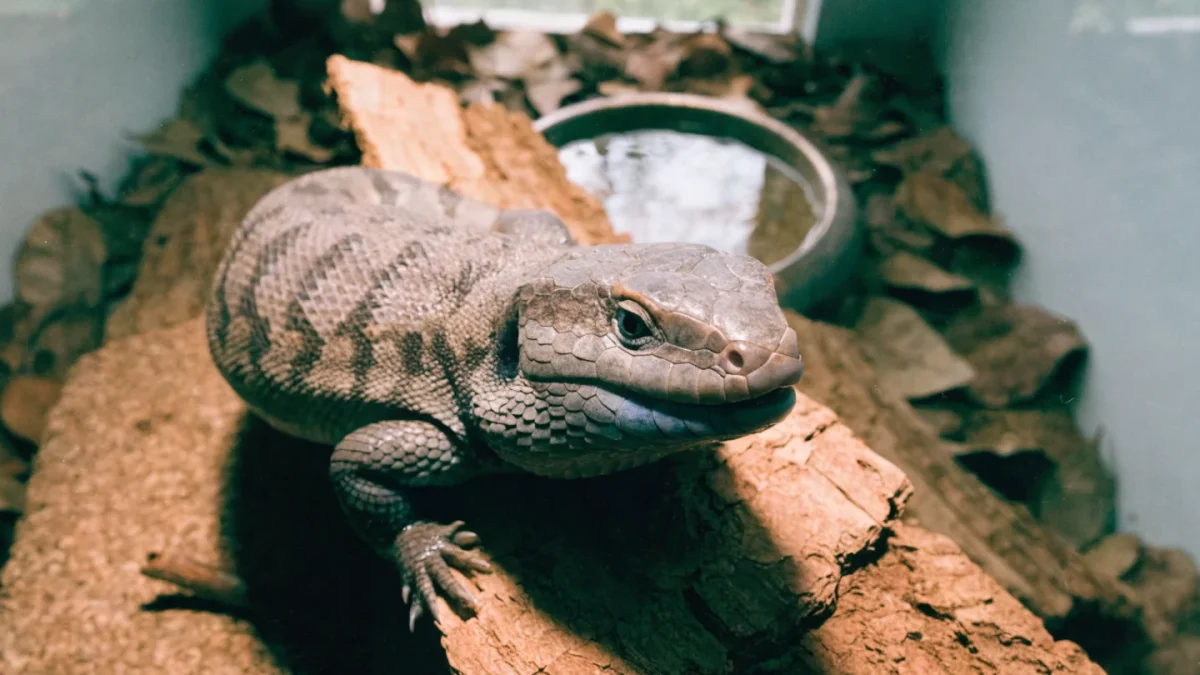
The first blue tongue skink I ever kept arrived at my house in a shoebox — a friend's kid had found a Merauke at a flea market and lost interest inside of three weeks. The animal was dehydrated, shedding in patches, and had been living on a diet of canned cat food and nothing else. It took two months of careful rehydration and diet correction before that skink started acting like itself: curious, slow-moving, tongue flicking at everything within reach.
Blue tongue skinks — genus Tiliqua — are heavy-bodied, omnivorous lizards that need a warm basking zone around 38°C (100°F), a cool side near 24°C (75°F), UVB lighting, and a varied diet split roughly between vegetables, protein sources, and a small percentage of fruit. Species selection determines humidity requirements, temperament, and price, so that decision comes first.
Picking the Right Species
There are roughly eight recognized species and subspecies of blue tongue skink in the hobby, but most keepers will choose between three: the Northern (Tiliqua scincoides intermedia), the Eastern (Tiliqua scincoides scincoides), and one of the Indonesian species — typically the Merauke or the Halmahera.
Northerns are the gold standard for beginners. They're the largest of the commonly kept species, often reaching 50-60 cm as adults, and they come from the arid grasslands and woodlands of northern Australia. Their humidity needs are forgiving — ambient room humidity works in most climates. They're also, in my experience, the most consistently docile species. I've handled hundreds of Northerns over the years and can count on one hand the ones that remained defensive past the first month of regular handling.
Easterns look similar but tend to be slightly smaller and a bit more variable in temperament. They're less common in the trade outside of Australia.
Indonesian species are a different animal in almost every practical sense. Halmaheras need humidity levels around 60-80%, which means a completely different substrate strategy and enclosure ventilation setup. Meraukes fall somewhere in between — not as humidity-demanding as Halmaheras but more so than Northerns. And Indonesian blue tongues, especially wild-caught imports, can be significantly more defensive and prone to stress.
I used to recommend "just get a Northern" to everyone who asked. I've softened on that a bit — some experienced keepers genuinely enjoy the challenge of Indonesian species, and captive-bred Meraukes are becoming more available. But for a first blue tongue? A captive-bred Northern is still the answer.
Enclosure Size and Layout
An adult blue tongue skink needs a minimum enclosure of 120 x 60 x 60 cm (roughly 4x2x2 feet). I've seen care sheets that still recommend 40-gallon breeder tanks, and those are too small — a full-grown Northern can barely turn around comfortably in that footprint.
Front-opening enclosures work better than top-opening aquariums. Blue tongues aren't arboreal — they're ground-dwellers with stubby legs and a low center of gravity — so floor space matters more than height. But approaching from above triggers a predator response in many skinks, and front-opening doors let you reach in at their level.
Substrate depends on species. For Northerns and other arid-type blue tongues, a mix of topsoil and play sand works well. Some keepers use paper-based bedding or aspen shavings, which are functional but boring to look at. For Indonesian species that need higher humidity, a coconut fiber or cypress mulch blend holds moisture better. Avoid cedar and pine — the phenols are toxic to reptiles.
Give them hides. At least two — one on the warm side, one on the cool side. Blue tongues don't climb, but they absolutely burrow and wedge themselves into tight spaces. A skink that can't hide is a stressed skink, and a stressed skink stops eating.
Heating and Lighting
The basking spot should reach 38-40°C (100-105°F), with the cool side sitting around 22-24°C (72-75°F). That gradient lets the skink thermoregulate — they shuttle between warm and cool zones throughout the day based on their metabolic needs.
A single overhead basking lamp on one end of the enclosure usually creates this gradient naturally in a 4-foot enclosure. I use ceramic heat emitters or halogen flood bulbs connected to a thermostat. No thermostat, no heat source — that's a rule I don't bend on. Unregulated heat lamps cause burns. I've seen it dozens of times.
UVB is where the debate gets heated (no pun intended). For years, the care sheet consensus was that blue tongues didn't need UVB because they're not desert baskers. Research in the last decade has pushed back hard on that. Blue tongues in the wild do bask. They do synthesize vitamin D3 through UVB exposure. I provide UVB for all of mine — a linear tube covering about two-thirds of the enclosure length, mounted inside the vivarium — and I've seen measurable improvements in appetite and activity compared to when I kept them without it years ago.
Night temperatures can drop to 18-20°C (65-68°F) without issue. Most homes stay above that naturally. If yours doesn't, a ceramic heat emitter on a thermostat handles it. No colored night bulbs — they disrupt the photoperiod.
Feeding an Omnivore
Blue tongue skinks eat everything. That's both the appeal and the trap.
The general ratio is 50% vegetables, 40% protein, and 10% fruit. But "protein" doesn't mean the same thing for a growing juvenile as it does for a sedentary adult. Juveniles under six months eat more frequently — every other day — with a higher proportion of protein (closer to 60%). Adults eat two to three times per week with more vegetation.
Good protein sources include snails (a wild staple they go absolutely crazy for), lean ground turkey, eggs, dubia roaches, black soldier fly larvae, and silkworms. I avoid mealworms as a staple — too much chitin relative to nutrition, and some skinks have trouble digesting them.
Vegetables should lean toward dark leafy greens: collard greens, mustard greens, dandelion greens, butternut squash, and green beans. Avoid spinach and kale as staples — both contain oxalates that bind calcium. An occasional offering is fine. A daily serving is not.
Fruit is a treat, not a category. A few blueberries or a slice of mango once a week. I had a Northern named Gus who would abandon all dignity for a single strawberry, but I kept it to once every ten days or so.
Calcium supplementation is non-negotiable. Dust protein items with a calcium powder (without vitamin D3 if you're providing UVB, with D3 if you're not) at every feeding for juveniles and every other feeding for adults. A multivitamin once a week.
Handling and Temperament
Blue tongue skinks are among the most handleable reptiles available, but "handleable" doesn't mean "instantly tame." A new skink — especially a juvenile or a wild-caught Indonesian — will huff, puff up its body, and flash that blue tongue as a threat display. Some will bluff-strike with a closed mouth. Actual bites are uncommon but they do happen, and an adult blue tongue has enough jaw pressure to leave a solid bruise.
The taming process is unglamorous. Short sessions — five minutes at first — picking the skink up from below (never grab from above), letting it sit on your forearm, and putting it back before it gets agitated. Every day, same time, same approach. Most Northerns calm down within two to four weeks of consistent handling. Indonesians can take months, and some never become what you'd call relaxed.
One thing that surprised me early on: blue tongues recognize routines. My longest-kept Northern would position herself near the enclosure door around feeding time. She knew the schedule.
Common Health Issues
Respiratory infections top the list, and they're almost always caused by incorrect humidity or temperatures. Symptoms include mucus bubbles around the nostrils, wheezing, and open-mouth breathing. An arid-species skink in a waterlogged enclosure is a respiratory infection waiting to happen.
Metabolic bone disease (MBD) shows up in skinks that don't get adequate calcium and UVB. The jaw softens, the legs become rubbery, and the spine can develop visible kinks. By the time you see the symptoms, significant damage has already occurred. Prevention is the only real treatment — proper supplementation and UVB from day one.
Parasites are common in wild-caught Indonesian imports. A fecal float at an exotic vet within the first week of ownership is standard practice. Internal parasites are treatable, but they'll drain an already-stressed animal if left unchecked.
Stuck shed happens, particularly around the toes and tail tip. A humid hide — a container with damp sphagnum moss — gives the skink a microclimate to help soften shedding skin. If shed remains stuck after 48 hours, a lukewarm soak usually does it. Don't peel it off. You'll damage the new skin underneath.
And find an exotic vet before you need one. Not every veterinarian has reptile experience. A skink with a respiratory infection needs someone who knows reptile-appropriate antibiotics, not someone guessing based on mammal protocols.
What Blue Tongues Actually Cost
The skink itself ranges from $150 to $500+ depending on species and morph. But the animal is the cheap part. A proper enclosure with heating, lighting, thermostat, substrate, hides, and water dish runs $300-600 if you're buying new. Ongoing costs include food, substrate replacement, calcium powder, vet checkups, and electricity for heating — budget roughly $30-50 per month, more if something goes wrong. These animals live 15-20 years in captivity, so do that math before you commit.
The comparison I always make is with bearded dragon care — similar upfront investment, but blue tongues eat less live prey and shed less frequently. Different animals, comparable commitment level.
Quick-Reference Parameter Table
| Parameter | Northern | Indonesian (Halmahera) |
|---|---|---|
| Enclosure size (min) | 120 x 60 x 60 cm | 120 x 60 x 60 cm |
| Basking temp | 38-40°C (100-105°F) | 32-35°C (90-95°F) |
| Cool side temp | 22-24°C (72-75°F) | 24-26°C (75-80°F) |
| Humidity | 40-60% | 60-80% |
| UVB | Yes, linear tube | Yes, linear tube |
| Diet ratio | 50/40/10 veg/protein/fruit | 50/40/10 veg/protein/fruit |
| Lifespan | 15-20 years | 15-20 years |
| Temperament | Calm, tames quickly | Variable, often defensive |
Frequently Asked Questions
Do blue tongue skinks need a heat lamp at night?
Only if your room temperature drops below 18°C (65°F). Most homes stay warmer than that. If you do need supplemental heat, use a ceramic heat emitter — no light at night.
Can blue tongue skinks eat dog or cat food?
Some keepers use high-quality wet dog food as a protein component, and it won't kill them. But it shouldn't be the sole protein source. It's formulated for mammals, not reptiles. The vitamin and mineral ratios are off, and many contain plant-based fillers that don't belong in a skink's diet. I use it occasionally as part of a rotation, never as a staple.
How often should I handle my blue tongue skink?
For taming, daily sessions of five to ten minutes work best. Once the skink is comfortable, three to four times a week maintains the bond without causing stress. Skip handling for 48 hours after feeding — regurgitation isn't common, but it's not a fun cleanup when it happens.
Are blue tongue skinks good for kids?
They're better than most reptiles for families because they're slower, less fragile than geckos, and less likely to bite than many lizards. But they're not toys. A child under ten shouldn't handle one unsupervised — not because the skink is dangerous, but because a startled kid might drop it, and falls cause fractures.
Do I need a bioactive setup?
No. Bioactive enclosures look fantastic and reduce maintenance once established, but they're not a requirement. Paper towels work fine as substrate for quarantine setups, and a simple topsoil-sand mix works for permanent housing. Bioactive is a project — a rewarding one, but it adds complexity and cost that isn't necessary for the animal's welfare.