

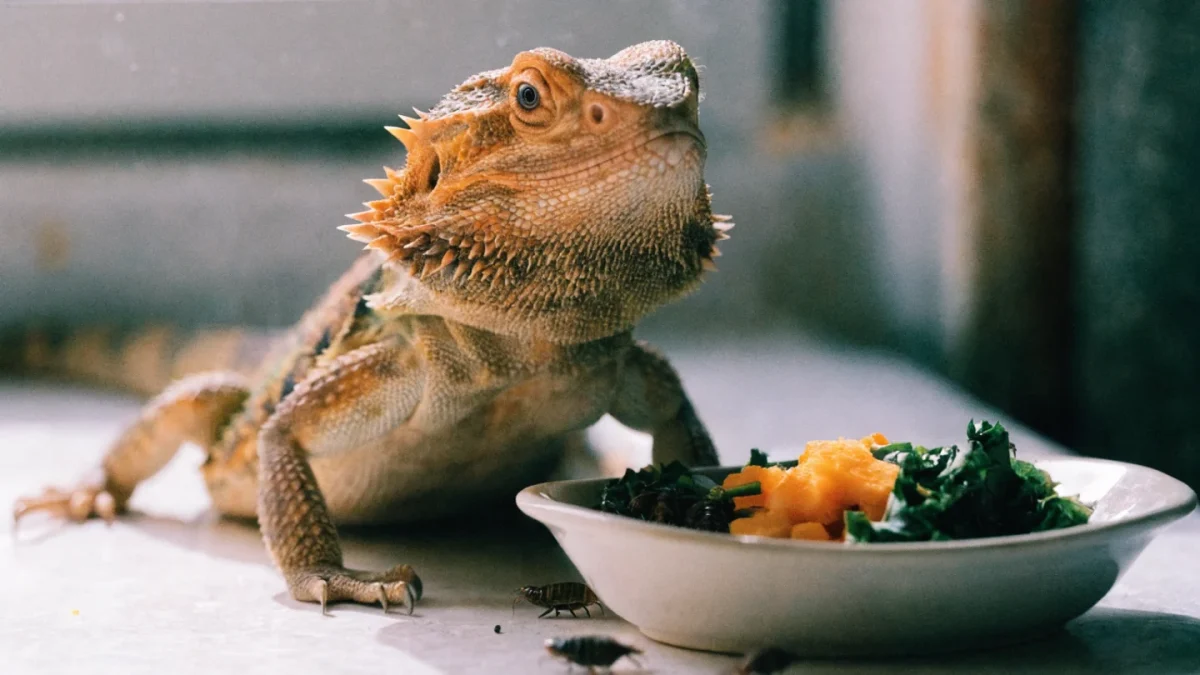
Fifty crickets a day. That's what someone at a reptile expo told me they were feeding their adult bearded dragon — fifty crickets a day, no vegetables at all. The dragon was overweight, lethargic, and starting to show early signs of gout. It was eating like a growing juvenile at three years old, and nobody had told the owner that the bearded dragon diet changes dramatically with age.
Bearded dragons (Pogona vitticeps) are omnivores that require a shifting balance of live insects and fresh vegetables throughout their lives. Juveniles need 70-80% insects and 20-30% greens to fuel rapid growth, while adults should eat roughly 70-80% vegetables and 20-30% insects. This ratio shift is the single most misunderstood aspect of dragon nutrition, and getting it wrong leads to obesity, fatty liver disease, kidney problems, and shortened lifespans.
If you've already worked through our bearded dragon care guide, you know that nutrition and husbandry are deeply connected. None of this dietary advice works unless your habitat setup is dialed in — a dragon with insufficient UVB or incorrect basking temperatures can't properly digest or metabolize its food regardless of what you feed it.
The Insect Side of the Bearded Dragon Diet
Live insects are the protein backbone. Not dried, not canned, not freeze-dried. Live. The movement triggers hunting behavior, which is both physically and mentally enriching for the animal.
Staple feeders — insects safe for regular rotation:
- Dubia roaches: high protein, low fat, soft-bodied, easy to gut-load. My go-to recommendation for anyone willing to keep a roach colony. Some people can't get past the idea. That's fine.
- Black soldier fly larvae (also called calci-worms or phoenix worms): naturally high in calcium, small enough for juveniles, low-maintenance. Not a complete protein source on their own, but an excellent supplement.
- Silkworms: soft, nutritious, great calcium-to-phosphorus ratio. Hard to source consistently depending on where you live.
- Crickets: the classic feeder. Widely available, decent nutrition when gut-loaded. Noisy, smelly, and they die easily — but they work.
Occasional treats — once or twice a week at most:
- Hornworms: high moisture, low protein. Good for hydration, not a staple.
- Waxworms: high fat. Think of them as candy. I use them to coax a reluctant eater back onto food after illness, not as a regular offering.
- Superworms: harder exoskeleton, higher fat than dubia. Fine for adults occasionally. Too large and chitinous for juveniles.
Mealworms get asked about constantly. They have a tough chitin shell relative to their size, and there's ongoing debate about impaction risk in younger dragons. I feed them to adults without much concern, but I don't offer them to anything under a year old. Plenty of better options exist for juveniles.
Never feed wild-caught insects. Pesticide exposure, parasites, and unidentified species make it a gamble you'll lose eventually.
Gut-Loading and Dusting
The insect is only as nutritious as what it ate. Gut-loading means feeding your insects a nutrient-dense diet 12-24 hours before offering them to your dragon. Dark leafy greens, sweet potato, carrots, squash — the same vegetables your dragon should be eating.
Calcium dusting is mandatory. Lightly coat feeder insects with a calcium powder (without vitamin D3 if your UVB setup is correct, with D3 if you're compensating for weak UVB — though fixing the lighting is always the better answer). Dust at every feeding for juveniles. Adults get calcium dusting every other feeding.
A multivitamin powder applied once a week covers trace minerals and vitamin A. Over-supplementing vitamin A is genuinely dangerous for reptiles — according to Today's Veterinary Practice, hypervitaminosis A in reptiles causes skin sloughing, erythema, and lesions that can mimic the appearance of deficiency, with toxic doses roughly 100 times the safe supplementation range. Stick to the label dosing, or better yet, ask your exotic vet for a supplementation schedule tailored to your specific setup.
Vegetables and Greens
Adults should be eating a salad daily. Not iceberg lettuce — that's basically crunchy water. Not spinach every day either, because the oxalates bind calcium and work against you.
Daily staple greens:
- Collard greens
- Mustard greens
- Turnip greens
- Endive/escarole
- Dandelion greens (pesticide-free, obviously)
These have strong calcium-to-phosphorus ratios and low oxalate content. I rotate between three or four of them throughout the week.
Good additions — a few times per week:
- Butternut squash (peeled, shredded or finely chopped)
- Bell peppers (any color, seeds removed)
- Snap peas
- Acorn squash
- Green beans
Occasional — once a week or less:
- Kale: good nutrition but moderate oxalates. Fine in rotation, problematic as a sole green.
- Bok choy: same story. Goitrogenic in large quantities, perfectly fine in moderation.
- Cucumber: mostly water, minimal nutrition. Adds variety but don't build a diet around it.
I chop everything small — nothing wider than the space between the dragon's eyes. That's the standard sizing rule for both insects and produce. Larger pieces increase choking risk, especially for eager eaters that barely chew.
One trick I stumbled into years ago: mix a few insect feeders into the salad bowl. Dragons that ignore their greens will sometimes eat them accidentally while snapping at a roaming dubia roach. After a few weeks of this, many learn to eat greens independently. Not all of them. Some dragons are stubbornly insectivorous their whole lives, and those animals need more aggressive calcium supplementation to compensate.
Fruits — Less Than You'd Think
Fruit should be a treat, not a staple. The sugar content is too high for regular feeding and can disrupt gut flora over time.
Safe fruits in small amounts: blueberries, strawberries, mango, papaya, melon, peeled apple. A few small pieces once or twice a week. I use fruit as a reward after handling or to add interest to a salad that's being ignored.
Citrus fruits are too acidic. Avocado is toxic. Rhubarb is toxic. These aren't "be careful" foods — they're "never, under any circumstances" foods.
Foods That Will Harm Your Dragon
This list isn't exhaustive, but it covers what I most commonly see fed by mistake:
Fireflies and lightning bugs. Extremely toxic to bearded dragons. Research from Cornell University and the ASPCA Animal Poison Control Center has documented that lucibufagins — steroidal pyrones structurally similar to toad bufotoxins — are cardiotoxic, and ingestion of even half a firefly can kill an adult bearded dragon within minutes. Clinical signs include head shaking, gaping, color change to black, and death as rapidly as fifteen minutes post-ingestion. This isn't a gray area or a "some dragons tolerate it" situation. Any glowing insect is an immediate no.
Avocado. Contains persin, which is toxic to most reptiles. All parts of the plant, including the flesh.
Lettuce (iceberg, romaine). Not toxic, but nutritionally empty. A dragon filling up on romaine is a dragon not eating the nutrient-dense greens it actually needs.
Wild-caught insects. Pesticides, herbicides, parasites. You don't know what that grasshopper has been exposed to.
Spinach in large quantities. The oxalic acid binds calcium, effectively creating a calcium deficit even if you're supplementing. Small amounts occasionally won't cause problems, but it shouldn't be a regular green.
Onion and garlic. Toxic to reptiles. No amount is safe.
Feeding Schedules by Age
Juvenile bearded dragons (0-12 months) eat like athletes in training. Offer live insects two to three times per day — as many as they'll eat in a 10-15 minute window. Fresh greens should be available at all times in a shallow dish, even though most juveniles ignore them for the first few months. Keep offering. They'll come around.
Sub-adults (12-18 months) start the transition. One insect feeding per day, with a progressively larger salad portion. I reduce insect quantity by about 20% every few weeks during this phase and increase green variety.
Adults (18 months and older) eat one salad per day with an insect feeding every other day, or a smaller insect portion daily. An adult dragon eating 30-50 appropriately sized insects per week is plenty. Some keepers go lower. The key metric is body condition — you should see a slight abdominal tuck when viewed from the side, and the fat pads behind the eyes shouldn't be visibly bulging.
Overfeeding adult dragons is genuinely the most common nutritional mistake I encounter. People love feeding their pets. I get it. But an obese bearded dragon has a shortened lifespan and a higher risk of fatty liver disease, gout, and reproductive complications in females. The same calorie-awareness applies across every species I keep — the exotic pet nutrition guide breaks down the broader principles if you want the full picture.
Water and Hydration
Bearded dragons are desert animals, but "desert" doesn't mean "dehydrated." They get moisture from their food — especially greens, hornworms, and the occasional fruit — and some drink from shallow dishes. Others don't.
I mist my dragons lightly in the morning a few times a week. Some drink the droplets off their snout. Others just look annoyed. A weekly lukewarm bath (shallow, no deeper than the dragon's elbows) encourages drinking and helps with shedding.
Watch for signs of dehydration: sunken eyes, wrinkled skin that tents when gently pinched, reduced appetite. If your dragon's urate — the white part of its droppings — is yellow or orange instead of white, hydration is likely inadequate.
FAQ
Can bearded dragons eat dog or cat food?
No. Dog and cat food is formulated for mammals with completely different protein, fat, and vitamin requirements. The protein sources are wrong, the fat content is too high, and the vitamin D3 levels can be toxic to reptiles. I've had people tell me they ran out of crickets and gave their dragon a few kibbles "just for the night." Don't.
How do I know if my bearded dragon is overweight?
Look at the body from above and from the side. The belly shouldn't drag on the ground or bulge outward past the ribline. The tail base should have some muscle definition, not be rounded with fat deposits. The fat pads on the head — right behind the eyes — shouldn't be swollen or protruding. If you're unsure, an exotic vet can do a body condition assessment in about thirty seconds.
Do bearded dragons need vitamin supplements if they eat a varied diet?
Yes. Even a well-rounded diet of gut-loaded insects and diverse greens doesn't perfectly replicate wild nutritional intake. Calcium powder at most feedings and a multivitamin once weekly are standard. The exact schedule depends on your UVB setup, the dragon's age, and whether it's breeding — talk to an exotic vet for a plan specific to your animal.
Can I feed my bearded dragon only vegetables and skip insects?
Technically, some adult dragons survive on very low insect diets, but I don't recommend eliminating insects entirely. Insects provide animal protein, essential fatty acids, and amino acid profiles that plants alone can't match. Juveniles absolutely cannot thrive without insects — they need the protein for bone and muscle development. An all-vegetable diet in a growing dragon leads to stunting and deficiency diseases.
Why does my bearded dragon refuse to eat greens?
Usually habit. Dragons raised on insects-only diets learn to hold out for the "good stuff." Stop offering insects for two to three days (for healthy adults only — don't do this with juveniles or sick animals) and present fresh, finely chopped, colorful greens. Mixing in a few live feeders among the greens can trick them into eating vegetables while hunting. Bee pollen sprinkled on top attracts some reluctant eaters. Patience is the real answer — I've had dragons take three weeks to start eating greens voluntarily.