

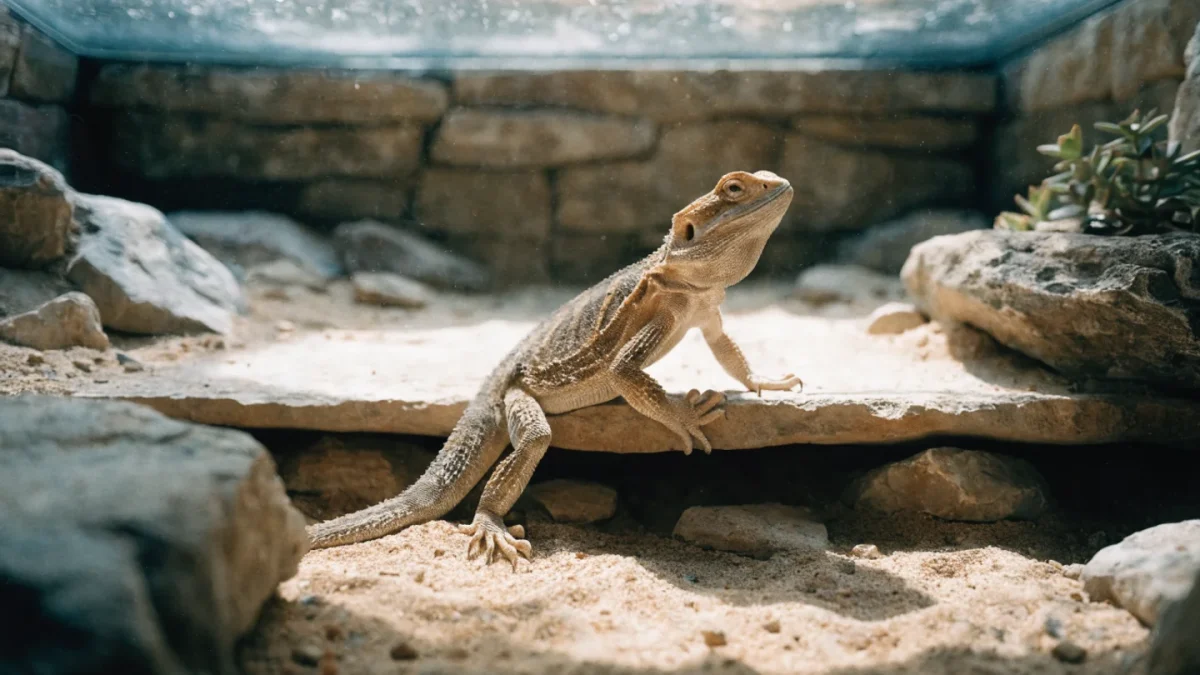
I watched a perfectly healthy juvenile bearded dragon develop metabolic bone disease in under three months. The owner had done research, bought a decent enclosure, even spent good money on a heat lamp. But the UVB tube was the wrong type, mounted outside the mesh screen, and positioned too far from where the dragon actually sat. Three months. That's all it took.
A proper bearded dragon habitat setup requires four things working together: the right enclosure size, correct heating with a defined temperature gradient, appropriate UVB lighting covering two-thirds of the enclosure, and a safe substrate. Nail those four and you've eliminated maybe 80% of the health issues that land these animals at an exotic vet.
If you're working through our full bearded dragon care guide, this is where the real planning starts. Habitat mistakes compound fast with reptiles because dragons can't regulate their own body temperature or manufacture vitamin D3 without the right light spectrum.
Choosing the Right Enclosure
Forget the 40-gallon tanks you'll see recommended in outdated care sheets. An adult Pogona vitticeps — that's the central bearded dragon, the species almost everyone keeps — needs a minimum of 120 gallons, and I genuinely prefer a 4x2x2-foot (120x60x60 cm) enclosure. Bigger is always better here.
Juveniles can start in something smaller. A 75-gallon works for the first six months or so. But I've stopped recommending people buy a small tank and then upgrade, because most don't. They keep the dragon in the small enclosure until problems show up, then scramble. Buy the adult-sized setup from day one if your budget allows it.
Material matters more than people realize. Glass terrariums hold humidity well — too well for a desert species. PVC or melamine enclosures maintain heat more efficiently, weigh less, and give the dragon solid walls on three sides instead of glass, which reduces stress. Bearded dragons can see their reflection in glass and interpret it as a territorial rival. I've had dragons that stopped eating and glass-surfed constantly until we switched them to an opaque-sided enclosure.
Front-opening doors are non-negotiable. Reaching in from above mimics a predator, and your dragon will associate your hand with threat instead of food. Every reptile expo I work, I say the same thing to new keepers: top-opening tanks are for fish.
Heating and the Temperature Gradient
This is where most setups fail, and it's where the consequences hit hardest.
Bearded dragons are ectotherms — they rely entirely on their environment to regulate body temperature. In the wild, they shuttle between sun-baked rocks and cooler burrows throughout the day. Your enclosure needs to replicate that choice.
Basking spot: 38-43 C (100-110 F), measured at the surface where the dragon sits, not the air temperature six inches above it. Use an infrared temperature gun. Seriously. Dial thermometers lie.
Cool side: 26-27 C (78-80 F). If your cool side is hitting 32 C (90 F), the enclosure is too small or your heat source is too powerful. The dragon has nowhere to cool down, which means it can't digest food properly and will eventually stop eating.
Nighttime: Let temps drop to 18-22 C (65-72 F). This natural cycle matters. If your house gets colder than that, use a ceramic heat emitter — not a colored bulb. Red and blue "nighttime" bulbs aren't actually invisible to reptiles. That's a myth that refuses to die.
I use overhead halogen flood bulbs for basking heat. They produce a more natural spectrum than ceramic heat emitters during the day, and the bright visible light encourages normal basking behavior. Mount it above the mesh screen — never inside the enclosure where the dragon can touch it. Burns are one of the most common injuries I treat at expos. Second-degree burns on the belly and tail from heat rocks or exposed bulbs.
Heat rocks, by the way? Never. Not under any circumstances.
A quality thermostat controls everything. Plug your heat source into a dimming thermostat with the probe positioned at the basking surface. Without one, a heat bulb can push a basking spot well past 48 C (120 F) on a warm day. That's lethal.
UVB Lighting — the Part Most People Get Wrong
I could write an entire article on UVB alone and barely scratch the surface, but here's what you need to build a functional habitat.
Bearded dragons require UVB radiation to synthesize vitamin D3, which allows them to absorb calcium from their food. Without adequate UVB, they develop metabolic bone disease — rubbery jaws, curved spines, limbs that fracture under their own body weight. It's preventable and it's heartbreaking.
Use a linear fluorescent or T5 HO tube that spans at least two-thirds of the enclosure length. Compact or coil UVB bulbs don't cut it. The coverage area is too small, and the dragon would need to sit directly beneath one for hours to get adequate exposure.
Mount the tube inside the enclosure if possible, not above a mesh screen. Metal mesh filters out roughly 30-50% of UVB radiation depending on wire thickness and gap size, according to UV output testing documented by the UV Guide UK and consistent with measurements from multiple enclosure manufacturers. If you must mount it above the screen, position the basking spot closer — within 20-25 cm (8-10 inches) of the tube.
And here's the thing nobody tells new keepers: UVB output decays before the bulb burns out. A tube can still produce visible light for two years while emitting functionally zero UVB after ten to twelve months. Replace UVB tubes every six months to be safe, or invest in a UV meter if you want to measure actual output.
The photoperiod should mimic natural daylight. Twelve hours on, twelve hours off works for most of the year. Some keepers adjust seasonally — 14 hours in summer, 10 in winter — and I've seen better brumation behavior with that schedule, though it's not strictly necessary for a pet-only animal.
Substrate That Won't Kill Your Dragon
This topic generates more arguments online than almost anything else in reptile keeping.
Loose particle substrates — sand, crusite, ground walnut shell — carry a risk of impaction if ingested. Juvenile dragons are especially vulnerable because they're clumsy eaters and scoop up substrate with every cricket. I've seen necropsy photos of dragons with stomachs packed solid with calcium sand. The "digestible" marketing claim on those products makes me furious.
For juveniles and any dragon under a year old, use non-particle substrate. Textured tile (slate or ceramic), non-adhesive shelf liner, or excavator clay hardpacked to a solid surface. Easy to clean, zero impaction risk.
Adults in a well-heated enclosure with proper UVB and good hydration have a lower impaction risk, and some experienced keepers use a topsoil-sand mix (roughly 70/30) that packs down and allows digging behavior. I don't recommend this for first-time keepers. Get your husbandry dialed in first. If your temperatures, UVB, and hydration are all correct for a full year, and your dragon is eating well and passing waste normally, then you can experiment with bioactive or naturalistic substrates.
Reptile carpet? I used to recommend it. I don't anymore. The loops catch toenails, harbor bacteria even when washed, and it's genuinely a pain to keep clean.
Furnishing and Layout
The enclosure needs more than a heat lamp and a water dish.
Basking platform: A flat rock or sturdy branch positioned under the basking spot, 15-20 cm (6-8 inches) below the heat source. The dragon should be able to fully flatten its body on it. I use natural flagstone — it absorbs and radiates heat, which aids belly digestion.
Hides: At least two. One on the warm side, one on the cool side. Bearded dragons aren't as secretive as ball pythons, but they still need the option to retreat. A dragon with no hiding spots has elevated stress hormones. You won't see obvious signs until the animal stops eating or develops dark stress marks on its belly.
Climbing opportunities: Bearded dragons are semi-arboreal, especially as juveniles. Sturdy branches, cork bark, and stacked stone give them vertical space. Anchor everything securely — a rockslide in an enclosure can crush or trap a dragon.
Water dish: Shallow, easy to enter and exit. Some dragons drink from dishes, others don't. I mist mine lightly once a day and offer water via syringe if they're not drinking. But a dish should always be present.
Skip the fake plants unless they're firmly attached and too large to swallow. I've removed artificial leaves from more than one dragon's digestive tract.
Putting It All Together
I set up enclosures from left to right: cool side to warm side. The basking platform and heat lamp go on the far right (or left — pick one and commit). UVB tube stretches from the basking area across to roughly the center. Cool hide on the opposite end, warm hide near the basking spot but not directly under the lamp. Food dish on the cool side so live feeders don't bake before the dragon finds them.
Run the full setup for 48 hours before adding the dragon. Check your temperatures at the basking surface, cool side, and ambient air at least three times across the day. Verify your thermostat cuts the heat when it should. Let the UVB run on the timer and make sure it cycles correctly. If you're new to reptile keeping in general, the exotic pet habitat setup fundamentals cover the universal principles — heating, lighting, ventilation — that apply across species.
And one thing I always mention: get what to feed your bearded dragon sorted before you bring the animal home. Habitat and diet are two halves of the same equation — perfect temperatures won't help a dragon that's eating the wrong food.
FAQ
Can I keep two bearded dragons in the same enclosure?
No. Bearded dragons are solitary and territorial. Cohabitation leads to stress, competition for basking spots, bite injuries, and sometimes the death of the subordinate animal. It might look like they're "cuddling" when they stack on top of each other — they're actually competing for the best UV and heat exposure. The one on the bottom is losing.
How often should I clean the habitat?
Spot-clean feces and uneaten food daily. Deep-clean the entire enclosure every four to six weeks — remove everything, disinfect surfaces with a reptile-safe sanitizer, rinse thoroughly, and let it air dry before reassembling. Substrate replacement depends on the type. Tile gets wiped down during deep cleans. Loose substrates should be fully replaced at each deep clean.
Do bearded dragons need a night light?
No. Total darkness at night supports their circadian rhythm. If you need supplemental heat after lights-out, use a ceramic heat emitter — it produces warmth without visible light. Most homes stay above 18 C (65 F) at night and don't need supplemental heat at all.
What's the minimum I should budget for a full setup?
Expect to spend between 300 and 600 USD-equivalent on a proper adult-sized enclosure, lighting, heating, thermostat, and furnishings — and that's before the dragon itself. Cutting corners on UVB or thermostats is where I see the most expensive vet bills later. The thermostat alone prevents the kind of overheating emergency that costs hundreds in treatment, if the animal survives it at all.