
A panther chameleon arrived at a rescue I volunteer with last October, housed in a 30 cm glass cube with a single red bulb clipped to the top. No UVB. No misting system. No live plants. The ambient humidity in that cube was around 25% — this is an animal from Madagascar that needs 60-80%. Its casque was soft, its eyes were sunken, and its grip on the single plastic vine inside was weak enough that it kept falling to the floor. Six weeks and a proper habitat later, the same chameleon was firing bright greens and hunting crickets mid-air.
Every exotic pet habitat must address four fundamentals: heating to create an appropriate thermal gradient, lighting that matches the species' biological needs (including UVB where necessary), humidity calibrated to the animal's native climate, and an enclosure designed for the species' size, behavior, and ventilation requirements. Mess up one of those four and you'll see symptoms within weeks, sometimes days.
This guide breaks down each pillar, species by species where the differences matter most. But I want to be direct about something first: there is no universal exotic pet setup. A ball python, a green tree frog, a cockatiel, and a chinchilla have almost nothing in common in terms of habitat needs. The frameworks here give you the logic behind every parameter so you can apply them correctly to whatever species you're keeping.
Heating: Thermal Gradients Are Non-Negotiable
Most exotic pets are ectotherms. Reptiles, amphibians, fish — they can't regulate their own body temperature the way mammals and birds do. They rely on their environment to provide a range of temperatures so they can move between warmer and cooler zones as their metabolism demands. This is called a thermal gradient, and it's the single most important concept in exotic pet husbandry.
A ball python, for example, needs a basking surface around 32°C (90°F) on one end and an ambient cool side near 26°C (78°F). A leopard gecko needs a belly-heat surface between 30-32°C (86-90°F) with an ambient air temperature in the low-to-mid 20s°C. A tropical fish tank might need a steady 25-27°C (77-80°F) throughout. These aren't suggestions — they're the parameters that allow digestion, immune function, and growth to work normally.
I can't emphasize this enough: a single temperature across the entire enclosure is almost always wrong. Even aquariums benefit from slight variation near the heater versus the far end of the tank.
Heating Methods at a Glance
Several heat sources exist, and each has its place:
Overhead heat lamps (halogen flood bulbs, deep heat projectors) produce a basking spot with infrared radiation that penetrates tissue similarly to sunlight. I use these as primary heat for most diurnal reptiles. They create the most naturalistic thermal gradient — hot directly under the lamp, cooling with distance.
Ceramic heat emitters (CHEs) produce heat without light. Useful for nighttime heating or for species that don't need a visible basking lamp. They run hot and dry the air, so factor that into your humidity plan.
Under-tank heat mats deliver belly heat through conduction. Popular for snakes and ground-dwelling geckos, but they must be controlled by a thermostat. An unregulated heat mat will exceed safe temperatures within an hour. I've seen thermal burns from mats left on without a thermostat — the damage looks like a brand mark on the ventral scales.
Aquarium heaters (submersible glass or titanium) handle fish and aquatic turtle setups. Size them at roughly 3-5 watts per liter for tropical species. An undersized heater in a large tank won't hold temperature during winter.
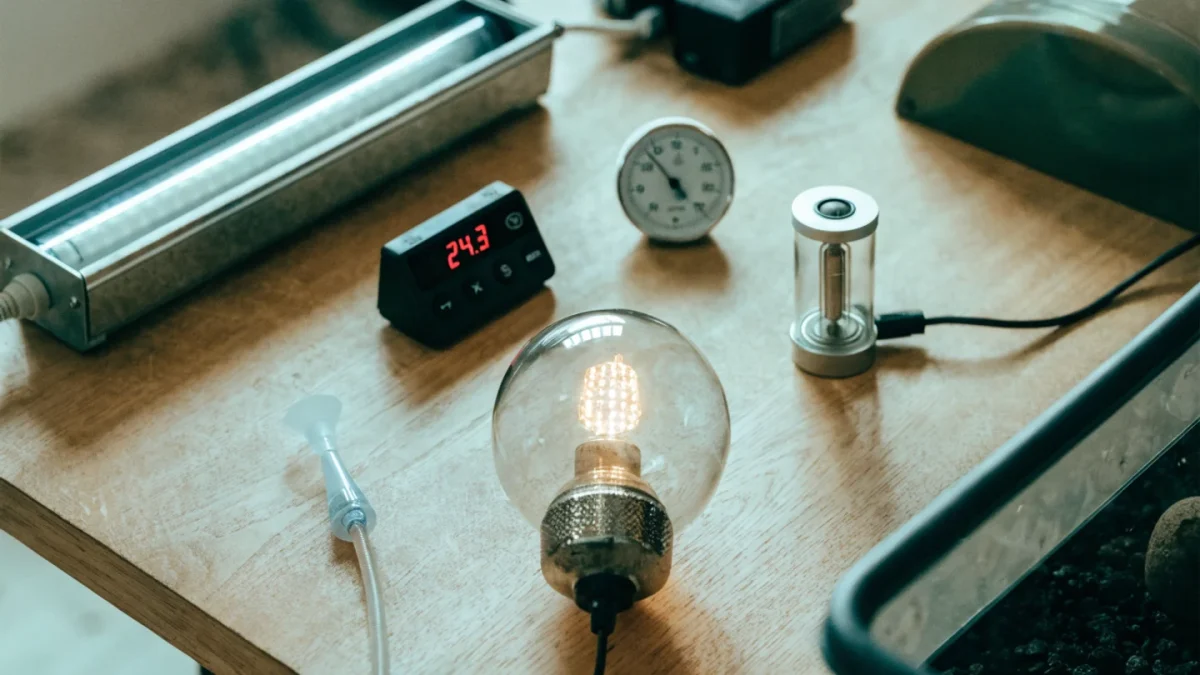
Every heat source needs a thermostat. No exceptions. A proportional thermostat dims or pulses the output to maintain a set point. An on/off thermostat is better than nothing, but proportional models prevent the temperature swings that stress animals over time. The thermostat probe goes on the hottest surface the animal can touch — not the ambient air, not the cool side.
Species-Specific Temperature Ranges
I won't dump a full chart here because temperature needs vary not just by species but by age, health status, and activity cycle. The principle: research your specific species from a reputable source (veterinary texts, peer-reviewed husbandry guides, experienced keeper communities), note the basking/warm zone temperature and the cool zone temperature, and build your gradient accordingly. If you're seeing the animal spending all its time on one end of the enclosure, the gradient is probably wrong.
Nighttime drops are natural for most species. Desert reptiles can safely experience drops to the low 20s°C or even high teens. Tropical species need the drop to be smaller — maybe 3-5°C below daytime ambient. A constant 24/7 temperature with no dip is unnatural and can disrupt hormonal cycles, particularly in species that need seasonal cues for breeding or brumation.
Lighting: More Than Just Seeing
Lighting in an exotic pet habitat serves three functions: photoperiod (day/night cycle), UVB exposure for vitamin D3 synthesis, and heat (in the case of incandescent or halogen basking lamps). Not every species needs all three from artificial sources, but every species needs the photoperiod respected.
UVB — Who Needs It and Why
Any reptile that basks in sunlight in the wild needs UVB. That includes bearded dragons, chameleons, blue-tongue skinks, most tortoises, and many lizards. Without UVB, they can't synthesize vitamin D3 in their skin, which means they can't metabolize dietary calcium, which leads to metabolic bone disease. MBD is exactly as bad as it sounds — bones soften, jaws deform, limbs fracture under the animal's own weight.
Snakes are the gray area. Ball pythons and corn snakes can metabolize D3 from dietary sources (whole prey items contain it), so UVB isn't strictly mandatory for them. But research increasingly suggests that access to UVB improves immune function and behavior even in crepuscular and nocturnal species. I've provided UVB to my ball pythons for the past five years, and while I can't point to a controlled study proving it made a difference, they bask under it voluntarily. That behavior tells me something.
Amphibians are another nuance — some dart frogs and tree frogs benefit from low-output UVB (around 2% or "shade dweller" lamps), while others get enough D3 through dusted feeder insects. Check species-specific resources.
UVB Bulb Types
Two main categories: compact/coil fluorescents and linear tube fluorescents. Linear tubes (T5 or T8) distribute UVB more evenly across a larger area and are the standard recommendation for most setups. T5 high-output bulbs are stronger and can be mounted further from the basking spot. Compact fluorescents concentrate the output in a small area, which works for small enclosures but creates uneven coverage in larger ones.
UVB bulbs decay. Even if they still produce visible light, the UVB output drops below useful levels after 6-12 months depending on the bulb type and brand. Replace them on schedule, not when they burn out. A UV meter is the only way to verify output — I consider it an investment, not a luxury, if you keep multiple UVB-dependent species.
I was at a reptile expo two years ago helping at a rescue booth, and a keeper brought in a juvenile veiled chameleon with rubber jaw — classic MBD. The UVB bulb over the enclosure "still worked." It had been in place for two and a half years. It was producing visible light and essentially zero UVB. That's the sneaky thing about UVB decay — you can't see it happening.
Photoperiod
Even species that don't need UVB need a consistent light cycle. Twelve hours on, twelve hours off is a reasonable default for tropical species. Temperate species benefit from seasonal variation — longer days in summer, shorter in winter. Use a timer. Manual light switching leads to irregular cycles that stress animals and mess with feeding and activity patterns.
Humidity: The Most Overlooked Parameter
If I had to pick one environmental factor that new keepers get wrong most often, it's humidity. Temperature problems tend to show up fast and obviously — the animal stops eating, becomes lethargic, or seeks extreme ends of the enclosure. Humidity problems are slower and sneakier. A ball python in chronically low humidity won't die immediately; it'll have stuck sheds, develop respiratory irritation, and slowly decline over months. A crested gecko in excessive humidity with poor ventilation grows mold in its enclosure and risks skin infections.
How Humidity Works in a Closed System
An enclosure is a small, sealed (or semi-sealed) environment. Humidity comes from water dishes, substrate moisture, misting, and the animal's own respiration. It leaves through ventilation — screen tops, air gaps, fan systems. The balance between input and output determines your stable humidity level.
Glass enclosures with screen tops leak humidity aggressively. This is fine for arid species. For tropical species, it's a constant battle. PVC enclosures with restricted ventilation hold humidity far better, which is one reason they've become the default for ball pythons, boas, and tropical geckos.
Raising Humidity
Several tools work, alone or in combination. A larger water dish on the warm side evaporates more water into the air. Moisture-retaining substrates like coconut fiber, sphagnum moss, or cypress mulch act as humidity reservoirs. Manual misting with a spray bottle works but requires consistency — twice a day, every day, gets old fast. Automated misting systems and ultrasonic foggers solve the consistency problem. A fogger produces a cold mist, so it's best for raising ambient humidity without saturating surfaces. A pressure mister produces larger droplets — better for species like chameleons that drink from water droplets on leaves.
Layering strategies work best. For my emerald tree boas, I use a moisture-retaining substrate on the enclosure floor, a large water bowl, and an automated misting system set to three 30-second bursts per day. Ambient humidity stays 70-80% without standing water pooling on surfaces.
Lowering Humidity
Excessive humidity with poor airflow causes mold, bacterial growth, and respiratory infections. If your enclosure runs too humid, increase ventilation before reducing water input. Adding a small computer fan to move air through screen panels can drop humidity 10-15% while preventing stagnant air pockets. For arid species, choose a substrate that doesn't retain moisture — paper towels, tile, or excavator clay.
Enclosures: Size, Material, and Design
The enclosure is where all the other factors come together. An undersized or poorly designed enclosure makes it impossible to maintain proper gradients, humidity zones, and enrichment.
Minimum vs. Ideal Sizing
Published minimum sizes are minimums. They represent the smallest space in which the animal can survive without obvious suffering — not thrive. A 120 cm x 60 cm enclosure for an adult ball python is a minimum. The same snake in a 180 cm x 60 cm enclosure will use the space, display more natural behaviors, and maintain a more stable thermal gradient.
For arboreal species, height matters more than floor space. A crested gecko in a vertically oriented 45 x 45 x 60 cm enclosure uses three-dimensional space in ways that a terrestrial species never would. Conversely, giving a terrestrial snake a tall enclosure and no climbing structures wastes vertical space the animal won't use.
When you're choosing your first exotic pet, research the adult enclosure requirements before purchasing the animal. The baby ball python that fits in a shoebox will need a meter-plus enclosure within 18 months.
Enclosure Materials
Glass — clear visibility, heavy, poor insulation, leaks humidity through screen tops. Works for display setups, arid species, and aquariums. Affordable in small sizes, expensive in large ones.
PVC/HDPE panels — lightweight, insulates well, holds humidity, typically front-opening. The standard for serious reptile keepers. Higher upfront cost, but lasts longer and performs better than glass for tropical and humidity-sensitive species.
Mesh/screen — maximum ventilation. Good for chameleons and some arboreal species that need constant airflow. Terrible for humidity-dependent species and nearly impossible to heat efficiently.
Wood — DIY-friendly, insulates well, but absorbs moisture unless sealed. Common in custom builds for large species. Needs waterproof coating on all interior surfaces.
The enclosure material choice should follow the species' humidity needs. Tropical species in glass with a screen top = constant humidity battle. Arid species in sealed PVC = excessive humidity without extra ventilation. Match the material to the animal, not the price tag.
Enrichment and Interior Design
A bare enclosure with a hide and a water dish keeps the animal alive. It doesn't keep it healthy long-term. Reptiles, birds, small mammals, and fish all display more natural behaviors, show lower stress markers, and maintain better body condition when their habitat includes appropriate enrichment.
For reptiles: multiple hides (warm side, cool side, humid hide), climbing structures for semi-arboreal species, leaf litter or cork bark for terrestrial species, and textured surfaces for healthy shedding.
For birds: perches at multiple heights and diameters, foraging opportunities (shredding toys, food puzzles), and enough space to fly short distances or at minimum stretch wings fully.
For small mammals: bedding deep enough to burrow (for species that burrow), running wheels of appropriate diameter, platforms and tunnels, and chew-safe materials.
For aquariums: plants (live or silk, never sharp plastic), caves and driftwood, appropriate substrate depth, and water flow matched to the species' natural habitat.
An understaffed pet store near me once had a young green iguana in a 60 cm glass tank with a single plastic log and a heat lamp sitting directly on the screen. No UVB. No substrate. No humidity. The iguana had developed MBD within four months. That's not an exotic pet setup — it's a container with an animal slowly dying in it. The fundamentals exist because cutting corners has real consequences.
Putting It All Together: The Setup Checklist
Every species has its own parameter sheet, but the process of setting up any exotic pet habitat follows the same logic:
-
Research the species first. Know the adult size, temperature range, humidity needs, UVB requirements, activity pattern (diurnal, nocturnal, crepuscular), and social behavior before buying equipment.
-
Choose the enclosure based on the species' needs. Material, size, and orientation (horizontal vs. vertical) should follow the animal's biology.
-
Install heating and verify with a thermostat. Place the probe where the animal will contact the heat source. Run the system for 48 hours before introducing the animal. Check temperatures at multiple points — the gradient, not just one spot.
-
Install lighting on a timer. UVB bulb if required, with correct distance and no glass or plastic between the bulb and the animal (these materials block UVB). Record the installation date — set a calendar reminder for replacement.
-
Establish humidity control. Substrate, water dish placement, misting or fogging system if needed. Measure with a digital hygrometer — analog ones are unreliable below and above 50%.
-
Add enrichment. Hides, climbing structures, substrate depth, plants. Arrange them to create microclimates — a humid hide over damp moss, a dry basking platform, a shaded retreat.
-
Cycle the environment before the animal arrives. For aquariums, this means the nitrogen cycle (4-6 weeks). For terrestrial setups, it means running all equipment for at least 2-3 days to verify temperature and humidity stability. Bioactive setups need even longer — the clean-up crew needs to establish before the animal adds waste to the system.
Once the habitat is stable and verified, then — and only then — introduce the animal. Alongside a solid habitat, you'll also want a species-specific diet and supplement plan in place from day one.
Common Mistakes I See Repeatedly
Relying on analog gauges. The stick-on thermometers and hygrometers sold in pet stores are notoriously inaccurate. Invest in digital probes. You're trusting your animal's life to those readings.
Heating without a thermostat. I've said it above and I'll say it again: every heat source needs a thermostat. A heat mat without a thermostat can exceed 50°C (122°F). That's not heat — that's a burn.
Skipping the quarantine period. New animals should be isolated from established collections for 60-90 days. This matters less for single-pet homes, but if you keep multiple species, one sick arrival can devastate a room.
Upgrading enclosure size too late. Buy the adult enclosure first. The baby can live in it with extra hides and clutter to reduce open space. The idea that "a big enclosure stresses a small animal" is mostly myth — poor furnishing in a big enclosure is the actual problem.
Ignoring nighttime temperature drops. A lot of keepers run heat 24/7 at daytime levels because they're nervous about low temperatures. Most species need a drop. Check the species' native climate — nighttime lows in their range give you the safe floor.
Frequently Asked Questions
Do I really need a thermostat for every heat source?
Yes. Without exception. A heat mat, ceramic heat emitter, or radiant heat panel without thermostat regulation will exceed safe temperatures. The thermostat is not an accessory — it's the device that prevents thermal burns and enclosure fires. I've seen heat mats warp PVC enclosures and scorch wooden vivariums. The cost of a proportional thermostat is a fraction of a vet bill for thermal burns.
Can I keep the enclosure near a window for natural sunlight instead of UVB bulbs?
Window glass filters out nearly all UVB radiation, so the animal gets visible light but none of the wavelengths needed for vitamin D3 synthesis. Worse, direct sun through glass creates a greenhouse effect that can overheat a small enclosure within minutes. I lost a juvenile anole to this exact scenario early in my keeping career — the enclosure was near a south-facing window, ambient temp spiked to over 40°C before I noticed. Use artificial UVB and keep enclosures away from direct sunlight.
How often should I replace UVB bulbs?
T5 high-output tubes should be replaced every 12 months. T8 tubes and compact fluorescent UVB bulbs lose effective output faster — replace at 6-9 months. These timelines assume the bulb is running 10-12 hours per day. The bulb will still produce visible light well past these points, which is why so many keepers delay replacement. A UV meter removes the guesswork entirely.
What's the single biggest habitat mistake beginners make?
Buying the animal before the habitat is ready. I've taken calls from people who bought a chameleon at an expo and brought it home to a bare glass tank with a desk lamp. The enclosure should be fully set up — heated, lit, humidified, furnished, and running stable for at least 48 hours — before the animal enters it. Rushing this step causes more early-stage health problems than any other single error.