

I helped a new keeper set up her first hamster enclosure last year after she'd already bought the cage — a brightly colored plastic unit with tubes that a pet store employee recommended. The total floor space was barely 300 square inches. Her Syrian hamster couldn't even turn around in the wheel that came with it. We returned the cage the next day and started over.
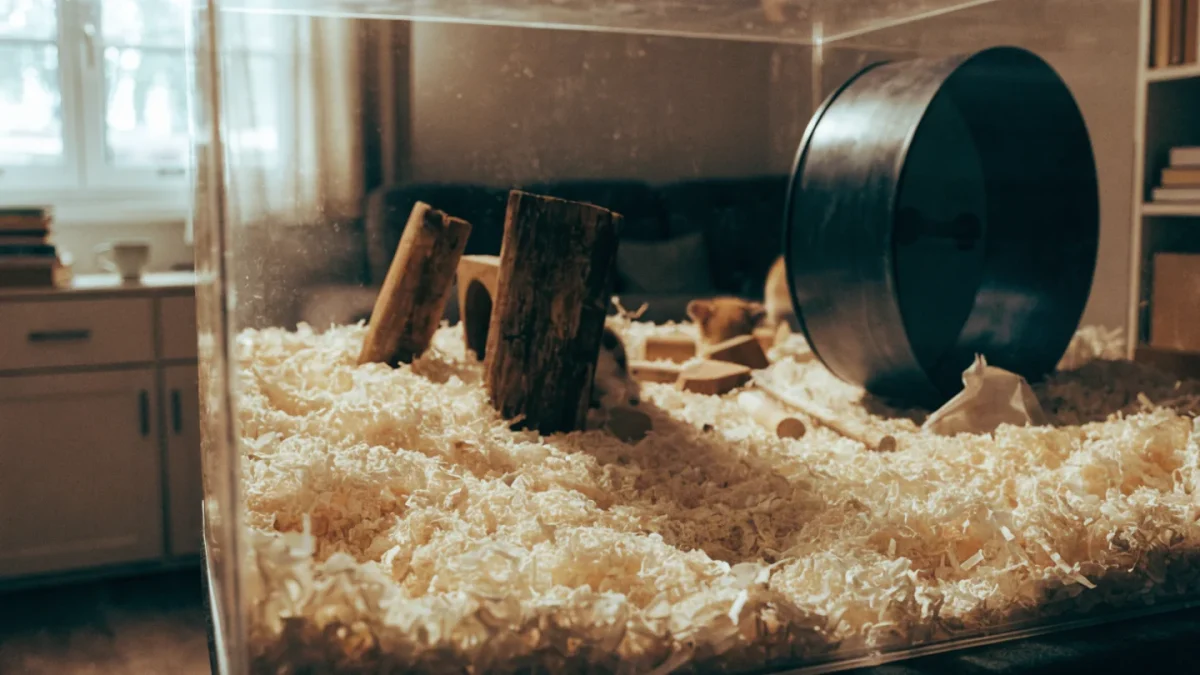
A proper hamster cage setup requires at least 775 square inches of unbroken floor space, deep bedding for burrowing, a correctly sized wheel with a solid running surface, and enrichment items that engage natural behaviors. Most commercial cages marketed for hamsters fail on at least two of these requirements, and some fail on all four.
Floor Space: Bigger Than You Expect
The minimum widely accepted by welfare-focused keeping communities is 775 square inches (about 5,000 square centimeters) of continuous floor space for dwarf species, with Syrian hamsters benefiting from 900+ square inches. That 5,000 cm² figure comes from German animal welfare standards, and a 2007 study published in Animal Welfare by Fischer, Gebhardt-Henrich, and Steiger found that even at that size, stereotypic behaviors persisted — hamsters in 10,000 cm² enclosures showed significantly less wire-gnawing than those in 5,000 cm² cages.
Multi-level cages with platforms don't count the same way — hamsters use horizontal space far more than vertical space. A cage with three small floors connected by tubes provides less usable space than a single large bin on one level.
Bin cages — large plastic storage bins modified with ventilated lids — are the most cost-effective option for meeting size requirements. A 110-quart bin provides roughly 700 square inches and costs a fraction of commercial hamster cages. I've helped set up dozens of these for keepers who wanted adequate space without spending a fortune.
Glass aquariums (40-gallon breeder tanks) work well too — good visibility, easy to pile deep bedding without it spilling, and a solid base. They're heavier and more expensive, but they look better in a living space than a plastic bin.
Whatever you choose, ensure adequate ventilation. Bin cages need mesh lids. Tanks need mesh screen tops. Stagnant air with deep bedding can produce ammonia buildup faster than you'd expect in a small space. See the broader enclosure principles for small animals for ventilation guidelines that apply across species.
Bedding: Depth Is Everything
Hamsters are burrowers. In the wild, they dig extensive tunnel systems. In captivity, providing at least six inches of bedding — ideally eight to ten — lets them express this behavior. A hamster in shallow bedding is a stressed hamster.
Paper-based bedding is the safest standard option. It's absorbent, dust-free when you buy quality products, and holds burrow structure reasonably well. Aspen shavings are the other safe choice — they're more affordable and some keepers find they control odor better.
Cedar and pine shavings are not safe. The phenols in softwood shavings cause respiratory irritation and liver damage in small rodents. This is one of those issues where pet stores still stock harmful products and label them for hamster use. If it smells strongly of wood, don't use it.
I mix paper bedding with hay for added structure. The hay fibers help burrows hold their shape, and hamsters seem to enjoy weaving it into their nests. Orchard grass or Timothy hay both work.
Pack the bedding in layers. Loose, fluffy bedding on top for digging; slightly compressed bedding underneath for tunnel stability. A hamster cage with properly deep bedding is one of the most entertaining enclosures to watch — you'll see tunnel entrances appear, food hoards materialize in corners, and the entire landscape shift overnight.
The Wheel: Non-Negotiable
Hamsters run. A lot. Wild hamsters cover several miles per night. In captivity, a properly sized wheel channels that drive safely.
Syrian hamsters need a wheel at least 28 centimeters (11 inches) in diameter. Anything smaller forces the hamster to arch its back while running, which causes spinal problems over time. Most pet store wheels are undersized for Syrians.
Dwarf hamsters need a minimum of 20 centimeters (8 inches), though larger is always better.
The running surface must be solid — not wire mesh, not rungs. Wire wheels catch toes and cause injuries. I've seen broken toes and bumblefoot from mesh wheels, and both are entirely preventable by using a solid-surface wheel from the start.
Silent or near-silent wheels with sealed bearings save your sanity if the cage is in a bedroom. Hamsters are nocturnal and will run for hours after midnight. The wheel-squeak-at-3am experience is a rite of passage, but it doesn't need to be permanent.
Enrichment Beyond the Basics
A wheel and hideout alone aren't enough. Hamsters need variety — things to chew, things to explore, things to interact with. Understanding the differences between hamster species helps tailor enrichment, since Syrians tend to be more bold and curious while Roborovskis are fast and skittish.
Hideouts: Multiple, not just one. A hamster with a single hide feels trapped in or exposed out of it. Two or three small wooden or ceramic hides placed in different zones give options. One becomes the sleeping nest; others serve as food stashes or emergency retreats.
Chew toys: Hamster teeth grow continuously and need wear. Untreated hardwood blocks, apple wood sticks, and hay cubes serve double duty as enrichment and dental maintenance. Plastic chew toys are useless — hamsters ignore them or ingest fragments.
Sand bath: A shallow dish or container filled with reptile-safe sand (not dust) gives hamsters a place to groom their coat. Dwarf species especially benefit from regular sand baths. This is something most hamster care sheets skip, but every hamster I've watched immediately uses a sand bath when offered one.
Foraging opportunities: Scatter food across the bedding instead of using a bowl. Hamsters naturally forage and stuff their cheek pouches — bowl feeding removes half the enrichment their feeding behavior provides.
Tunnels and platforms: Cardboard tubes, cork logs, and wooden bridges add complexity to the environment. Rotate items regularly. A hamster that's explored every inch of an unchanging cage starts bar-chewing, excessive grooming, or repetitive climbing — all stress behaviors.
What a Good Setup Costs
The hamster itself is the cheapest part of hamster ownership. A proper cage setup — bin or tank, bedding, wheel, enrichment — runs significantly more than what most people budget when they buy the animal on impulse. I cover the full financial picture in the hamster cost guide, but expect the initial setup to cost several times what you pay for the hamster.
That cost is a one-time investment for years of keeping, though. A quality wheel lasts the hamster's lifetime. A bin cage doesn't need replacing. Bedding is the recurring expense, and deep bedding in a large enclosure goes through product faster than a thin layer in a small cage — which is another reason pet stores sell small cages with minimal bedding recommendations. It's cheaper for the customer upfront, worse for the hamster always.
FAQ
How often should I clean a hamster cage?
Spot-clean the toilet area every few days. Full bedding changes every three to four weeks for a properly sized enclosure with deep bedding. Overcleaning destroys the hamster's scent marks and burrow system, which causes stress. Keep a handful of old bedding to mix with fresh bedding during changes so the cage doesn't smell completely unfamiliar.
Can I use a wire cage for a hamster?
Wire cages with bar spacing under 1 centimeter work for Syrians, but most commercial wire cages don't provide enough floor space. Dwarf hamsters can squeeze through surprisingly small gaps. The bigger issue is that wire cages can't hold deep bedding — it spills through the bars. Bin cages, tanks, and solid-walled enclosures are better options overall.
Where should I put the hamster cage?
Away from direct sunlight, drafts, and loud speakers or TVs. Room temperature between 18-24 degrees Celsius is comfortable. Hamsters are sensitive to temperature extremes — too cold triggers torpor (a dangerous hibernation-like state), too hot causes heat stress. A quiet room with stable temperature is ideal.
Do hamsters need a light cycle?
Yes — natural ambient light that follows the day-night cycle is fine. Don't keep them in constant darkness or under artificial lights at odd hours. Their circadian rhythm responds to light cues, and disrupting it stresses them. A room with windows that gets naturally darker in the evening is perfect.