

The first rabbit I helped rehome was living in a cage meant for a guinea pig. A wire-bottom cage, maybe two feet by one foot, tucked in a corner of a dorm room. The rabbit — a three-year-old Mini Rex — had sore hocks from the wire flooring and couldn't even turn around without pressing against the sides. Her owner wasn't cruel. She'd followed the care sheet from the pet store, which said the cage was "suitable for rabbits up to 5 lbs."
A good rabbit housing indoor setup starts with space — at minimum 12 square feet of enclosure area, plus daily free-roam time outside that space. Most traditional "rabbit cages" sold in stores don't come close. Exercise pens, dedicated rooms, or free-roaming setups all work better than any cage with a door.
Why Most Store-Bought Cages Fail
Walk into any pet store and the rabbit cages on display will fit on a desk. That's the problem. A rabbit needs room to hop at least three full body lengths in one direction, stretch out flat, and stand on hind legs without hitting a ceiling. For a medium breed like a Dutch or a Mini Lop, that's around 12 square feet of floor space minimum. Larger breeds need more — a Flemish Giant in a 12-square-foot pen is like you living in a bathroom.
The multi-level "rabbit condos" look impressive but miss the point. Rabbits aren't climbers. They're runners. Vertical levels connected by ramps don't substitute for floor space. I've watched dozens of rabbits in those setups — most of them park on the bottom level and ignore the ramps entirely.
Wire-bottom cages are worse. They cause sore hocks (pododermatitis), a painful condition where the skin on the bottom of the feet breaks down from constant pressure on wire. Some rabbits develop this within weeks.
Exercise Pens: The Standard That Works
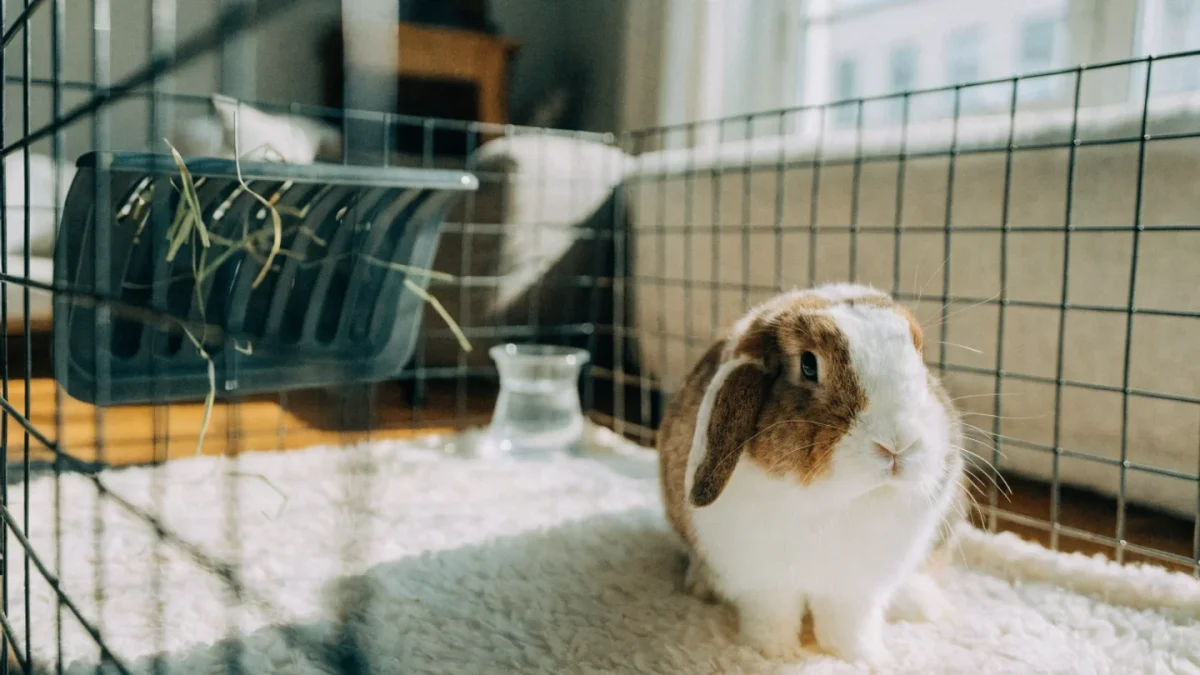
The setup I recommend to most people is an exercise pen — sometimes called an x-pen — originally designed for puppies. They're panels of metal fencing that clip together in any configuration you want. Set up as a square or rectangle, a standard 8-panel pen gives you about 16 square feet of floor space. No top needed for most rabbits, though some athletic breeds can clear a 30-inch panel.
Inside the pen, you need a few basics. A litter box in one corner — rabbits pick a corner and stick with it. A hay rack or hay pile, because a rabbit should always have unlimited timothy hay. A water bowl (not a bottle — bowls are more natural and rabbits drink more from them). A hiding spot, because even the friendliest rabbit needs somewhere to retreat. A cardboard box with a door cut in it works perfectly.
The flooring matters. Bare hardwood or tile is too slippery — rabbits can't get traction and it stresses their joints. Fleece liners, cotton rugs, or interlocking foam mats covered with a washable layer all work. I use old cotton bath mats from thrift stores. They're cheap, washable, and rabbits seem to like the texture.
Free-Roaming: The Gold Standard (With Caveats)
Some rabbit owners let their rabbits free-roam an entire room or even the whole house. Done right, this is the best possible setup. Rabbits that free-roam tend to be more social, more confident, and get more exercise than pen-kept rabbits.
But it requires serious bunny-proofing, and I mean serious.
Rabbits chew. They chew wires, baseboards, carpet edges, furniture legs, book spines, and anything made of cardboard. A friend of mine lost a laptop charger, two phone cables, and a lamp cord in the first week of free-roaming. The lamp cord could have killed her rabbit — electrical burns to the mouth are a genuine veterinary emergency.
Cover every wire with split loom tubing or hard plastic cord covers. Block access behind entertainment centers and desks where cables congregate. Baseboards can be protected with clear plastic panels or corner guards. Carpet edges — particularly in doorways — are the hardest to protect. Some people lay ceramic tiles in the chewing zones, which also gives rabbits a cool surface for temperature regulation.
If full free-roaming feels overwhelming, start with a pen as a home base and give supervised free-roam time in a bunny-proofed room for three to four hours daily. That's the minimum for a healthy activity level. Many keepers open the pen door in the evening and let the rabbit explore while they're home to supervise.
Room-by-Room Thinking
Not every room works. Kitchens have hot appliances and toxic cleaning products at floor level. Bathrooms are usually too small and have slippery floors. Bedrooms work well if you accept that your rabbit will probably claim the space under your bed. Living rooms are the most common choice — and the most work to bunny-proof because they have the most furniture and electronics.
A dedicated rabbit room is ideal if you have the space. A spare bedroom with the door closed, bunny-proofed, and set up with the pen as home base gives your rabbit security and freedom. I helped a family convert a walk-in closet — removed the door, added a baby gate, lined the floor with washable mats — and their rabbit was visibly happier within days. More binkies, more exploring, fewer destructive behaviors.
One thing people overlook: temperature. Rabbits tolerate cold far better than heat. Anything above 80°F (27°C) is dangerous, and above 85°F (29°C) can be fatal. Place the housing away from direct sunlight and heating vents. A room with good airflow and consistent temperature between 60-72°F (15-22°C) is ideal. If your home gets hot in summer, a ceramic tile or frozen water bottle in the pen gives your rabbit something cool to lie against. You can find more guidance on habitat setup fundamentals for exotic pets if you're thinking about environmental controls.
Location Within the Room
Rabbits are prey animals. They startle easily and stress from constant foot traffic, loud TVs, or being placed at eye level with dogs or cats. Put the pen against a wall — never in the center of a room — so the rabbit has at least one "safe" side. Avoid high-traffic hallways.
That said, rabbits are social. Total isolation in a back room where nobody goes is almost as bad as too much stimulation. They want to be near you — just with an escape route. A corner of the living room where they can watch the household activity and retreat to their hiding box works for most rabbits.
If you're setting up an indoor rabbit care space for the first time, plan the pen location before you buy the pen. Measure the corner. Know where your outlets are.
The Overnight Question
Should the rabbit sleep in the pen or free-roam overnight? I've seen both work, but it depends on your bunny-proofing confidence. Rabbits are crepuscular — most active at dawn and dusk — so they'll be hopping around at 5 AM regardless. If your space isn't fully proofed, closing the pen at night prevents unsupervised chewing disasters. If you've been thorough with the wire covers and baseboard guards, overnight free-roaming is fine.
I'd recommend starting with the pen closed at night for at least the first month. You'll discover chewing habits you didn't anticipate, and it's better to find those with the pen as a safety net.
Pairing your housing setup with a proper rabbit diet makes the litter training and enclosure maintenance significantly easier, since hay-heavy diets produce firm, dry droppings that are simple to sweep up.
FAQ
How big should a rabbit enclosure be for two rabbits?
Double the minimum. If 12 square feet works for one rabbit, aim for 24 square feet for a bonded pair. They'll share space when resting but need room to get away from each other during the occasional disagreement.
Can I keep a rabbit in a bedroom at night?
Yes, but know that they'll be active during your lightest sleep hours. The thumping and hay-munching at 4 AM is real. Some people adjust; others move the pen to the living room within a week.
Do rabbits need a top on their pen?
Most don't. A 30-36 inch exercise pen contains the majority of rabbit breeds. However, if your rabbit is a jumper or you have cats or dogs in the home, a cover adds security. A fitted sheet draped over the top works in a pinch.
Is it cruel to keep a rabbit in a pen if I can't free-roam?
A properly sized pen with daily supervised exercise time outside it is a good life. Not every living situation allows free-roaming, and a spacious pen is vastly better than the cramped cages many rabbits spend their entire lives in. The cruelty is the small cage with no exercise — not the pen with room to move.