

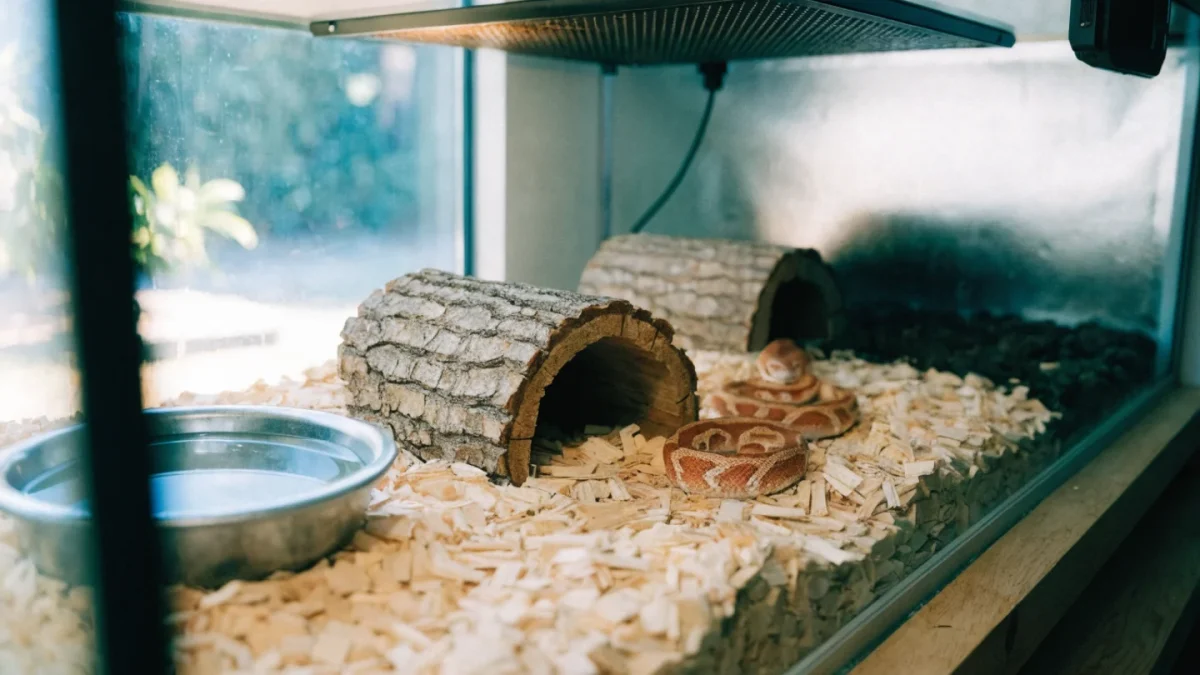
A forum post last week asked whether a 10-gallon tank was "enough for life" for an adult corn snake. Thirty-seven replies, and about half said yes. I closed my laptop and went to check on my own adults in their 4-foot enclosures — watching one stretch from one end to the other during an evening explore — and thought about how much bad advice circulates because people confuse survival with adequate care.
Setting up a corn snake enclosure setup correctly from the start saves money, stress, and trips to the exotic vet. You need the right size for the snake's current age, a temperature gradient maintained by a thermostat-controlled heat source, at least two hides, a water bowl, and substrate that holds some humidity without molding. That's the framework — the details below explain why each piece matters and where most keepers go wrong.
Step 1: Choose the Right Enclosure Size
Hatchlings do best in enclosures equivalent to 10-20 gallons. Too large and they feel exposed, spending all their time buried and stressed. I start my hatchlings in 15-gallon tubs — inexpensive, easy to maintain proper heat and humidity, and the snake actually uses the space.
Adults need a minimum of 40 gallons, though I strongly prefer 4-foot (48" x 18" x 18") enclosures. A full-grown corn snake reaches 4-5 feet, and watching one try to turn around in a 30-gallon tank should be enough to convince anyone that bigger is better here.
Front-opening enclosures beat top-opening aquariums for one practical reason: your hand doesn't approach from above like a predator. The snake stays calmer during routine maintenance, and you'll actually enjoy interacting with the setup instead of dreading the startle response every time you open the lid.
Step 2: Establish the Temperature Gradient
If you've read about corn snake care fundamentals, you know the gradient matters more than any single temperature. Warm side: 83-88°F at substrate level. Cool side: 72-78°F. A thermostat is mandatory — not optional, not "nice to have." Unregulated heat sources burn snakes. I've seen the photos. I've treated the rescues.
Under-tank heaters work well for glass aquariums. Radiant heat panels are better for PVC and wood enclosures because they warm air rather than just the floor. Ceramic heat emitters are another option, but they dry out the air faster than panels do.
Place your thermostat probe directly on the surface where the snake sits — not stuck to the glass wall, not dangling in midair. The snake's belly contacts the floor, so that's where the reading needs to be accurate. And for those following habitat setup fundamentals, the same principle applies across every reptile species.
Step 3: Set Up Hides
Two hides minimum. One on the warm end, one on the cool end. The snake should fit inside with minimal extra space — snug is secure, roomy is exposed.
I learned this the hard way with a juvenile that had access to a beautiful large resin cave. Looked great. The snake never used it, spending all its time wedged behind the water bowl instead. Replaced it with a half-log that barely fit the snake's coiled body — immediately the snake started using it and its feeding response improved within a week.
Cork bark rounds, half-logs, and simple commercial hides all work. Material matters less than fit. If you can see the snake from outside the hide, it's too big.
A humid hide — a container with damp sphagnum moss inside — sits on the warm side and becomes critical during shed cycles. Some keepers leave it in permanently. I do.
Step 4: Substrate and Water
Aspen shavings are the most common corn snake substrate, and they work well. Two to three inches deep allows burrowing, absorbs waste, and doesn't hold excessive moisture. Coconut fiber retains more humidity, which helps in dry climates but can mold in poorly ventilated setups.
Avoid cedar and pine — the oils are toxic to snakes. Avoid sand, which causes impaction if ingested. Reptile carpet works but harbors bacteria in the fibers and doesn't allow natural burrowing behavior.
Water bowl: heavy enough that the snake can't tip it, large enough for the snake to soak if it chooses. I use ceramic crocks for adults. Change the water every two days minimum, immediately if the snake defecates in it (and they will, eventually).
Step 5: Lighting and Enrichment
Corn snakes don't require special lighting for survival, but a basic day-night cycle using room lighting or a low-wattage LED on a timer supports natural behavior patterns. My corns with ambient light cycles are noticeably more active during their crepuscular windows than those I kept years ago in a dark closet setup.
Enrichment makes a real difference in behavior. Climbing branches — even simple dowels secured at angles — give the snake vertical space to explore. I've watched supposedly "terrestrial" corn snakes spend hours climbing when given the option. Fake plants provide additional cover and visual barriers that reduce stress.
Don't overcrowd the enclosure, though. The snake still needs clear paths to move between the warm side, cool side, water, and hides.
Frequently Asked Questions
Can I use a glass aquarium with a screen top?
You can, but expect two challenges. Screen tops lose heat fast, making it harder to maintain your warm side temperature — you'll likely need a stronger heat source or insulation (aluminum foil tape on part of the screen works). Screen tops are also the most common escape point. Clamp it down with screen clips or weighted objects. I've moved entirely to front-opening enclosures for this reason, but glass aquariums absolutely work if you address those two issues.
How often should I replace the substrate completely?
Every three to four weeks for aspen. I spot-clean waste as I find it — usually every few days — and do a full change monthly. If you're using a bioactive setup with a cleanup crew, the timeline extends significantly, but that's a more advanced approach I wouldn't recommend for a first-time corn snake keeper.
Do I need a thermostat even if I'm using a low-wattage heat mat?
Yes. Low-wattage mats still malfunction. A thermostat costs about the same as a single vet visit for a burn, and it's the only way to guarantee your snake's belly isn't sitting on a surface that quietly climbed to 110°F overnight. Non-negotiable.