

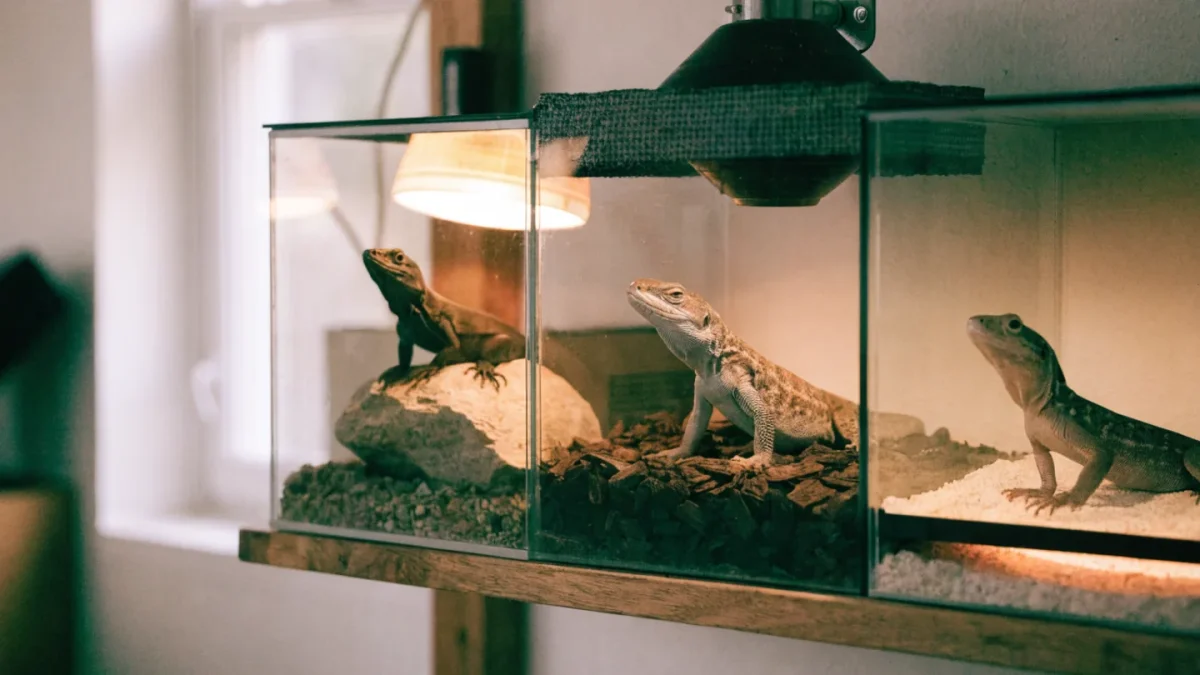
A ball python nearly died on my watch because I trusted a heat mat without a thermostat.
This was years ago — I was maybe two years into keeping reptiles and thought I knew what I was doing. The mat was stuck to the bottom of a glass tank, plugged straight into the wall. Surface temperature hit 52°C overnight. The snake had a burn across three belly scales before I noticed. That moment rewired how I think about every piece of heating equipment I buy.
Reptile heating methods break into three broad categories: heat mats, basking lamps, and ceramic heat emitters. Each one produces heat differently, suits different species, and fails in different ways. Most keepers end up combining two or three to build a proper thermal gradient — a warm zone the animal can move toward and a cool zone it can retreat to. No single method does everything well.
Heat Mats: Belly Heat From Below
Heat mats — also called under-tank heaters or UTHs — are adhesive pads that stick to the outside bottom of a glass enclosure. They radiate gentle warmth upward through the glass and substrate.
For species that thermoregulate by pressing against warm surfaces, like ball pythons and leopard geckos, belly heat matters. In the wild, these animals absorb residual warmth from sun-baked rocks and soil after dark. A heat mat mimics that principle.
But heat mats don't warm the air. In a 60 cm tall enclosure, the ambient temperature at perch height might be the same as room temperature even with a mat running underneath. That's fine for terrestrial species in shorter enclosures. It's almost useless for arboreal species or anything kept in a rack system with deep substrate.
The real limitation — and this is where my ball python story comes in — is unregulated output. A mat plugged directly into a wall outlet has no way to reduce its temperature when the surface gets too hot. You must pair every heat mat with a thermostat. Not optional. A proportional thermostat is best because it dims the output smoothly rather than cycling on and off, but even a basic on/off thermostat prevents burns.
Cost-wise, heat mats are cheap upfront. A mat sized for a 60 cm enclosure runs about $15-25, and they last years. But add a thermostat — $30-100 depending on type — and the total isn't dramatically different from a lamp setup.
Basking Lamps: Heat and Light Together
Basking lamps are overhead heat sources — incandescent bulbs, halogen floods, or deep heat projectors mounted above the enclosure. They create a localized hot spot where the reptile can bask and warm its core.
Halogen floods are my go-to recommendation for diurnal baskers. They produce a broad spectrum of infrared radiation — IR-A and IR-B — that penetrates tissue more deeply than the IR-C from heat mats or CHEs. A bearded dragon sitting under a halogen basking spot is getting heated from the surface inward, which more closely mimics natural sunlight. Research on reptile thermoregulation — including work reviewed in the Journal of Comparative Physiology B — has shown that infrared wavelengths capable of penetrating tissue are more efficient at raising core body temperature than surface-only heat sources.
The downside: light. Basking lamps produce visible light, which means running one at night disrupts the photoperiod. Most reptiles need darkness to cycle properly — cortisol, melatonin, feeding behavior, all of it ties to a consistent day/night rhythm. So basking lamps work during the "day" portion of the cycle and need to be turned off at night.
For enclosures that drop below safe temperatures overnight, you'll need a secondary heat source — typically a CHE or a radiant heat panel — to maintain ambient warmth without light.
Placement matters more than wattage. A 75W halogen at 20 cm from the basking surface might create the same hot spot as a 100W halogen at 30 cm. Start with a lower wattage, measure the surface temperature with a temp gun, and adjust height before swapping bulbs. And always, always protect the bulb with a cage or guard if the animal can reach it. Burns from direct bulb contact are one of the most common reptile injuries I see posted online.
Ceramic Heat Emitters: Nighttime Workhorse
Ceramic heat emitters — CHEs — screw into a standard ceramic lamp socket and produce infrared heat without any visible light. They're the default nighttime heat source for most setups.
CHEs heat the air around them more effectively than heat mats do. In a well-ventilated enclosure, a CHE can raise ambient temperature by 5-10°C depending on wattage and enclosure size. They don't create a tight basking hot spot the way a halogen does — the heat spreads more diffusely. That makes them good for ambient warmth, less useful as a primary basking source for species that need a defined hot zone.
I ran CHEs exclusively for my crested gecko room for a while before realizing they were drying the air faster than I could mist. Ceramic emitters dehydrate the enclosure. In tropical setups where you're fighting to maintain 70-80% humidity, a CHE running overhead can undermine your misting efforts. Radiant heat panels are a better option in those cases — they're more expensive, but they emit IR more directionally and dry the air less aggressively.
CHEs also get screaming hot to the touch. The ceramic element itself can reach 200°C+ at the surface. Every CHE needs a thermostat and a ceramic socket rated for the wattage — plastic lamp sockets will melt. Not might. Will.
Side-by-Side Comparison
| Factor | Heat Mat | Basking Lamp | CHE |
|---|---|---|---|
| Heat type | Contact/belly (IR-C) | Radiant + visible light (IR-A, IR-B) | Radiant, no light (IR-C) |
| Air heating | Minimal | Moderate (localized) | Good (ambient) |
| Night use | Yes | No (light disruption) | Yes |
| Humidity impact | Low | Moderate | High (drying) |
| Thermostat required | Yes | Yes | Yes |
| Typical cost | $15-25 + thermostat | $5-15 per bulb + fixture + thermostat | $15-25 + ceramic fixture + thermostat |
| Lifespan | 3-5 years | 3-6 months (halogen) | 2-5 years |
| Best for | Terrestrial snakes, leopard geckos | Diurnal baskers (beardies, tegus, many lizards) | Nighttime ambient heat, light-sensitive setups |
Combining Methods: What Actually Works
Single-method setups rarely cover everything. Most enclosures need a primary daytime heat source and a plan for nighttime temperature maintenance.
The combination I recommend most often for diurnal lizards: a halogen basking lamp on a timer for daytime, paired with a CHE on a thermostat for overnight ambient warmth. If the room stays above 18-20°C at night, you might not need the CHE at all — plenty of my enclosures run without any nighttime heat because my reptile room stays warm year-round.
For nocturnal species like leopard geckos or ball pythons, a heat mat with a proportional thermostat handles the main thermal gradient. I still add a low-wattage CHE if winter room temperatures drop below 20°C, but many keepers in climate-controlled homes skip it entirely.
The one combination I'd avoid: heat mat plus basking lamp in a small enclosure with no thermostat on the mat. That's a recipe for a thermal hotspot on the floor that you don't notice until the animal parks on it and gets burned. Every heat source gets its own thermostat or dimmer — every single one.
What About Radiant Heat Panels and Deep Heat Projectors?
Radiant heat panels are flat, wall- or ceiling-mounted panels that emit gentle IR heat directionally. They're popular in PVC and rack setups because they're efficient, low-profile, and don't dry the air as aggressively as CHEs. The catch: they cost $40-80 each and need a thermostat just like everything else.
Deep heat projectors are a newer technology — they produce IR-A and IR-B without visible light, combining the tissue-penetrating warmth of a halogen with the lightless operation of a CHE. I've been using them in a few setups for the past year and I'm cautiously impressed, though they're pricier than standard CHEs and availability varies.
Neither replaces the three core methods entirely, but they're worth knowing about as your collection grows.
FAQ
Can I use a colored heat bulb (red or blue) at night?
No. Despite decades of pet store advice claiming reptiles "can't see" red light, research shows most reptiles do perceive red wavelengths. Colored bulbs disrupt the photoperiod. Use a CHE, radiant heat panel, or deep heat projector for lightless nighttime heat.
How do I know which wattage to buy?
Start lower than you think you need. A 50W CHE or halogen in a 120 cm enclosure will probably be too weak, but a 150W might cook it. The right wattage depends on enclosure size, ventilation, room temperature, and distance from the basking surface. Buy a mid-range option, measure with a thermometer and temp gun, and adjust.
Do heat rocks work?
I won't stock them, recommend them, or keep them in the same sentence as responsible husbandry unless it's to say: don't use them. Heat rocks have a long history of causing severe ventral burns because their surface temperature is virtually impossible to regulate evenly. There are better options for every application.
Is it safe to use two thermostats in one enclosure?
Absolutely — in fact, it's ideal. Each independent heat source should have its own thermostat probe placed at the animal's level, not stuck to the ceiling or taped to the heat source itself. One thermostat controlling a basking lamp and a separate thermostat controlling a CHE is standard practice in well-run setups.