

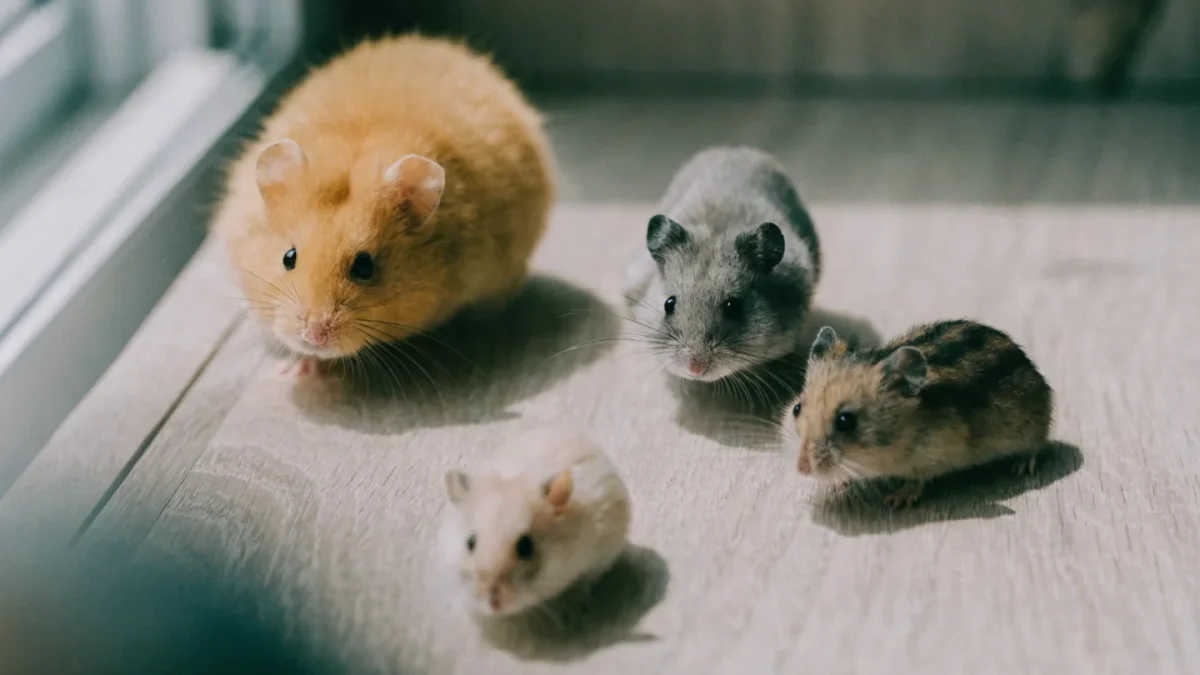
A guy at a reptile expo last year told me he'd bought a "dwarf hamster" for his daughter, and three weeks later it was the size of a small potato and growing fast. He'd been sold a juvenile Syrian. Happens constantly. Pet stores mislabel hamsters, and the care differences between species are significant enough that getting the wrong one means your setup, your expectations, and your handling approach are all wrong from day one.
Syrian, Campbell's, Winter White, Roborovski, and Chinese — these are the five species you'll encounter in the pet trade. They share a family tree and a general body plan, and that's about where the similarities end.
Syrian Hamsters (Mesocricetus auratus)
The classic. The one most people picture when they hear "hamster." Syrians are the largest pet hamster species at 15-18 cm (6-7 inches) in body length, and they come in a dizzying range of coat types and colors — short-haired, long-haired (sometimes called "teddy bear"), satin, rex, and combinations thereof.
Temperament is where Syrians earn their reputation. They tame down faster than any other species, tolerate handling well once accustomed, and move at a speed that human hands can actually follow. I've tamed Syrians that went from bitey to hand-sitting in under a week with daily short sessions.
The non-negotiable: Syrians are solitary. Period. Not "prefer to be alone," not "can sometimes live with a cage mate." Solitary. Adult Syrians housed together will fight, and these fights cause serious injuries — I've seen photos from keepers who thought their pair was "bonded" until one morning when they found blood and bite wounds. It doesn't matter if they're siblings, if they grew up together, or if they've been fine for months. The aggression switch flips eventually in the vast majority of cases.
Syrians also need more space than dwarfs. I wouldn't go below 800 square inches of floor space, and their wheel needs to be at least 28 cm (11 inches) — preferably 30 cm.
Long-haired Syrian males need regular brushing or their fur mats. Not something most hamster guides mention, but if you've ever tried to gently detangle a matted hamster coat with a soft toothbrush at 10 PM, you'll appreciate the heads up.
Campbell's Dwarf Hamsters (Phodopus campbelli)
The most commonly sold dwarf species, and the one behind most of the "dwarf hamsters can live together" advice floating around online. They can — sometimes. I'd estimate about half the Campbell's pairs I've seen keepers attempt work long-term. The other half end in separation, injuries, or worse.
Campbell's are about 10-12 cm (4-5 inches) and significantly faster than Syrians. They're more prone to nipping, especially during the taming period, and their small size makes them harder to handle safely. A startled Campbell's will bolt, and they're fast enough that catching one on an open floor is a genuine challenge.
Color morphs are extensive: normal agouti, argente, albino, black, opal, and many more. Campbell's as a species have a well-documented genetic predisposition to diabetes — a trait that breeders and veterinary sources consistently flag — and glaucoma has also been reported in the literature. Some breeders note that certain color morphs appear alongside these health issues more frequently, though the link is to the species' genetics broadly rather than to specific coat colors alone. It's worth asking a breeder about the health history of their lines when selecting an animal.
I had a pair of Campbell's in a 900-square-inch bin cage for about eight months. They shared nests, groomed each other, looked like a buddy comedy. Month nine, I came in to find one with a badly bitten ear and a chunk of fur missing from its flank. Separated them that night. Both lived out their remaining time perfectly content as solo hamsters. That experience colored my recommendation permanently: if you want to try pairing dwarfs, always have a second complete enclosure ready to go.
Winter White Dwarf Hamsters (Phodopus sungorus)
Here's the frustrating reality: most "Winter White" hamsters in the pet trade are actually Campbell's-Winter White hybrids. The two species are closely related and hybridize readily — breeding between the two became so widespread that hybrids eventually outnumbered purebreds in the commercial supply chain. Purebred Winter Whites are genuinely uncommon outside of dedicated breeders who maintain documented lineage records.
True Winter Whites are slightly rounder and stockier than Campbell's, with a distinctive dorsal stripe and — in their wild form — the ability to change coat color to white or pale grey in winter as daylight hours decrease. Captive animals in artificially lit rooms often don't show this change, which is one of the more fascinating things about the species that most owners never get to see.
Temperamentally, Winter Whites are often described as slightly calmer than Campbell's. In my experience, individual variation overwhelms species-level generalizations here. I've had mellow Campbell's and hyperactive Winter Whites. The cohabitation considerations mirror Campbell's exactly — possible but unpredictable.
Size and space requirements are essentially identical to Campbell's.
Roborovski Hamsters (Phodopus roborovskii)
The smallest species at 4-5 cm (about 2 inches) and, ounce for ounce, the fastest mammal I've ever tried to hold. I say "tried" deliberately.
Robos are observation pets. You set up a beautiful enclosure with deep sand areas and scattered seed, and you watch them zoom. And they do zoom. Research has clocked them running the equivalent of four human marathons per night on their wheels. Their energy output relative to body size is remarkable.
Handling a Roborovski is an exercise in humility. They're not aggressive — biting is actually rare — but they are perpetual motion machines with zero interest in sitting still on a human palm. I once spent twenty minutes trying to transfer a Robo from one enclosure to another. Cup method, tube method, the works. The hamster won every round.
They're also the longest-lived dwarf species, with some individuals reaching 3-3.5 years. This might be connected to their insane activity level, though I'm speculating.
Robos can cohabit more successfully than other dwarf species, particularly in same-sex groups. They're naturally more social in the wild. But "more successfully" still doesn't mean "always" — monitor any group for signs of bullying, especially around food and nesting areas.
If you want a hamster you can hold and interact with, a Robo is the wrong choice. If you want a tiny, endlessly entertaining animal to watch, they're spectacular.
Chinese Hamsters (Cricetulus griseus)
The oddball of the group. Chinese hamsters look different — longer and leaner, with a noticeable tail (about 2-3 cm) that other pet hamster species lack. They're roughly 10-12 cm in body length and have a mouse-like build that throws people off initially.
Temperamentally, Chinese hamsters are often the calmest once tamed. They move with a deliberate quality that's different from the frantic energy of dwarfs. I've found them to be excellent handlers — they grip onto fingers and clothing and seem genuinely comfortable being held, which is unusual for a small rodent.
They're solitary like Syrians. Cohabitation attempts with Chinese hamsters end badly more often than not.
The main drawback: availability. Chinese hamsters are less commonly bred and stocked than Syrians or Campbell's. Finding one may require contacting a breeder directly. And in some jurisdictions, they're classified as agricultural pests and require permits or are outright banned.
Side-by-Side Comparison
| Feature | Syrian | Campbell's Dwarf | Winter White | Roborovski | Chinese |
|---|---|---|---|---|---|
| Body length | 15-18 cm | 10-12 cm | 8-10 cm | 4-5 cm | 10-12 cm |
| Lifespan | 2-3 years | 1.5-2 years | 1.5-2 years | 3-3.5 years | 2-3 years |
| Handleability | Excellent | Moderate | Moderate | Poor | Good |
| Social housing | Never | Sometimes | Sometimes | Often | Never |
| Min wheel size | 28 cm / 11" | 20 cm / 8" | 20 cm / 8" | 20 cm / 8" | 20 cm / 8" |
| Min floor space | 800+ sq in | 600+ sq in | 600+ sq in | 600+ sq in | 600+ sq in |
| Activity window | Evening/night | Evening/night | Evening/night | Night | Evening/night |
| Taming ease | Easy | Moderate | Moderate | Difficult | Moderate-Easy |
| Availability | Common | Common | Rare (pure) | Moderate | Uncommon |
Your cage setup requirements will vary based on which species you choose — Syrians demand more floor space and larger wheels, while Robos benefit from deeper sand areas.
Frequently Asked Questions
Which hamster species is best for children?
Syrians. They're large enough that small hands can hold them without squeezing, they tame quickly, and they move at a manageable pace. Dwarfs are too fast and too small for most children under about 10 — they get dropped, they escape, and the bites (while not serious) discourage kids quickly. Any hamster for a child should be the parent's responsibility. The child enjoys the animal; the adult manages the care.
Can I keep different hamster species together?
No. Different species should never be housed together. Even within species, cohabitation is risky for all except Roborovskis, and even then it requires monitoring. Mixed-species housing leads to territorial aggression, stress, and injuries. Every species has different communication signals — a behavior that means "back off" in one species might mean nothing to another.
Which species lives the longest?
Roborovskis hold that record among the commonly kept species, with some reaching 3.5 years. Chinese hamsters and Syrians can also push past 3 years with excellent care, though 2-2.5 is more typical. Genetics, diet, and enclosure quality all affect lifespan — but species sets the baseline range.
Why do pet stores mix up hamster species?
Profit margins on small animals are thin, and staff training on species identification is often minimal. Campbell's, Winter White, and their hybrids look similar to an untrained eye. Juveniles of different species can be close in size. The result is widespread mislabeling. If species accuracy matters to you — and it should, because care needs differ — buy from a breeder who can tell you exactly what you're getting, ideally with lineage information.
Species choice sets the trajectory for your entire hamster-keeping experience. I've kept all five at various points, and my honest shortlist for most people is a Syrian. Biggest, calmest, easiest to handle, and the hamster care fundamentals are most straightforward with them. But if you want something different — a tiny speedster to watch, a calm oddball with a tail, a social group in a sand-filled setup — the other species each have something genuinely worthwhile to offer. Just make sure you know which one you're actually buying.