

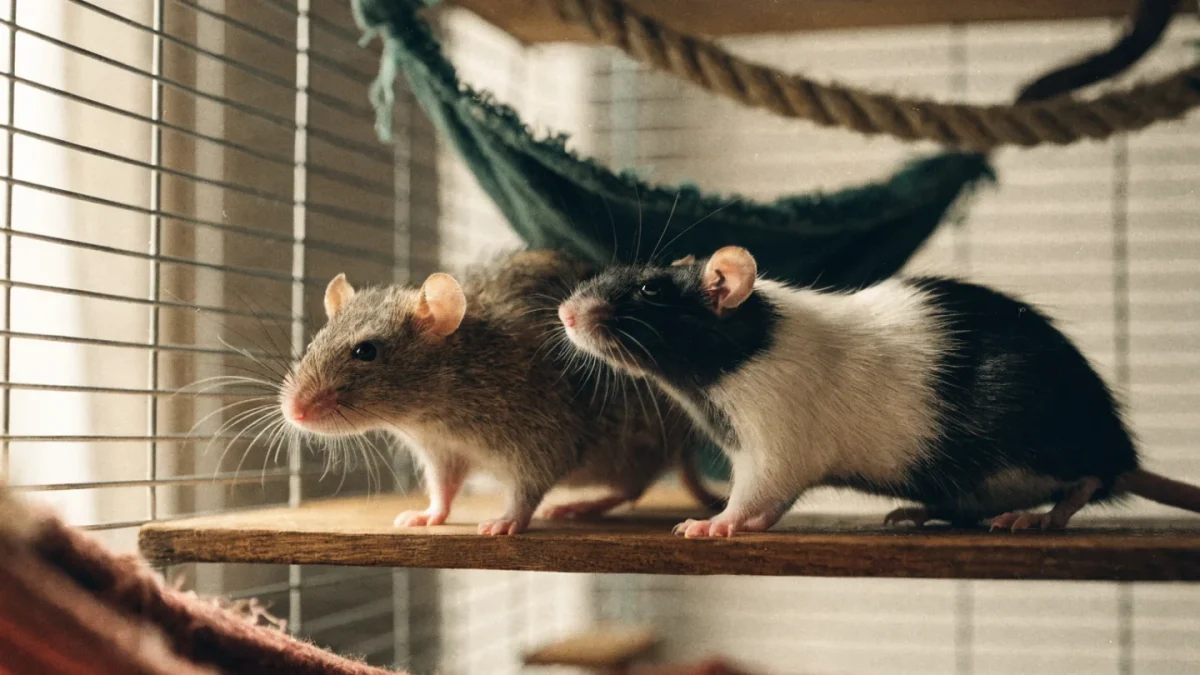
The first rat I ever kept was a rescue from a friend's college dorm — a lone female who'd been living in a tank barely big enough for a hamster. She was skittish, overweight, and had the beginnings of a respiratory wheeze. Within three months of proper housing, a companion, and a decent diet, she was a completely different animal: leaping to greet me at the cage door, bruxing when I scratched behind her ears, and healthy enough to run laps during free-roam time.
Pet rats and mice need appropriately sized wire cages with solid floors, a diet centered on a quality lab block or seed mix supplemented with fresh produce, and daily social interaction. Rats require at least one cagemate, while mice differ by sex — males often live solo, females thrive in groups. Both species pack enormous personality into a small package, but they're not interchangeable. Their housing, dietary needs, social structures, and health concerns diverge in ways that matter.
Rats and Mice Are Not the Same Pet
I can't count the number of messages I get from people who bought a mouse thinking it'd be like a small rat. Or vice versa. They're both rodents, sure, but the experience of keeping them is dramatically different.
Rats (Rattus norvegicus, the domestic fancy rat) are larger — adults range from 200 to 500 grams — and intensely social. They bond with their owners in ways that surprise people who've never kept one. They learn their names. They come when called. They'll ride on your shoulder and fall asleep in your hoodie pocket. That level of interaction is part of the deal, though. A rat that doesn't get handled and stimulated becomes depressed and sometimes aggressive.
Mice (Mus musculus, the domestic fancy mouse) are tiny, fast, and fascinating to observe but much less likely to enjoy being held. They're prey animals down to their bones — even generations of captive breeding haven't fully erased the flight instinct. What they lack in cuddliness, they make up in entertainment value. A well-set-up mouse enclosure is basically a tiny nature documentary happening on your desk.
Housing That Actually Works
The single biggest mistake I see with new rodent keepers is the enclosure. Pet stores sell cages that are too small and tanks that trap ammonia. Both will wreck your animal's health.
For rats, the minimum cage size for a pair is roughly 60 cm x 40 cm x 50 cm — but honestly, bigger is always better. Wire cages with horizontal bars allow climbing, and rats are climbers. Solid floors and shelves protect their feet from bumblefoot, a painful condition caused by standing on wire mesh. Multiple levels give them the vertical space they crave. You'll want at least two hammocks, a hide box, and something to chew. Rats chew constantly, and if you don't provide appropriate materials, they'll remodel the cage accessories themselves.
For mice, the requirements differ. Mice do well in either wire cages with narrow bar spacing (under 6 mm — they squeeze through anything larger) or well-ventilated tanks with mesh lids. They need floor space more than height, though they'll use climbing opportunities if offered. A 60 cm x 30 cm footprint works for a small group of females.
Bedding matters enormously. Cedar and pine shavings release phenols that damage rodent respiratory tracts. Paper-based bedding, aspen shavings, or hemp are safe choices. I've switched most of my setups to a paper-based substrate after seeing the respiratory difference it makes over time — especially in rats, which are already prone to mycoplasma infections.
Spot-clean daily. Full bedding changes every five to seven days for rats, weekly for mice. Your nose will tell you if you're not doing it often enough, but by the time it's obvious to you, the ammonia has been bothering your animals for days.
For more on ventilation, heating, and substrate choices across species, our habitat setup fundamentals guide covers the principles in detail.
Diet: Lab Blocks, Seed Mixes, and the Fresh Food Question
Feeding rodents seems simple until you realize how easy it is to create nutritional imbalances.
Lab blocks (sometimes called rodent pellets) are the foundation I recommend for rats. They're formulated to be nutritionally complete, and because every block is identical, your rat can't pick out the sunflower seeds and leave the rest — which is exactly what happens with loose seed mixes. A good lab block has 14-16% protein and around 4-5% fat for adult rats. Pregnant, nursing, or growing rats need higher protein, around 18-20%.
Mice can do well on either a quality lab block or a formulated seed mix. Their metabolisms are faster relative to body size, and they're less prone to the selective feeding problem because they eat such small quantities.
Fresh foods supplement the base diet. Both rats and mice benefit from small amounts of vegetables — broccoli, kale, peas, carrots — and occasional fruit. Rats especially enjoy cooked pasta, small pieces of egg, and the odd bit of chicken. The "occasional treat" category is where people go wrong: too many seeds, nuts, and fatty treats lead to obese rodents, and obesity in a rat shortens an already short lifespan dramatically.
Foods to avoid entirely: citrus for male rats (d-limonene, the major compound in citrus oil, causes male-rat-specific kidney damage by binding to the protein alpha-2u-globulin — an effect documented in multiple toxicology studies and specific to male rats, since females and other species lack the protein), raw dry beans, raw sweet potato, caffeine, alcohol, and anything moldy. Chocolate in large amounts is also a problem, though rats can handle trace quantities better than dogs can.
Fresh water in a bottle with a sipper tube — check daily that the ball valve isn't stuck. I lost a mouse years ago because the water bottle malfunctioned over a weekend. That mistake still bothers me.
Socialization and Handling
This is where rats and mice diverge the most.
Rats are social animals that need companions. Two is the minimum. Three is better. A solo rat, no matter how much human attention it gets, will show signs of stress and loneliness: excessive grooming, lethargy, sometimes aggression. I've taken in rehomed rats that were kept alone for months, and the behavioral transformation once they're introduced to a group is striking. One male I received had been biting his owner — within two weeks of living with two neutered males, the biting stopped entirely.
Handling rats is straightforward if you start early. Scoop from below, never grab from above (that's how predators attack). Let them explore your hands in the cage first. Most rats are riding on shoulders within a week or two. The key is consistency — ten minutes of handling daily beats an hour once a week.
Mice are observers, not cuddlers. You can tame mice to walk onto your hand, but expecting them to enjoy being held like a rat will only frustrate both of you. Female mice are more amenable to group living and can become reasonably calm with gentle, consistent handling. Male mice are territorial — housing two males together almost always ends in fighting and injuries. A single male mouse with adequate enrichment and regular (brief, calm) handling sessions is the standard approach.
If you're drawn to the bond-with-your-pet experience, a rat is the better choice. If you prefer watching complex social behaviors in a well-designed habitat, mice have a lot to offer. The hamster care comparison is worth considering too — hamsters fall somewhere between the two in terms of handleability but are strictly solitary.
Health: What to Watch For
Both rats and mice have short lifespans — two to three years for rats, one to three years for mice. That compressed timeline means health problems escalate fast.
Respiratory disease is the number one issue in rats. Mycoplasma pulmonis is essentially ubiquitous in domestic rats — nearly all carry it. Stress, poor ventilation, dusty bedding, and ammonia buildup trigger flare-ups. Symptoms: sneezing, porphyrin staining (red discharge around the eyes and nose that looks alarming but isn't blood), labored breathing, clicking sounds. Early veterinary intervention with appropriate antibiotics makes a real difference. Waiting "to see if it gets better" is the mistake I see most often.
Tumors are the second major concern in rats, particularly mammary tumors in unspayed females. These can grow shockingly fast — I've seen tumors double in size in under a week. Many are benign and surgically removable, but the surgery needs to happen before the tumor compromises mobility or blood supply.
Mice face their own set of issues: wet tail (proliferative ileitis), mites, and dental problems from overgrown incisors. Bar chewing — often a sign of enclosure stress — can cause broken teeth.
For both species, find an exotic vet before you need one. Not every veterinary practice is comfortable treating rodents, and emergency is the wrong time to discover that.
The Commitment Reality Check
Rats and mice are inexpensive to acquire. The ongoing cost of proper care is not.
A quality cage runs anywhere from 50 to 200 dollars. Bedding is a recurring monthly expense. Vet visits for exotics often cost more than standard companion animal appointments, and rodents don't have the robust insurance options that dogs and cats do. A single respiratory infection treatment can run 75 to 150 dollars. Tumor removal surgery, if your rat needs it, can range from 100 to 400 dollars depending on complexity and location.
Then there's time. Rats need at least an hour of out-of-cage interaction daily. Cage cleaning is a weekly task. You're committing to two to three years per animal, and since rats need groups, you'll often be staggering introductions as older rats pass — the "rat cycle" is real, and some keepers find the rapid succession of loss emotionally draining.
None of this is meant to discourage. I've kept rodents for over a decade and they're among the most rewarding small pets you can own. But I'd rather you know what you're signing up for at the start than discover it six months in.
Frequently Asked Questions
Can rats and mice live together?
No. Rats are predators of mice in the wild, and that instinct doesn't vanish in captivity. Even a well-socialized rat can kill a mouse, and the stress alone — from the mouse's perspective, it's living with a predator — is harmful. I once got a panicked call from someone who'd housed them together based on internet advice. The mouse survived, but barely. Separate enclosures, separate species, no exceptions.
Do pet rats smell?
Rats themselves are fastidious groomers and don't smell much. The cage smells if you don't maintain it. Intact males mark with urine more than females or neutered males, which can add odor. With proper bedding, spot-cleaning every day or two, and a full change weekly, smell shouldn't be a significant issue. If someone tells you their rat smells terrible, the problem is almost always husbandry, not the animal.
How do I introduce new rats to each other?
The carrier method works well for most introductions. Place all rats in a small, neutral carrier (one they haven't used before) for short supervised sessions. The confined space limits territorial behavior. Gradually increase the time and eventually move to a freshly cleaned cage with rearranged furniture so no one has territorial claims. Expect some scuffling — sidling, puffing up, and pinning are normal dominance behaviors. Actual biting that draws blood means you need to separate and slow down.
Are rats or mice better for kids?
Rats handle the unpredictability of children much better. They're sturdier, less likely to bite when startled, and their slower movements make them easier to hold. Mice are fragile, fast, and will leap off a hand without warning. For a child under ten, I'd suggest rats with adult supervision. For a child over twelve who's more interested in observation than handling, mice can work — but the adult should manage cage maintenance regardless.