

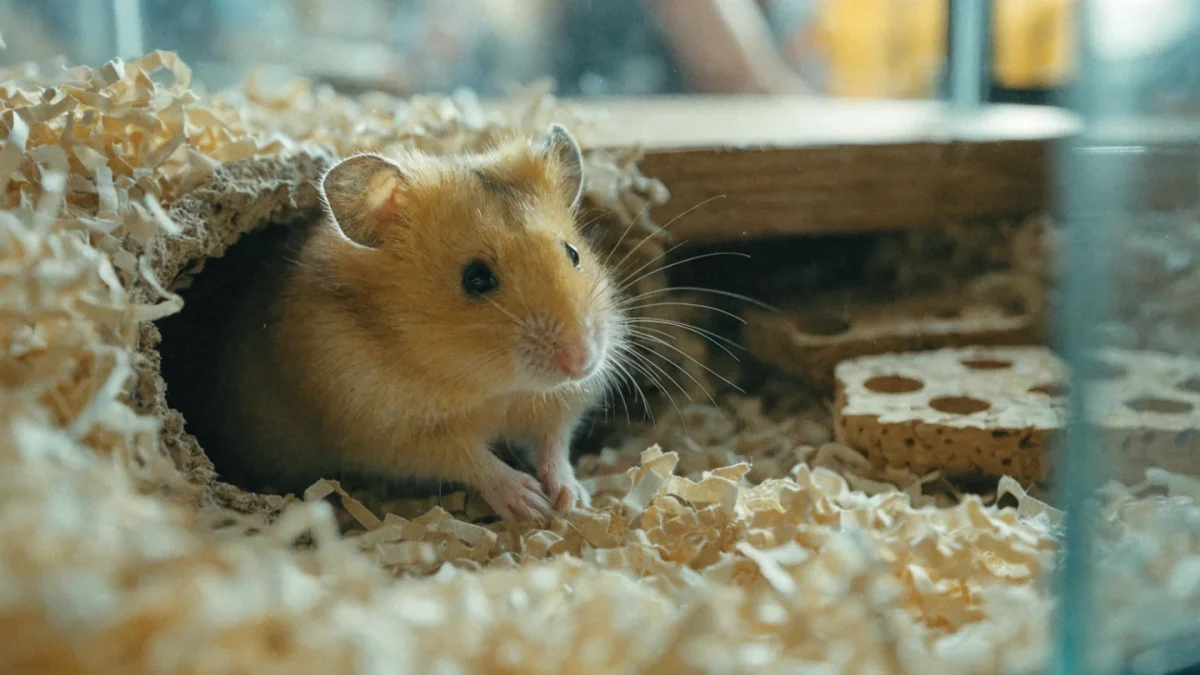
The first hamster I ever owned lived in a cage that was, by any reasonable standard, a prison cell. Wire-bar cage from the pet store, maybe 300 square inches of floor space, an inch of pine shavings on the bottom, and a wheel so small the poor animal's back arched like a horseshoe every time she ran. I was twelve. I didn't know better. She lived about eighteen months — which I later learned is actually within normal range for a dwarf hamster, but I've always wondered how much longer she might have gone with decent husbandry.
Hamsters need a spacious enclosure with at least 775 square inches of unbroken floor space, deep bedding for burrowing (6-10 inches minimum), a wheel large enough that the hamster's back stays straight while running, a varied diet based on a quality seed mix with fresh food supplements, and a quiet environment during daylight hours. They're crepuscular to nocturnal, meaning they're most active at dawn, dusk, and overnight.
I've kept hamsters on and off for over fifteen years alongside my reptile collection, and they remain one of the most underestimated small pets in terms of care requirements. The gap between what pet stores sell as "hamster supplies" and what hamsters actually need is staggering.
Picking the Right Species
Five species show up regularly in the pet trade, and they're not interchangeable. A Syrian hamster and a Roborovski hamster are as different in temperament and care needs as a leopard gecko and a crested gecko — same general category, completely different animals in practice.
Syrian hamsters (Mesocricetus auratus) are the largest, the most handleable, and the most commonly recommended for first-time owners. They're solitary. Absolutely, non-negotiably solitary. Two Syrians in one cage will fight, often to the death. They need the most space — I'd call 775 square inches the bare minimum and push for 900+ if possible.
Campbell's dwarf hamsters (Phodopus campbelli) are smaller, faster, and can sometimes live in same-sex pairs if introduced young. "Sometimes" is doing heavy lifting in that sentence. I've seen plenty of Campbell's pairs that looked bonded for months before one turned on the other overnight. If you pair them, you need a backup enclosure ready at all times.
Winter White dwarf hamsters (Phodopus sungorus) are similar to Campbell's and frequently hybridized in the pet trade — most "Winter Whites" sold in pet stores are actually hybrids. They can cohabit under the same uncertain conditions as Campbell's.
Roborovski hamsters (Phodopus roborovskii) are tiny, absurdly fast, and not great for handling. They're observation pets. Fascinating to watch — they can run the equivalent of four human marathons in a single night — but trying to hold one is like trying to hold water. They're the longest-lived dwarf species, sometimes reaching 3-3.5 years.
Chinese hamsters (Cricetulus griseus) have a longer body and a noticeable tail, which sets them apart visually. They're generally solitary like Syrians. Calm temperament once tamed, but they're less commonly available.
Housing That Actually Works
Forget the wire cages with plastic tube attachments. Those systems were designed to sell accessories, not to house hamsters well. The tubes are hard to clean, poorly ventilated, and too small for adult Syrians to move through comfortably.
What works: large bin cages (DIY from storage bins with ventilated lids), glass aquariums with mesh tops, or purpose-built enclosures with solid walls. The enclosure needs unbroken floor space — not stacked levels connected by ramps. Hamsters aren't climbers by nature. They're burrowers. Vertical space matters less than square footage.
Minimum floor space: 775 square inches (approximately 5,000 square centimeters). For Syrians, I push for more. A 2007 study in Animal Welfare by Fischer, Gebhardt-Henrich, and Steiger tested golden hamsters in four cage sizes and found that stereotypic wire-gnawing decreased significantly as floor space increased — hamsters in 10,000 cm² cages gnawed at roughly half the frequency and duration of those in 5,000 cm² cages. A hamster that's constantly trying to get out is telling you the enclosure is too small.
Bedding depth is where most setups fail. Hamsters are burrowing animals. In the wild, they build elaborate tunnel systems underground. An inch of bedding on the bottom of a cage is like giving a fish a puddle. I keep bedding at 8-10 inches deep in at least two-thirds of the enclosure, with one section shallower for the wheel and food area. Paper-based bedding or aspen shavings work well. Never cedar or pine — the phenols in softwood shavings cause respiratory damage.
The wheel is non-negotiable. Hamsters run. A lot. An undersized wheel forces the spine into an unnatural arch that causes long-term spinal problems. Syrians need a minimum 28 cm (11 inch) wheel. Dwarfs need at least 20 cm (8 inches). Solid-surface wheels only — wire or mesh wheels catch toes and cause injuries. I've treated hamsters with broken and dislocated toes from wire wheels, and it's entirely preventable.
For a deep dive into enclosure specifics, the guide on habitat setup fundamentals covers heating and ventilation principles that apply across species.
Feeding Your Hamster Right
Hamster nutrition is less complicated than reptile nutrition, but the pet store staples are often terrible. Those colorful pellet mixes with dried corn, peanuts, and yogurt drops? Mostly filler and sugar.
A good base diet is a quality seed mix — not pellet-only, and not the rainbow-colored stuff. Hamsters are scatter hoarders by instinct. They forage, select, and stash. A varied seed mix lets them express that behavior. Lab block-only diets meet nutritional minimums but strip out the behavioral enrichment of choosing food, which matters for an animal that spends significant energy in the wild foraging.
Fresh food supplements: small pieces of broccoli, cucumber, carrot, cauliflower, and leafy greens a few times per week. Tiny amounts — a piece the size of your thumbnail is plenty for a dwarf. Fresh food goes bad quickly in a warm enclosure, so remove uneaten portions within 12 hours.
Protein supplements: a mealworm or small piece of cooked egg once or twice a week. Hamsters are omnivores, not strict herbivores. In the wild they eat insects, and the protein is especially important for pregnant or nursing females.
Avoid: citrus fruits, raw potato, onion, garlic, almonds, and anything sticky that can get packed in the cheek pouches and cause an impaction. Cheek pouch impactions are a real veterinary issue — I've talked to keepers dealing with them, and they're unpleasant for everyone involved.
Water: always available via a bottle. Bowls get filled with bedding within minutes. Check the bottle daily — the ball-valve mechanism can get stuck, leaving the hamster without water. I've made it a habit to tap the spout and confirm water flows every time I check on my animals.
Handling and Taming
Hamsters bite. That's the first thing. They bite because they're prey animals with poor eyesight who identify the world primarily through scent and vibration. A giant hand descending into the cage smells unfamiliar and moves fast. Of course they bite.
Taming takes patience. The sequence that works for me:
Start by just placing your hand in the enclosure — palm flat on the bedding — without reaching for the hamster. Do this for a few days. Let the hamster investigate on its own terms. Once it's comfortable walking over your hand, try offering a treat (sunflower seed, small piece of vegetable) on your palm.
After a few days of treat-taking, you can try gently scooping the hamster up. Cup both hands under it — never grab from above. Keep low to a surface at first. Hamsters have terrible depth perception and will launch themselves off your hands without hesitation. A fall from even a few feet can cause serious injury.
Evening is the best time for taming sessions. A hamster that's been woken from deep sleep for handling is going to be cranky and defensive. Wait until the animal is already awake and active.
Syrians are the easiest to tame. Most become genuinely handleable within a week or two. Dwarfs are trickier — they're faster, more skittish, and some individuals never fully relax in hand. Robos are speed demons that will tolerate sitting in a cupped palm for about three seconds before teleporting to the other side of the room. I'm barely exaggerating.
One thing people don't mention enough: never wake a hamster by poking or touching it. They startle violently and will bite reflexively. Talk softly near the enclosure first, let them stir naturally, then interact.
Health Basics
Find a vet who sees small exotics before you need one. This applies to every exotic pet, but hamsters get overlooked because people assume they're disposable pets that don't warrant veterinary care. They're not, and they do.
Wet tail — proliferative ileitis — is the most urgent health threat, especially in young Syrians within two weeks of purchase or rehoming. Signs: severe watery diarrhea, lethargy, hunched posture, wet and matted fur around the tail area. It's a bacterial infection that escalates fast. Without treatment, mortality is high. With prompt veterinary intervention including antibiotics and supportive care, many hamsters recover. The stress of rehoming — new cage, new smells, new schedule — is a major trigger, which is why the first two weeks are the highest risk.
Respiratory infections present as sneezing, wheezing, nasal discharge, and labored breathing. They're common when bedding is dusty, when the enclosure is in a drafty location, or when ammonia from urine-soaked bedding builds up. Good ventilation and regular spot-cleaning prevent most cases.
Dental problems show up because hamster teeth grow continuously. If the incisors become misaligned (malocclusion), they can overgrow into the opposite jaw or the roof of the mouth. Signs: drooling, difficulty eating, weight loss, food dropping from the mouth. A vet can trim the teeth, but recurring malocclusion often needs regular management.
Skin issues — mites, ringworm, and allergic reactions to bedding — cause scratching, hair loss, and flaky skin. Cedar and pine bedding are common culprits. Switching bedding resolves many skin problems without any other treatment.
Tumors are unfortunately common in hamsters over 18 months. Both benign and malignant growths occur. Any lump warrants a vet visit — some can be surgically removed if caught early, and a vet can differentiate between an abscess (treatable with drainage and antibiotics) and a tumor.
The Environment Matters More Than You Think
Hamsters are sensitive to location within your home. Direct sunlight overheats the enclosure dangerously fast — hamsters are susceptible to heatstroke above about 26°C (80°F). Drafty spots near windows or exterior doors cause respiratory stress. And noise matters: a hamster enclosure next to a TV or in a high-traffic hallway means the animal is being disturbed during its primary sleep period.
The ideal spot: a quiet room with stable temperatures between 18-24°C (65-75°F), away from direct sun and drafts. A bedroom works if you can tolerate wheel noise at 2 AM — and you'd better be sure about that before committing, because hamsters are not quiet at night. I've had keepers surrender hamsters specifically because the overnight noise was unbearable. Bigger wheels are actually quieter than small ones, if that helps.
Light cycles matter. Hamsters need a consistent light-dark cycle. Don't keep them in a room that's lit 24/7 or in complete darkness. Natural room lighting from windows is fine. Artificial room lighting on a normal human schedule works too — 12-14 hours of light, 10-12 hours of dark.
And temperature drops below about 10°C (50°F) can trigger torpor — a hibernation-like state that's dangerous for pet hamsters. It looks exactly like death. More on that in specific hamster health resources.
Lifespan and Commitment
Syrian hamsters live 2-3 years. Dwarf species average 1.5-2.5 years, with Roborovskis sometimes pushing past 3. Chinese hamsters fall in the 2-3 year range.
These lifespans are short compared to most pets, which makes people underestimate the commitment. But a hamster's daily needs — fresh food and water, spot-cleaning, health checks, enrichment rotation — add up. And the upfront cost of a proper setup is significant. A hamster from a pet store might cost the equivalent of a takeout meal. The enclosure, bedding, wheel, and initial supplies will run ten to twenty times that amount.
I tell people to expect a hamster care setup to mirror the commitment of a guinea pig — less expensive overall, but the daily attention is comparable.
Frequently Asked Questions
Do hamsters need sand baths?
Dwarfs absolutely do. Campbell's, Winter Whites, and Robos use sand to maintain their coat — it absorbs excess oils and keeps the fur from matting. Use chinchilla sand (not dust — dust causes respiratory problems) in a shallow dish left in the enclosure. Syrians can have sand baths too, but they're less dependent on them. Some Syrians love rolling in sand; others ignore it entirely. I keep a sand dish available for all my hamsters and let them decide.
Can hamsters eat hamster treats from the pet store?
Most commercial hamster treats are overpriced sugar bombs. Yogurt drops, honey sticks, "gourmet" seed bars — they're candy. An occasional sunflower seed, a tiny piece of hard-boiled egg, or a single blueberry is a better treat. If you want to spoil your hamster, scatter-feed their regular food instead of using a bowl. It takes thirty seconds and gives them hours of foraging enrichment.
Why does my hamster bar chew constantly?
Bar chewing is almost always a sign of insufficient space, inadequate enrichment, or both. It's a stereotypic behavior — repetitive, functionless, and a welfare red flag. The fix isn't a chew toy (though those help teeth). The fix is a bigger enclosure with more bedding depth, more enrichment variety, and a properly sized wheel. Switching to a solid-walled enclosure eliminates the behavior by removing the bars, but the underlying need for space and stimulation still has to be addressed.
Are hamster balls safe?
I don't use them. The ventilation is poor, the hamster has no way to stop or exit voluntarily, and the disorientation — suddenly rolling across an open floor with limited visibility — is stressful. A better option: a dry bathtub or a playpen with high walls on a flat floor, scattered with toys and treats. Supervised free-roam in a hamster-proofed space is enriching. Forced rolling in a plastic sphere isn't.
Should I get a male or female hamster?
For Syrians, temperament differences between sexes are minimal. Individual personality matters more than sex. Females tend to be slightly more active and can be a touch more territorial, but the variation within each sex is larger than the variation between them. For dwarfs, same-sex pairs (if you're attempting cohabitation) should ideally be siblings that have never been separated. Mixed-sex pairs mean babies — and hamsters breed prolifically.
That covers the framework. Hamsters aren't complex animals, but the gap between "alive" and "thriving" is entirely a function of setup quality and daily consistency. Most of what goes wrong — bar chewing, biting, short lifespans, wet tail — traces back to enclosure size, bedding depth, or handling mistakes that are easy to fix once you know what to look for. Don't cheap out on the setup, and you'll spend two to three years with an animal that's genuinely fascinating to watch.